







What makes Panama geisha coffee beans from Boquete different?
Panama geisha coffee beans are usually sold as natural or washed lots, but honey-processed geisha is less common. A honey-processed geisha from Boquete, Panama, keeps some of the fruit sweetness of natural processing while retaining the floral and citrus character the variety is known for.
Boquete sits on the slopes of Baru Volcano, where volcanic ash soil, cool fog, variable sunlight and abundant rain support specialty coffee. Estates such as Hacienda La Esmeralda, Elida and Kotowa Duncan work in the same area, and Front Street has published roast, cupping and V60 staged brewing data for this honey-processed lot.
Panama Geisha has always been dominated by natural or washed processing, with the former emphasizing berry notes and the latter highlighting floral aromas and citrus acidity. However, this article introduces a relatively rare honey-processed Geisha—from the Boquete region of Panama, acquired by Front Street Coffee. The article will guide you through Boquete's high-altitude volcanic terroir, the origin and principles of the honey processing method, the journey to fame of the Geisha variety, as well as Front Street's roasting curve, cupping data, and V60 staged brewing plan for this bean. Whether you want to understand the sweetness expression of honey-processed Geisha or need a set of reference pour-over parameters, you will find the corresponding content in this article.
When it comes to Panama Geisha coffee beans, most people first think of natural or washed processing methods. Natural processing is often used to amplify Geisha's berry flavors, while washed processing focuses more on presenting floral aromas and clean acidity. For example, Front Street's Hacienda La Esmeralda Red Label Geisha follows the natural route, with flavors centered on a full-bodied juice texture and rose floral aromas; Front Street's Hacienda La Esmeralda Green Label uses washed processing, highlighting Geisha's rich, fresh floral notes and bright citrus-like acidity. What Front Street wants to discuss in this article is another processing method known as "sweet as honey"—honey-processed Geisha coffee beans.
Boquete Region
Boquete
FrontStreet Coffee recently acquired a honey-processed coffee bean from Panama's Boquete region. Boquete is a high-altitude volcanic area, where Baru Volcano has brought quite fertile soil. Combined with the towering terrain, damp and cold air, variable sunlight conditions, abundant rainfall, and converging rivers, these factors together create high-quality Panama specialty coffee.
Within the Boquete region, there are also many excellent estates, including the famous Hacienda La Esmeralda, as well as Elida Estate, Kotowa Duncan Estate, and others—all well-known estates producing high-quality specialty coffee. This is likewise thanks to the fertile volcanic ash soil of the Baru volcanic area and the unique microclimate created by the cool, foggy, and mountainous geographical environment.
Front Street's Boquete Geisha is the representative flagship of Panamanian coffee. It uses washed processing and carries the signature white floral aroma and bergamot acidity. From the sweet fragrance of cocoa to light fruits, it reminds one of yellow peach and sweet melon, with a clear mouthfeel and a tea-like finish. Because Front Street's Boquete Geisha is an entry-level high-end single-origin, its price is affordable and budget-friendly, making it one of the Geisha coffee beans that beginners must try.
Front Street Panama Honey-Processed Geisha Coffee Beans
Region: Boquete, Panama
Processing Method: Honey Process
Altitude: 1600-1650 meters
Variety: Geisha
Coffee Honey Processing Method
Honey
The honey processing method was born in Costa Rica in the mid-to-late 21st century. At that time, many micro-processing stations emerged in the country, and coffee farmers invested funds to purchase their own post-harvest processing equipment, enabling them to process most of their coffee cherries themselves. This also meant they had stronger control over the style of their own coffee. Since Costa Rica mainly used washed or semi-washed processing at the time, coffee farmers created this "sweet as honey" honey processing method to give their own processing station's coffee a more distinctive flavor.
What makes honey processing special is that after the coffee beans have their outer pulp removed, a sticky, gel-like mucilage remains on the surface. At this point, instead of rushing to wash it off, the beans are directly dried with the mucilage still on them. During the drying process, the sugars in the mucilage gradually penetrate and transform into the interior of the coffee beans, thereby enhancing the coffee's sweetness. FrontStreet Coffee cupped this Front Street honey-processed Geisha and found that it not only retained the fresh floral aroma of raw Geisha beans but also added an apple-like sweetness to this Front Street Panama Boquete Geisha.
Geisha Coffee Beans
Geisha
Geisha coffee beans were discovered in the forests of Ethiopia in 1931, then traveled through Kenya, Uganda, and Tanzania, eventually entering Panama in 1960. At first, because Geisha coffee beans had low yields, they remained unknown in a small corner of Panama's coffee-producing regions.
It was not until 2004 that the owner of Hacienda La Esmeralda noticed a faint, elusive, captivating floral aroma in the harvested coffee beans. Following the clues, they discovered this inconspicuous "little pitiful" Geisha coffee bean. The estate harvested it separately and sent it to competition, and Geisha became famous overnight, charging all the way to the forefront of the specialty coffee market and shining brilliantly.
Front Street Coffee Roasting Record
When Front Street Coffee received this Front Street Panama Boquete honey-processed Geisha coffee bean, a faint floral aroma and fresh apple fragrance rushed out as soon as the package was opened. Therefore, we decided to use a medium-light roast to highlight the captivating aroma of this Front Street Panama Boquete Geisha coffee bean and the sweetness brought by honey processing.
The roasting machine is a Yangjia 800N semi-direct fire, with a roasting amount of 300g. The drum temperature was preheated to 170°C for charging, the gas was adjusted to 120, the damper was opened to 3, the turning point was at 1'42", and the gas was maintained; at 140°C the gas remained unchanged, and the damper was opened to 4. At 5'25" the beans turned yellow, the grassy smell disappeared, and the dehydration stage began. At 166°C the gas was lowered to 100, and the damper remained at 4. At 176°C the gas was adjusted to 80, and the damper remained unchanged.
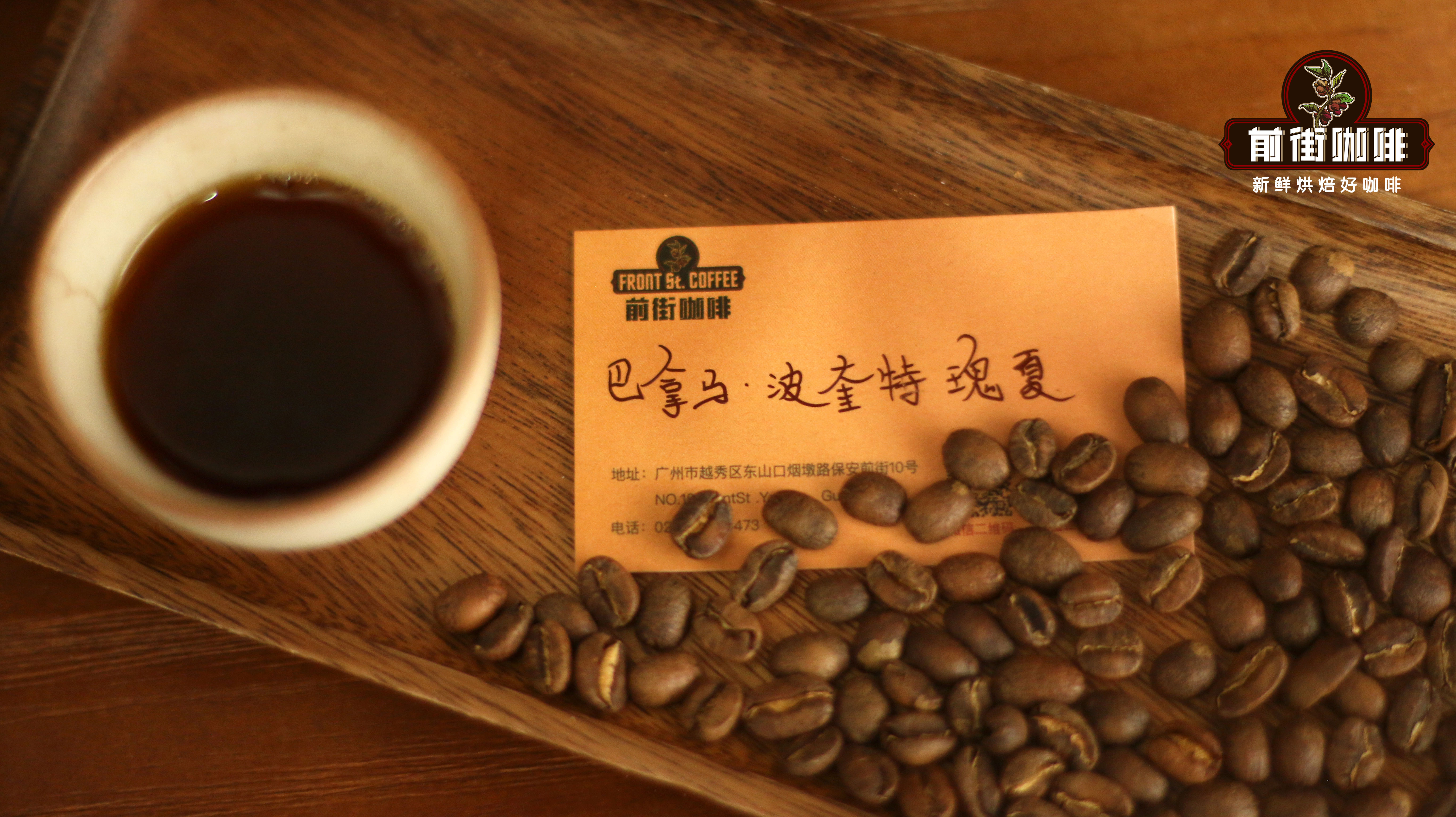
At 8'00" dehydration was complete, wrinkles and dark patches appeared on the bean surface, and the toast aroma turned into coffee aroma, signaling the prelude to first crack. At this point, pay attention to listening for the sound of first crack. At 8'37" first crack began, the damper was fully opened to 5, and the gas remained unchanged. The development time after first crack was 1'28", and the beans were dropped at 190.5°C.
FrontStreet Coffee Cupping Report
Front Street Coffee conducts cupping within 8-24 hours after the sample coffee beans are roasted. The cupping bowl generally used by Front Street baristas is a 200ml ceramic bowl. The water temperature used for cupping is 94°C. The grind size is controlled so that the passing rate through a No. 20 standard sieve (0.85 mm) is 70%-75%. Ratio: 11 grams of coffee grounds plus 200 milliliters of hot water, i.e., 1:18.18. In this way, the extracted concentration falls exactly within the golden cup range of 1.15%-1.35%, and the steeping time is 4 minutes.
Dry Aroma: Lemon
Wet Aroma: Orange
Flavor: Lemon, plum, sweet orange, apple, cream, jasmine, fermented sweetness, oolong tea
Front Street Brewing Notes
Dripper: V60#01
Dose: 15g
Coffee-to-water ratio: 1:16
Water temperature: 90°C
Grind size: Medium-fine grind (79% passing rate through No. 20 standard sieve)
Front Street Coffee staged brewing: 1. Pour 30 grams of water for the first stage and bloom for 30 seconds. 2. After the bloom ends, pour the second stage of water, circling from the center outward for 110 grams. This stage can be poured slowly; Geisha coffee is very resistant to extraction and needs a certain pouring time to bring out its aroma. After pouring, wait until the water level drops to half. 3. When the coffee bed is about to be exposed, pour the third stage of 100 grams of water, for a total poured water amount of 240 grams. Wait for the coffee to finish filtering, then remove the dripper. Total brewing time is 2 minutes 00 seconds.
[Front Street Coffee Panama Boquete Honey-Processed Geisha] Brewed Flavor: It smells of fermented aroma and floral notes; on entry there is citrus and lemon acidity; in the middle, creamy sweetness emerges; in the finish, there is an apple green tea sensation, with a sweet aftertaste of sugarcane and honey.
The above content is compiled by CoffeeHunters, a coffee news website.


