







What Defines the Yirgacheffe Kochere Micro-Region's Flavor?
Kochere is one of the most representative micro-regions inside Ethiopia's Yirgacheffe zone, sitting about 25 kilometers southeast of Yirgacheffe at 1,650 to 1,800 meters. Its washed beans are known for clean citrus acidity, silky sweetness and floral and fruity notes. A washed G1 batch roasted medium-light and brewed as V60 pour-over showed lemon, jasmine, orange and cane sugar.
Kochere is recognized as a separate production area in the ECX classification, and neighboring Wenago and Gelena Abaya fall under the Yirgacheffe category because their flavors are close. The area's advanced washing equipment and growing conditions help explain the clarity in the cup; Coffee Review once scored a Kochere washed bean 94 points. The article walks through terroir, washed processing, roasting curve and brewing parameters.
Kochere is one of the most representative micro-regions within the Yirgacheffe area of Ethiopia. With advanced washed processing equipment and exceptional growing conditions, the coffee beans it produces are known for their clean and translucent citrus acidity, silky sweetness, and rich floral and fruity notes. The Kochere washed G1 batch selected by Front Street Coffee is roasted to a medium-light level and presented through V60 pour-over with layers of lemon, jasmine, orange, and cane sugar, while the sweet aftertaste carries the lingering finish of honey and oolong tea. This article will guide you through the terroir characteristics of the Kochere production area, the washed processing flow, the roasting curve, and the brewing parameters, offering a comprehensive analysis of this bean's flavor code.
Friends who are fond of the Front Street Yirgacheffe series are surely no strangers to Kochere, a well-known Ethiopian micro-region. Within the entire Yirgacheffe zone, Kochere can be called the essence. In the ECX production region classification system, Kochere is listed as a separate production area, which shows just how important its status is. After cupping comparisons, Front Street found that Front Street Yirgacheffe Kochere differs noticeably from ordinary batches of green beans. The coffee beans produced in this origin have strong flavor recognizability, rich aromatic layers, a full body, lively and bright citrus acidity, silky smooth sweetness, and fruity notes.
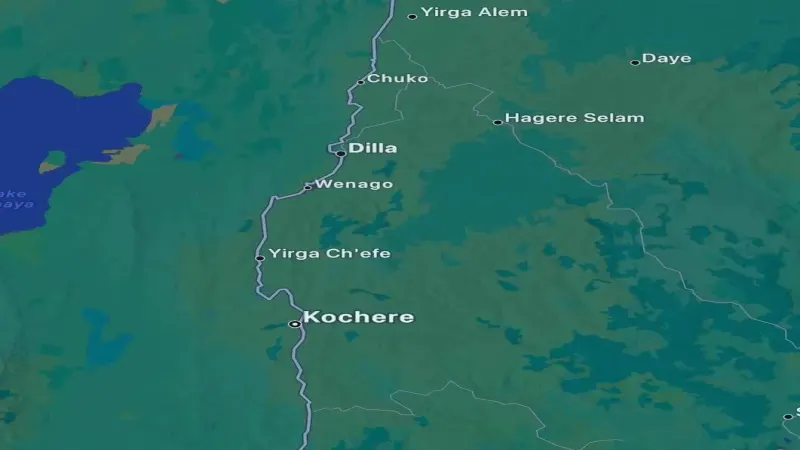
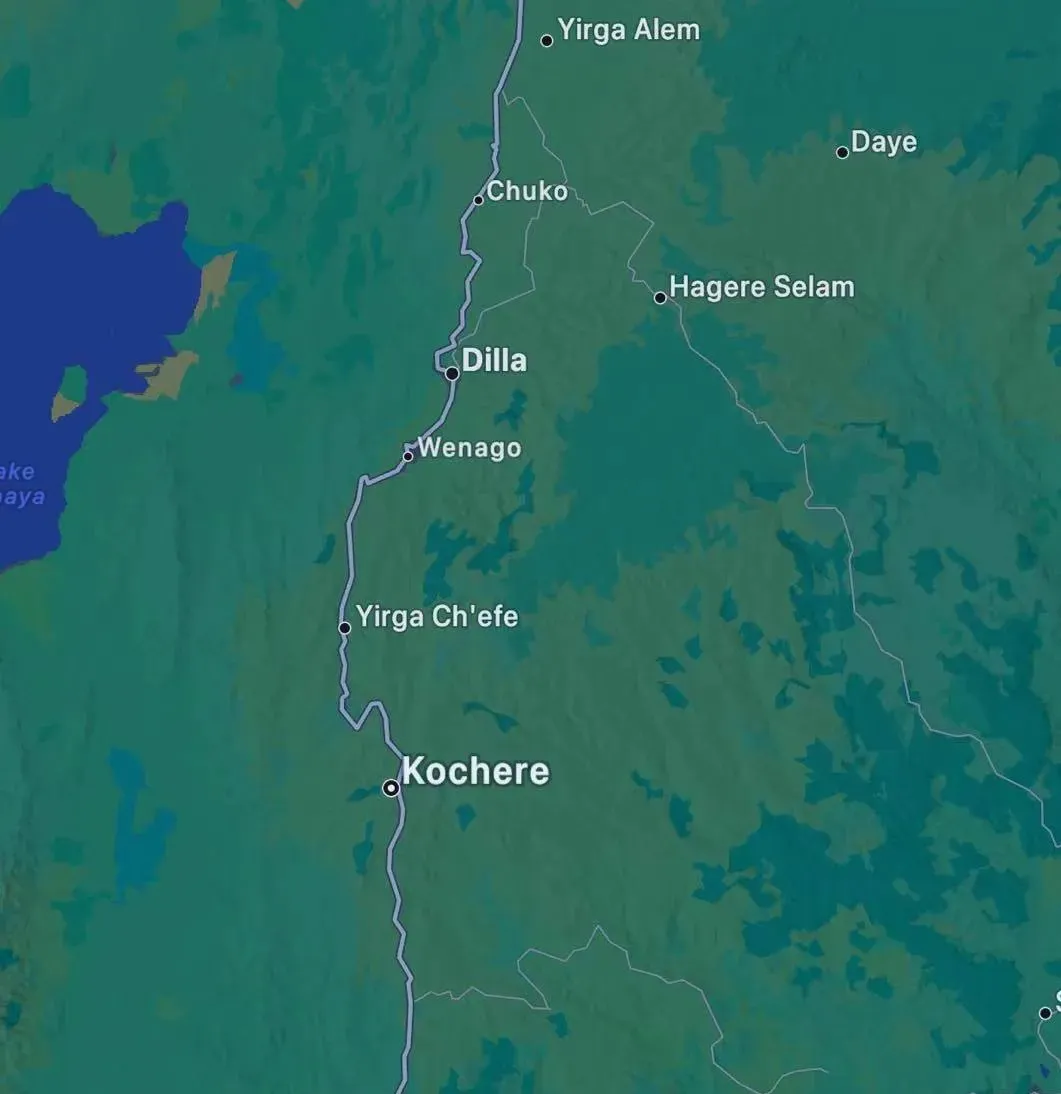
Kochere Production Area
Kochere
Yirgacheffe itself is a small town with a population of about 20,000. The three neighboring small production areas of Wenago, Kochere, and Gelena Abaya are also classified under the Yirgacheffe regional category because the flavors of the coffee they produce are almost identical to Front Street Yirgacheffe.
Kochere is located about 25 kilometers southeast of Yirgacheffe in Ethiopia, at an altitude ranging from 1,650 to 1,800 meters. It is a small production area made prosperous by the coffee industry and one of the three famous micro-regions of Yirgacheffe. The local population is about 100,000, and coffee beans are their main source of income. The processing equipment in this production area is quite advanced. The well-known coffee review website Coffee Review once gave Kochere washed beans a high score of 94 points.
Kochere is one of the 77 Woredas (administrative districts) of SNNPR in Ethiopia. In the coffee field, Kochere is part of Gediyo in Yirgacheffe and one of the most important production areas of Yirgacheffe. Kochere can be further subdivided internally into several micro-regions. Coffee produced in the area is sometimes named after the source town (such as Chelelektu or Teklu Dembel), the processing station (such as Teklu Dembel processing station and the Alim processing station used for this batch), or the micro-region (such as Banko Gutiti), so as to mark the batch source more precisely, which follows the current trend of coffee traceability. Of course, the stronger the traceability of a batch, the more specific its source, the higher the stability and reproducibility of its flavor each year, and naturally the more expensive its price.
Coffee Production Model in the Kochere Region
The production model in Kochere is mainly based on local smallholder farmers delivering their output batches to cooperatives for unified processing. About 100,000 people in the local village of Chalalacktu depend on coffee for their livelihood, and related production activities constitute their main source of income. Thanks to the income brought by coffee production, the local standard of living is considerably better than that of many Ethiopian villages, with well-equipped health facilities and higher schools. Advanced processing equipment allows the Kochere production area to consistently maintain a high standard in washed processing, presenting a clean and sweet cup with complex notes of molasses and citrus.
This Front Street Yirgacheffe Kochere purchased by FrontStreet Coffee is different from ordinary batches of green beans. It belongs to the highest specification G1 grade, with distinctive origin flavor characteristics, a clean and fresh lemon aroma, delicate and elegant jasmine fragrance, and rich aromas and flavors of muskmelon, citrus, ginger, and spiced tea.
Washed Processing Method
Washed
1. First, the coffee farmers pour all the harvested coffee cherries into water. Poor-quality or defective beans will float to the surface, while the qualified cherries sink to the bottom. This step also greatly reduces the time consumed by selecting cherries one by one.
2. The screened coffee cherries are sent into a depulper to remove the skin and pulp. After removal, a layer of sticky pectin still remains on the surface of the cherries, so a large amount of clean water is needed to wash the sticky substance off the surface of the coffee cherries.
3. Next, fermentation is used to completely break down the pectin, and this process takes about 18 hours. After fermentation is completed, fermentation bacteria will adhere to the surface of the coffee cherries, so they must again be scrubbed with a large amount of clean water. The entire process consumes a large amount of freshwater resources.
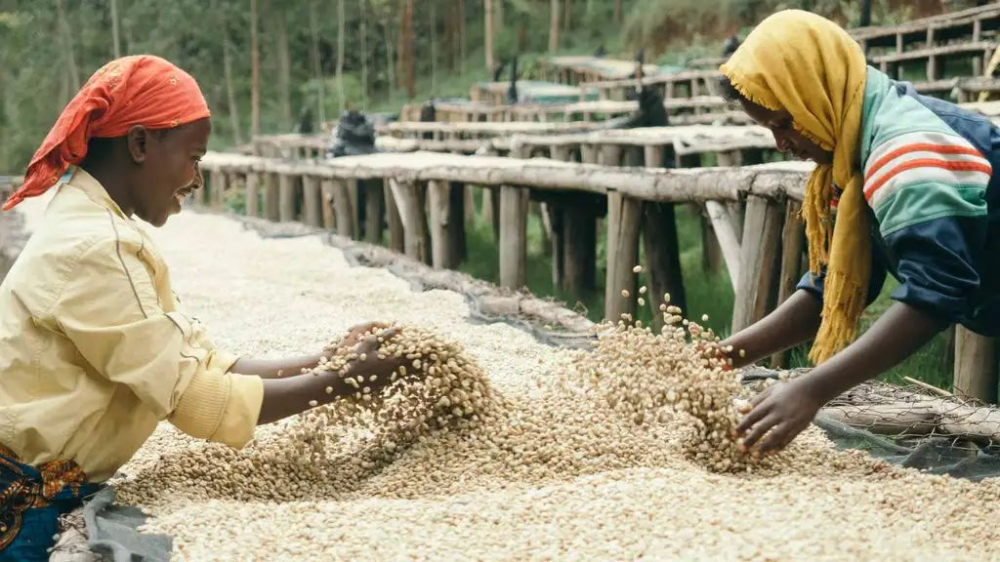
4. Finally, the cleaned coffee beans are moved outdoors and spread on drying beds to dry. Some more developed production areas instead send them to processing stations for machine drying, reducing the moisture content of the coffee to about 11%.
Product Name: Front Street Yirgacheffe · Kochere Washed
Region: Yirgacheffe Kochere
Variety: Local Heirloom
Growing Altitude: 1,650 m ~ 1,800 m
Processing Method: Washed Processing
Grade: G1
FrontStreet Coffee Roasting Record
In order to fully present the clean mouthfeel and bright acidity of this Front Street washed Kochere bean, the Front Street roaster decided to use a medium-light roast. The roaster is a Yangjia 800N, with a charge weight of 550 g: the beans are charged when the drum temperature rises to 200°C, the damper is set to 3, the heat is set to 160, and the damper remains unchanged. The turning point is at 1'32". When the drum temperature reaches 151, the damper is adjusted to 3.5; when the drum temperature reaches 140°C, the heat is adjusted to 180, and the damper remains unchanged. At this point the bean surface turns yellow, the grassy smell completely dissipates, and the dehydration stage begins.
At 8'35", wrinkles and dark patches appear on the bean surface, and the toast aroma clearly changes into coffee aroma, which can be regarded as the prelude to first crack. At this time, it is necessary to listen carefully for the sound of first crack. First crack begins at 8'53". The heat remains unchanged at 180, the damper is adjusted to 4, development after first crack lasts 1'45", and the beans are dropped at 195°C.
FrontStreet Coffee Cupping Report
FrontStreet Coffee conducts cupping within 8 to 24 hours after the sample beans are roasted. Front Street baristas usually use ceramic cupping bowls with a capacity of 200 ml, marked with 150 ml and 200 ml scale lines. According to SCAA standards, the TDS of the water is controlled at around 150 ppm. If the TDS is too low, over-extraction is likely; if it is too high, it affects the mouthfeel and tends to cause under-extraction. The cupping water temperature is 94°C. The grind size is controlled so that the passing rate through a No. 20 standard sieve (0.85 mm) is 70%-75%. The ratio is 11 grams of coffee grounds to 200 milliliters of hot water, that is, 1:18.18, so that the extracted concentration falls exactly within the golden cup range of 1.15%-1.35%. The steeping time is 4 minutes.
Dry Aroma: Orange Blossom
Wet Aroma: Sensory
Flavor: Lemon, Black Tea, Fruity Sweetness and Acidity
FrontStreet Coffee Brewing Notes
Dripper: V60 #01
Water Temperature: 90-91°C
Dose: 15 g
Coffee-to-Water Ratio: 1:15
Grind Size: BG6m / caster sugar size (80% passes through a No. 20 sieve)
Regarding grind size, Front Street determines it through sieving, based on the SCA's grind recommendations for pour-over coffee and verified through actual practice. If there is no sieve at home, FrontStreet Coffee suggests judging by observing the flow rate: if the flow is too fast, the grind is coarse; if the flow is too slow, the grind is fine.
Front Street brewing method: first rinse the filter paper and preheat the dripper and coffee server. In the first stage, pour 30 grams of water for a 30-second bloom, then pour 95 grams (about 125 grams shown on the scale), completing the pour in about 1 minute. When the water level drops to 2/3 of the coffee bed, pour the remaining 100 grams (about 225 grams shown on the scale), completing the pour in about 1 minute 35 seconds. Dripping is completed at 2 minutes 05 seconds. Remove the dripper, and extraction is finished.
Brewed Flavor: Lemon, Floral, Orange, Cane Sugar. The overall cup is clean and refreshing, with a sweet aftertaste featuring honey and an oolong tea finish.
For more specialty coffee beans, please add the private WeChat of FrontStreet Coffee, WeChat ID: kaixinguoguo0925
The above content is compiled by CoffeeHunters, a coffee news website.


