







What do Kenya coffee beans taste like from Nyeri?
Kenya Nyeri Gachatha Cooperative AB beans taste of citrus, plum, honey and green tea. The lot combines the SL28 and SL34 varieties, grown at about 1,825 meters and washed using the K72 method, which together produce the layered, bright cup the Nyeri region is known for.
Nyeri sits near Mount Kenya, above 1,500 meters, and Gathaithi washing station serves 1,080 smallholder farmers across roughly 160 hectares. A V60 recipe with a medium-fine grind and a slow, even pour suits the AB grade, which falls between 15 and 16 screen sizes.
The Nyeri region of Kenya has long been recognized as a benchmark origin in the specialty coffee world, and the AB-grade beans from the Gathaithi Cooperative are a prime example. This lot brings together the two classic varieties SL28 and SL34, processed via the K72 washed method, displaying layers of citrus, plum, honey, and green tea. This article will cover the origin background, cooperative details, processing technique, variety characteristics, as well as Front Street Coffee's roast profile, cupping data, and V60 brewing recipe, providing a complete overview of this coffee's flavor sources and extraction approach as a practical tasting and brewing reference for coffee enthusiasts.
For professional coffee knowledge exchange and more coffee bean information, please follow Coffee Workshop (WeChat public account: cafe_style)
Front Street Coffee: Kenya Gathaithi Cooperative AB Coffee Beans
Origin: Kenya, Nyeri, Gathaithi Cooperative
Washing Station: Gathaithi Washing Station
Altitude: 1825m
Variety: SL28 & SL34
Processing Method: K72 Washed
Harvest Season: 2020
Grade: AB (bean size between 15 and 16 screen mesh)
Nyeri Region
Nyeri
Nyeri is located in the high-altitude area near Mount Kenya and is a critically important region in Kenya's specialty coffee landscape, with an average altitude above 1500 meters. Many high-quality Kenyan coffees come from here. The area has an obvious altitude advantage and lies east of the Aberdare Range, positioned right at the promontory extending from Mount Kenya. The high elevation combined with fertile soil has made Nyeri the core town of Kenya's central coffee industry, with well-developed supporting infrastructure.
Gathaithi Cooperative
Gachatha
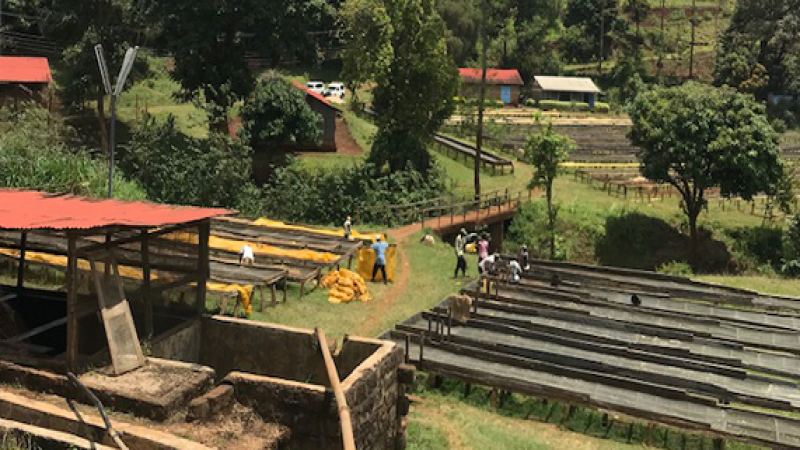
Gathaithi Farmers Cooperative is located in Giakanja village, in the Nyeri and Karundu areas, and operates a washing station of the same name, serving 1,080 smallholder farmers. The cooperative's coffee cultivation area totals about 160 hectares, with the main varieties being traditional SL28 and SL34, plus a small number of farmers growing R11 and Batian. The Kenyan Gathaithi Cooperative coffee beans selected by Front Street this time are precisely a combination of SL28 and SL34.
The washing station has a full-time factory manager and a nine-member committee. The Gathaithi Cooperative regularly organizes training for the factory manager and farmers, and farmers enjoy priority in areas such as paying their children's school fees, farm inputs, and hand-picking.
Gathaithi Washing Station
Gathaithi
Gathaithi Washing Station is located in the Tetu block of Kenya's most prestigious Nyeri region, where mineral-rich red volcanic soil is found throughout. Annual rainfall is about 1100 mm, and temperatures remain between 16 and 22 degrees Celsius year-round, cool and dry.
72-Hour Fermentation Washed Process
K72
The so-called 72-hour fermentation washed process means the entire fermentation process totals 72 hours. The Kenyan-style washed method uses alternating cycles of fermentation and washing: on the day of harvest, the best-quality coffee cherries are first selected, pulped, and then fermented. The first fermentation lasts 24 hours, followed by rinsing with clean river water.
After rinsing, a second 24-hour fermentation is carried out with clean river water, then washed again, repeating for three cycles in total, reaching 72 hours. This is the Kenyan-style 72-hour fermentation washed method, abbreviated as K72.
Coffee Bean Varieties
SL28 & SL34
In 1930, the Scott Laboratories selected and named Kenya's unique SL28 and SL34, both grown in good native forest environments. The original idea behind selecting SL28 was to obtain a variety with both high yield and pest and disease resistance. Although SL28 ultimately did not reach expected yields, its bronze young leaves and broad bean-shaped beans brought excellent sweetness, balance, and rich flavor variation, with particularly prominent citrus and dark plum notes.
SL34, on the other hand, combines French missionary, Bourbon, and more Typica lineage. Its bean appearance is similar to SL28, but it has better adaptability to sudden heavy rainfall.
SL34's flavor direction is similar to SL28, also featuring complex and varied acidity and a sweet finish, but its mouthfeel is heavier and more intense than SL28, and its cleanliness is even better.
Front Street Coffee Roasting Suggestions
Front Street's roaster uses a Yangjia 800N semi-direct fire roaster with a 480-gram charge: beans are added when the drum temperature rises to 165 degrees Celsius, the airflow is set to 3, and the power is set to 120. The turning point appears at 1 minute 28 seconds. When the temperature climbs to 113 degrees, the airflow is adjusted to 4. At 6 minutes, the temperature reaches 151.4 degrees, the bean surface turns yellow, the grassy smell completely dissipates, and the dehydration stage ends.
When rough wrinkles and dark spots appear on the bean surface, and the toast aroma clearly transitions into coffee aroma, this can be regarded as the prelude to first crack, and at this point the cracking sound of first crack must be carefully captured. First crack begins at 9 minutes 50 seconds; the airflow remains unchanged, and the power is reduced from 188 degrees to 90. The first crack development period lasts 1 minute 40 seconds, and the beans are finally discharged at 191 degrees.
Front Street Coffee Cupping Report
Front Street Coffee schedules cupping within 8 to 24 hours after the sample beans are roasted. Front Street Coffee baristas usually use a 200 ml ceramic cupping bowl, with water temperature controlled at 94 degrees. The grind size is based on 70% to 75% passing through a No. 20 standard sieve (0.85 mm). The coffee-to-water ratio is 11 grams of coffee powder to 200 ml of hot water, i.e. 1:18.18. At this ratio, the extraction concentration falls exactly within the golden cup range of 1.15% to 1.35%, and the steeping time is 4 minutes.
Dry aroma: citrus
Wet aroma: plum
Flavor: citrus, plum, honey, grape, tea-like
Front Street Coffee Brewing Notes
Dripper: V60 #01
Water temperature: 90 degrees
Dose: 15g
Coffee-to-water ratio: 1:15
Grind size: medium-fine (80% passing a No. 20 sieve)
Front Street brewing method: first rinse the filter paper, and preheat the dripper and coffee pot. Bloom with 30 grams of water for 30 seconds, then pour in a slow circular stream until 130 grams for one pour pause. When the water level drops and is about to expose the coffee bed, continue pouring until 240 grams and stop. When the water level again drops and is about to expose the coffee bed, remove the dripper. (Timing from the start of blooming) The total extraction time is 2 minutes 02 seconds.
[Front Street Coffee Kenya Gathaithi Cooperative] Brewing flavor: citrus acidity on entry, plum and grape emerging in the middle, and a honey-green-tea-like sweet aftertaste in the finish.
For more specialty coffee beans, please add the private WeChat of Front Street Coffee, WeChat ID: kaixinguoguo0925
The above content is compiled by CoffeeHunters, a coffee news website.


