







What Is Yirgacheffe's Role in Ethiopia's Guji Coffee Quality?
Guji, separated from Sidamo by the Ethiopia Commodity Exchange in 2010, has become one of Ethiopia's key coffee regions, and its floral, fruity profile drives consistent competition results. Hambela Flower Queen won the natural group at the 2017 TOH Ethiopian competition, and the 2020 washed group champion came from Uraga in Guji. Yirgacheffe was the earlier precedent for building regions with distinct flavors.
The Ana Sora Estate, a young private farm in Guji, relies on its geography and an enzyme-washed process to produce a cup reminiscent of white peach oolong tea. The article covers the estate's growing background and processing method, then explains how roasting and brewing bring out that flavor. Its stable coffee quality has drawn international attention, and a white peach oolong lot has become widely seen in specialty shops.
Ethiopia's Guji region has risen to fame in the specialty coffee world in recent years, and its intense floral and fruity aromas have attracted the attention of coffee lovers worldwide. As a young private estate in this region, the Ana Sora Estate relies on its unique geographical environment and enzyme-washed processing method to create a coffee flavor reminiscent of white peach oolong tea. This article will provide an in-depth analysis of Ana Sora Estate's growing background, processing techniques, and how Front Street Coffee presents this coffee's refined taste through roasting and brewing, giving you a comprehensive understanding of this highly anticipated Guji coffee.
The bold interwoven flavors of berries and cream in Sidamo coffee beans have long captivated countless coffee enthusiasts. The Guji region under Sidamo is even more of a treasure trove that continuously produces high-quality specialty beans. Whether in Ethiopian national or African continental coffee competitions, the name of the Guji region frequently appears on the winners' lists. For example, Hambela Flower Queen and Uraga washed beans are both included on Front Street's coffee bean list.
Flower Queen coffee beans won the championship in the natural group of the 2017 TOH Ethiopian competition; the 2020 TOH washed group champion came from the Uraga region of Guji. These honors are enough to demonstrate the stability and superiority of coffee quality in the Guji region.
Coffee from the Guji region is known for its rich floral and fruity aromas, and in recent years it has been increasingly sought after by international coffee lovers. In 2010, the Ethiopia Commodity Exchange (ECX) separated Guji from the Sidamo region and established it as an independent region. The Ethiopian government intends to create coffee regions with distinct flavors, and Yirgacheffe was a successful precedent. Today, the Guji region has become a key development project in Ethiopia, and more and more Guji coffees have won a good reputation in the international market.
Recently, a white peach oolong coffee bean also marketed for its rich fruity aroma has become popular everywhere, and it can be seen in almost every specialty coffee shop, with a reputation no less than that of Flower Queen coffee. Front Street's bean list is also about to add this widely popular rich fruity coffee. For coffee lovers who enjoy trying new things, this novel flavor has a strong appeal. When told that this bean with a prominent white peach oolong flavor comes from Ethiopia's Guji region, many people are surprised—after all, coffees with such distinctive flavors mostly come from South America.
FrontStreet Coffee Ethiopia White Peach Oolong Dorothy Coffee Beans
Region: Guji
Estate: Ana Sora
Altitude: 1900 meters—2350 meters
Variety: Local heirloom varieties
Processing Method: Enzyme washed
Grade: G1
Harvest Season: 2021
Dorothy coffee beans come from Ana Sora Estate, and near the estate is Buku village, which produces Flower Queen coffee, close to Yirgacheffe town. Ana Sora Coffee Estate was established in 2010, covering 250 hectares, of which 150 hectares are planted with coffee. Unlike the coffee cooperatives commonly seen in Ethiopia, Ana Sora Estate is privately owned and is currently managed by second-generation manager Israel Degfa. From an early age, he accumulated knowledge related to coffee production from his father, who served as a coffee cooperative manager, and his mother, who once sold green beans at a station.
Before the washing station was built in 2018, this young coffee plantation, Ana Sora Estate, produced only natural coffee beans. The estate is adjacent to the Turo River, so taking advantage of this natural resource, it built a green bean washing processing plant, and the water needed for the washing process is also drawn from this river. Therefore, the coffee beans produced by Ana Sora Estate are a rare estate-style washed coffee in Ethiopia with self-production and self-sales.
The estate is located in a high mountain area at an altitude of 1900 to 2350 meters, with inconvenient transportation, but albizia trees, Cordia africana trees, legume trees, and false banana plants are grown around the coffee trees, providing shade and nutrients for the coffee and helping to shape the balanced acidity and sweetness of Ana Sora coffee.
This coffee, reminiscent of fruit tea, uses an enzyme-washed processing method. Coffee farmers first sort the harvested ripe red cherries, then send the fruit into a depulper to remove the skin, and then put the parchment beans with the complete mucilage layer and some pulp into sealed tanks, adding enzymes to ferment for 24 hours. After that, the fermented parchment beans are placed in a water tank to soak for 48 hours. Through stirring and washing, the sticky mucilage layer is separated, then thoroughly cleaned and evenly spread on raised drying beds to dry.
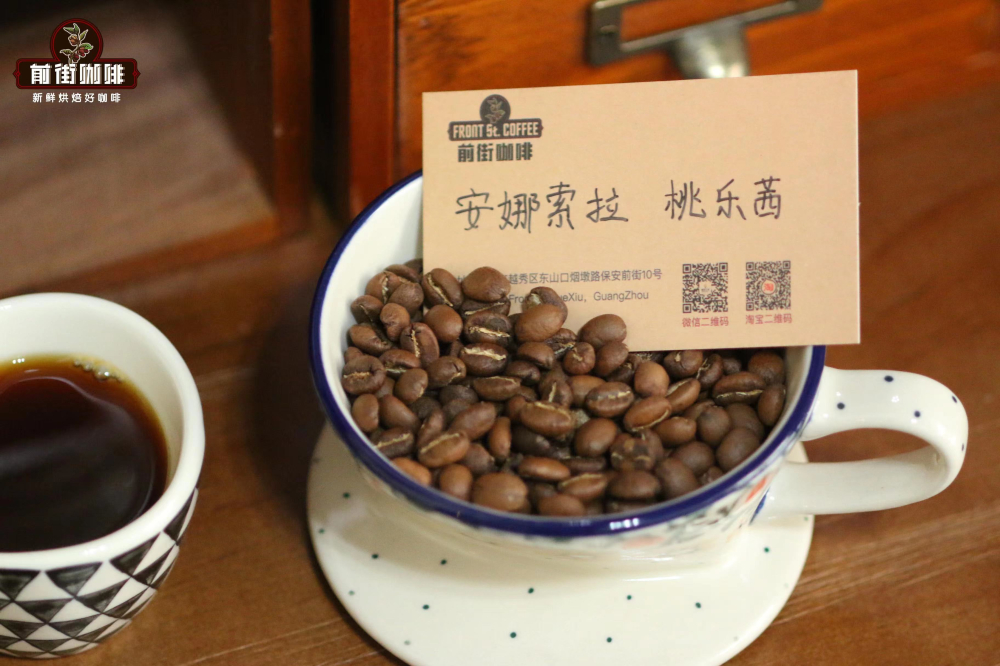
When FrontStreet Coffee's roaster received this green coffee, they observed that the Dorothy coffee beans were uneven in size and pale green in color. Instrument testing showed that the green bean moisture content was 10.2%. Considering the uneven particle size characteristic of local heirloom varieties, the roaster chose to slow down the roasting pace; at the same time, in order to retain more acidity, a bright mouthfeel, and rich aroma, a medium-light roast was used.
After FrontStreet Coffee's barista received the roasted Dorothy, cupping revealed that this coffee had elegant floral notes, with peach aroma especially rich and striking, acidity similar to citrus, and an oolong tea-like sweet aftertaste left in the mouth after drinking. The overall impression was very close to white peach oolong tea.
When brewing this coffee, because the roast level is relatively light, the flavor substances dissolve more slowly after the coffee beans come into contact with water, so the following methods are needed:
1. Finer grind size: Front Street uses an EK43s grinder, and after grinding, the coffee is sifted through a Chinese standard No. 20 sieve, with a pass rate of 80%. A finer grind can increase the contact area between the coffee grounds and hot water, speeding up the extraction of flavor substances.
2. Higher water temperature: When brewing medium and medium-light roasted coffee, Front Street uses a water temperature of 90 to 93 degrees Celsius. With other parameters kept the same, increasing the water temperature will increase the amount and rate of flavor substance extraction.
3. A dripper with faster flow: For pour-over brewing, Front Street uses only KONO and Hario V60. Among them, V60 is suitable for medium-light and medium grind coffee beans. Because of the high water temperature and fine grind, it can extract coffee flavor as much as possible, while V60's 12 long ribs and 12 short ribs can support the filter paper and guide the water flow, thereby reducing the risk of over-extraction caused by high temperature and fine grinding.
Dripper: Hario V60
Water Temperature: 91 degrees Celsius
Coffee Dose: 15 grams
Coffee-to-Water Ratio: 1:15
Grind Size: 80% pass rate through Chinese standard No. 20 sieve
Pour 15 grams of coffee grounds into the dripper and shake level, then starting from the center point, pour 30 grams of hot water in a circular motion and let it bloom for 30 seconds. After blooming, pour slowly in a circular motion from the center point with a small stream to 125 grams in stages; when the water level in the dripper drops to the point where the coffee bed is about to be exposed, continue pouring in a circular motion to 225 grams. The total extraction time is about 2 minutes.
For more coffee bean information, please follow Coffee Workshop (WeChat public account cafe_style) For professional coffee knowledge exchange, please add WeChat ID kaixinguoguo0925
The above content is compiled by CoffeeHunters, a coffee news website.


