








What grind setting does a moka pot need compared with other brewers?
A moka pot takes a fine grind, finer than pour-over but coarser than espresso, roughly like table salt. The same grinder behaves differently across units, so treat any chart as a starting point and adjust by taste. Grind size controls extraction yield, contact time, and flow rate together, and moving one shifts the others, which is why small changes matter more than beginners expect.
The article lists standards for Turkish coffee, espresso, AeroPress, siphon, pour-over, moka pot, cold brew and ice drip, and French press, and describes calibration with a standard sieve. For moka pot, brew time runs roughly a few minutes once the water heats, and a coarser grind slows it further. The SCA pour-over pass rate offers a reference point when checking grounds.
From seed to cup, every step determines the final flavor of the coffee, and grind size is often the key link that beginners most easily overlook and most easily get wrong. The tiny differences produced by the same grinder at different settings are enough to make a cup of good beans taste flat or even bitter. This article systematically sorts out the intrinsic relationship between grind coarseness and extraction yield, contact time, and flow rate, and lists one by one the grinding standards corresponding to eight brewing devices: Turkish coffee, espresso, AeroPress, siphon, pour-over, moka pot, cold brew and ice drip, and French press. The article also introduces a method for calibrating grind size using a standard sieve, and, based on the SCA-recommended pour-over pass rate, shares the complete brewing parameters and flavor performance of Front Street Ethiopia Huakui natural, for enthusiasts to refer to when adjusting.
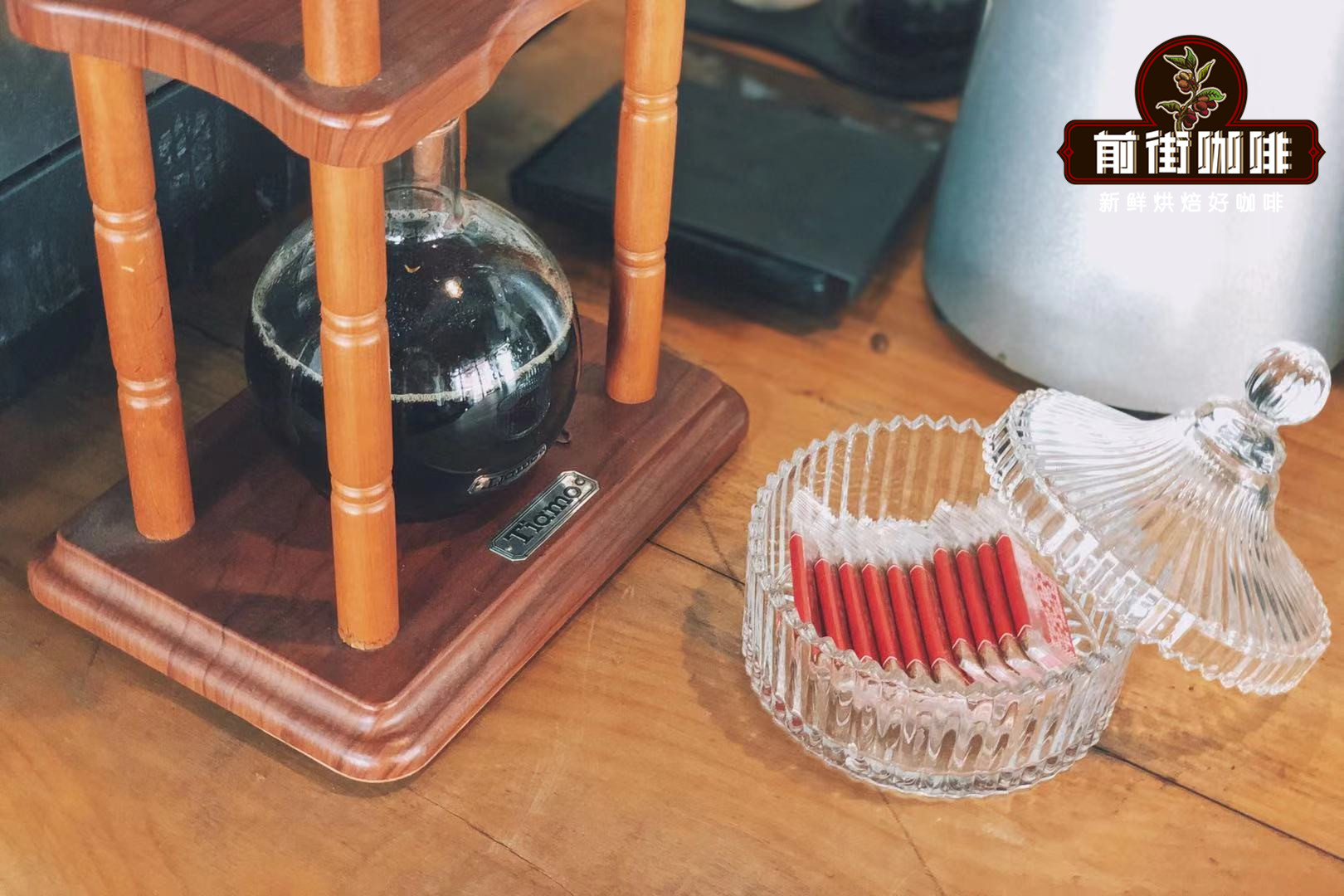
Wanting to drink a cup of satisfactory good coffee is by no means easy. From the coffee seed to finally being poured into the cup, this journey is long and full of variables. Even when you have reached the final step of extraction, you must still ensure that the coffee grounds in your hand meet the brewing requirements. Extraction itself is not complicated, but coffee grounds are the carrier of flavor substances, and water quality, bean condition, and device characteristics will all influence the final taste presentation. Today we focus on a seemingly simple yet subtly tricky step—grind size. The reason it is not simple is that even for grinders of the same brand, there are subtle differences between individual units, and these tiny deviations are enough to change the performance of the coffee grounds. Coffee grounds are not like soy milk, where once ground they can be used directly; precisely because of this, grinders have numerous settings and require repeated fine-tuning to find the matching grind size, otherwise even the highest-quality beans cannot escape the fate of being wasted.
Why grinding is so crucial
Grinding is directly related to the extraction effect of coffee. The finer the grounds, the higher the extraction yield; the coarser the grounds, the lower the extraction yield. Behind this are three mutually constraining elements: contact time, extraction yield, and flow rate. They are closely linked, and moving one affects the others.
1. The surface area of coffee grounds increases as the grind becomes finer, and the extraction yield rises accordingly
2. The finer the grind, the larger the surface area; the coarser the grind, the smaller the surface area
3. The finer the grounds, the higher the extraction yield, and the shorter the required contact time
4. The finer the grounds, the slower the water flows through, and the contact time is lengthened; the coarser the grounds, the faster the water flows, and the contact time is correspondingly shortened
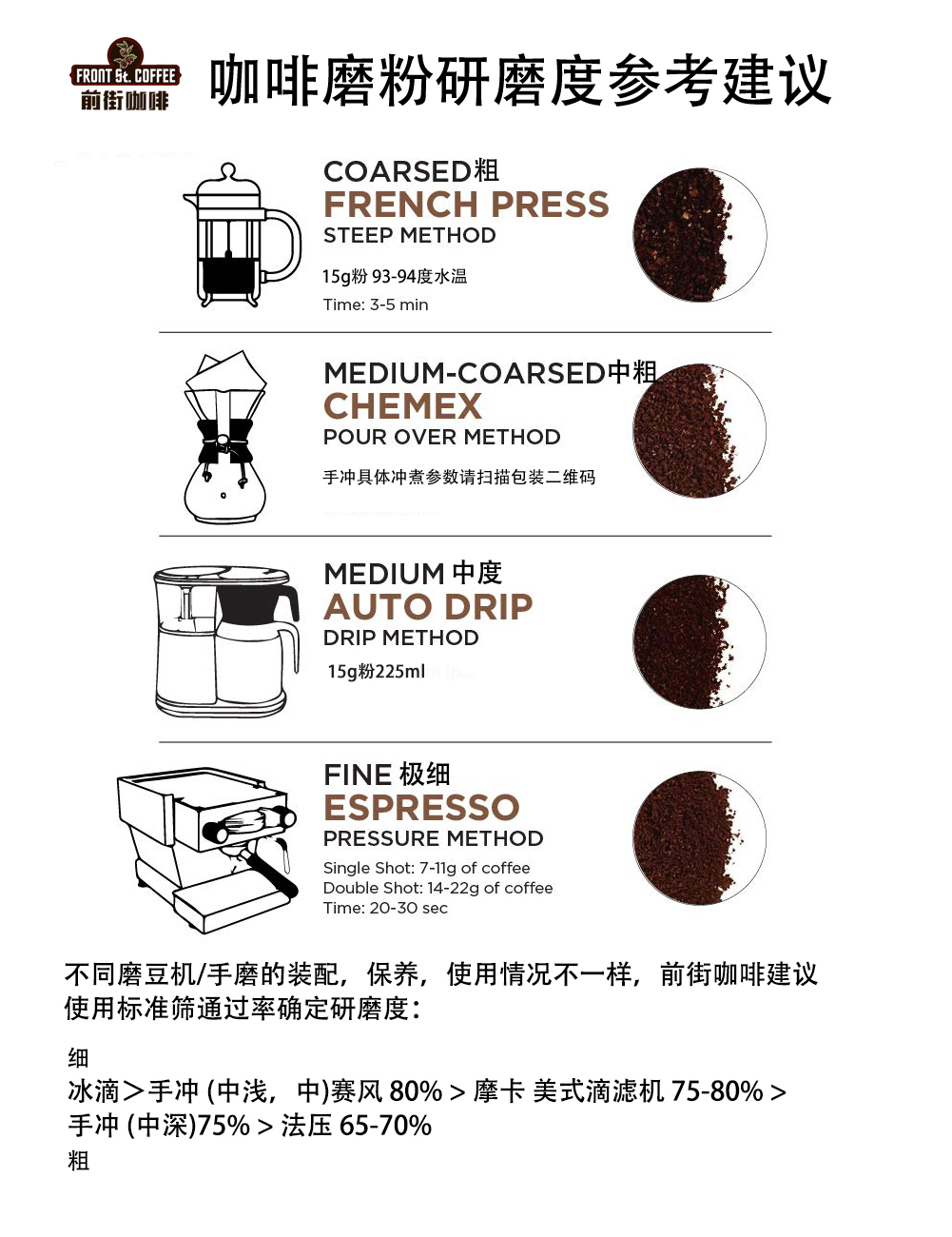
This principle is not hard to understand. Espresso machines use extremely fine grounds, so the extraction time is only about 30 seconds; drip coffee uses medium-fine grounds, and the contact time is around 2 minutes. When you choose a certain device to make coffee, you need to adjust the grind size accordingly, either coarser or finer. If you use extremely fine grounds for drip coffee, the water will inevitably flow down slowly, the contact time will be lengthened, and the extraction yield will accordingly be on the high side; conversely, if you use medium-fine grounds to operate an espresso machine, the contact area will be insufficient, the water flow will be too fast, the extraction time will be short, and the extraction yield will be on the low side. Even if you grind to pour-over coarseness, how do you judge whether it is accurate? A slight deviation, and the flavor will be completely different. Therefore, grind size must be verifiable in order to achieve as ideal a state as possible during brewing.
It is worth mentioning that many people mistakenly believe that grounds ground at the same setting are uniform in size. In fact, different grinders have certain assembly errors and can be calibrated periodically. At the same time, a standard sieve can also be used to measure the coarseness of the particles, thereby selecting a suitable grind size. The standard sieve pass rates for Front Street Coffee (FrontStreet Coffee) grind coarseness are as follows:
Ice drip > pour-over siphon (siphon) 80% > moka American drip 75-80% > cupping 70-75% > French press 65-70%
How to choose grind size
Different grind sizes suit different brewing devices. Therefore, the coarseness of the coffee grounds should be adjusted according to the device used. Below, in order from fine to coarse, the grind sizes and their corresponding devices are explained one by one.
1. Turkish coffee: This is ultra-fine grinding, with a feel like flour, basically the smallest setting on an espresso grinder; the smaller the number, the finer the grind.
2. Espresso (as shown above): An espresso machine extracts coffee substances at 9 atmospheres of pressure, and this is likewise extremely fine grinding. But if you grind to the level of Turkish coffee, it will clog the portafilter basket, preventing water from passing through and making the extraction time too long. Therefore, it needs to be adjusted coarser in the direction of a larger number and then tested. Usually, a single-spout portafilter basket for an espresso machine uses 8-9 grams of grounds, and a double-spout uses 18-20 grams. Extracting 25-30 grams of coffee liquid for a single spout and 50-60 grams for a double spout within 25-30 seconds is the standard.
3. AeroPress (as shown below): This is a piston-like extraction device that relies on manual pressing to push out the coffee liquid. The extraction time is about 2 minutes, but because it is immersion extraction, fine grounds easily lead to over-extraction, so it should be adjusted 1 to 1.5 settings coarser than pour-over coarseness, a grind size between medium-fine and fine.
4. Siphon (as shown below): The siphon heats boiling water with an open flame, and the water rises from the lower pot to the upper pot for immersion extraction, during which it is also stirred. Fine grinding likewise carries the risk of over-extraction, so it needs to be adjusted to a medium grind.
5. Pour-over coffee (as shown below): This is currently the most popular brewing method, but grinding deviations are still not uncommon. People often say to grind to a coarseness similar to fine granulated sugar, but many people do not clearly realize that even when comparing against a reference object, there will still be deviations. The grind for pour-over coffee is medium-fine, with a particle size close to fine granulated sugar. The SCA-recommended sieve pass rate is 75-80%, which is defined as the standard coarseness for pour-over coffee.
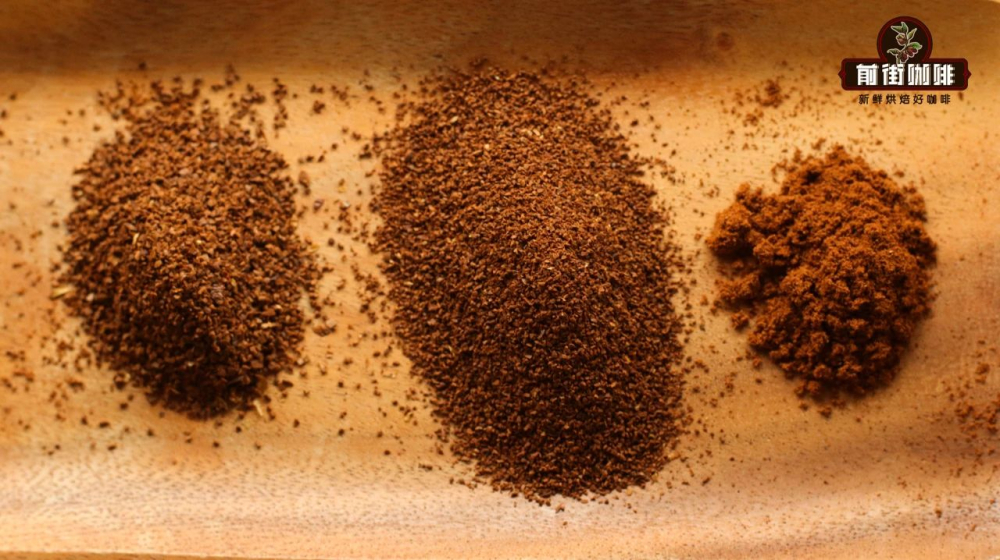
6. Moka pot (as shown below): The moka pot is a coffee device with a long history. It heats the water in the bottom to boiling, thereby extracting the coffee in the upper part. In earlier years it was the main tool for making espresso. The pressure is about 1.5 bar, so a relatively fine grind is required, close to espresso grinding but slightly coarser.
7. Cold brew, ice drip: Both belong to long-duration low-temperature immersion extraction, using ice water to slowly extract the coffee flavor substances. The extraction yield of ice water is extremely low, so long soaking must use a medium-coarse grind. A medium-coarse grind is easier to filter, and will not prevent water droplets from penetrating because the gaps between grounds are too fine; cold brew likewise makes it easier to filter out coffee grounds.
8. French press (as shown above): The French press is also immersion extraction. The difference is that the coffee remains immersed in the pot the whole time, and long immersion will inevitably lead to continuous extraction, so a coarse grind is necessary. The grind size is coarse, with particles similar in size to brown sugar.
The above are my personal suggestions for coffee grind size, for reference only. In actual operation, once a problem is found, it should be adjusted immediately; there is no need to rigidly stick to a certain grind size. People's tastes are inherently different. Some prefer light, some prefer strong; this is perfectly normal. The taste you find just right may seem too strong or too weak to others, so do not let uncontrollable factors interfere with your judgment. At present, the most commonly used pour-over coarseness has a sieve available for calibration, and friends who need it can purchase one for use. Next, let us move on to the brewing sharing section, brewing Sidamo Huakui using the standard pass rate defined by the SCA, and see what kind of surprise it will bring!
Taking Front Street [Ethiopia Huakui Natural] as an example Region: Guji Hambela Variety: Heirloom Altitude: 1800-2000 meters Processing method: Natural
Pour-over parameters Dripper: V60 Water temperature: 91°C Grind size: fine granulated sugar (standard No. 20 sieve pass rate 80%) Water-to-coffee ratio: 1:15 Technique: three-stage extraction Brewing: bloom with 30g of water for 30s, then in the second stage slowly pour in a circular motion up to 120g in stages; after the water level drops by half, pour again up to 225g and stop brewing; wait for the coffee liquid to finish dripping, then remove the dripper. Total extraction time is 2:00-2:10s.
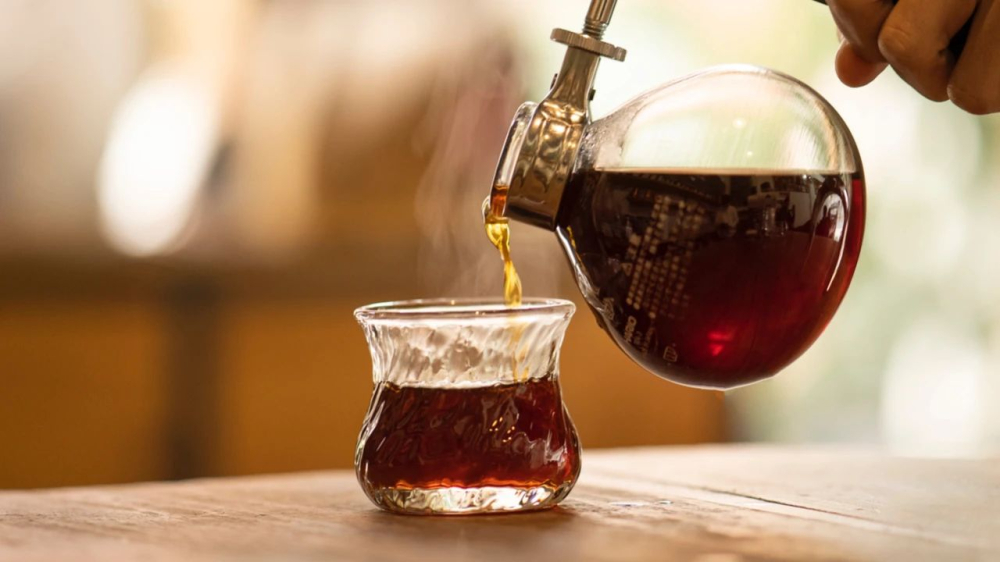
Flavor: tropical fruit, mango, strawberry, passion fruit; full and rounded acidity, solid mouthfeel
The above content is compiled by CoffeeHunters, a coffee news website.


