







How Do You Brew Huila Coffee With a Pour-Over?
For medium-roast Colombian coffee, use a 1:15 ratio of 15 grams of grounds to 225 grams of water, a water temperature of 90 to 91°C, and a medium grind resembling granulated sugar. Pour in stages for a total extraction time of about 2 minutes. This yields a balanced cup with full flavor and sweet-tart acidity.
Southern specialty regions such as Huila gained attention after the 2008 volcanic eruption there, and estates from the area began winning competitions. Volcanic soil, formed by weathered lava and ash, holds nutrients and trace elements including coffee calcium, iron, magnesium, potassium, and phosphorus, which support root development and help coffee build delicate flavors.
Colombian coffee is renowned for its fresh, fragrant fruit notes and diverse regional styles. Since the 2008 volcanic eruption in Huila, the southern specialty regions have gradually come to prominence. Front Street Coffee currently sells four Colombian specialty beans, covering washed, anaerobic natural, and double anaerobic washed processing methods, all roasted to a medium level to balance body and mild acidity. This article will systematically explain the pour-over parameters for medium-roast Colombian coffee, including a 1:15 coffee-to-water ratio of 15g grounds to 225g water, a water temperature of 90-91°C, a medium grind resembling granulated sugar, and the complete process of staged pouring with a total extraction time of 2 minutes, helping you brew a cup of full-flavored, balanced sweet-and-sour Colombian pour-over coffee at home.
For more specialty coffee knowledge, please follow our WeChat official account: Front Street Coffee (FrontStreet Coffee)
The most outstanding advantage of Colombian coffee lies in its rich stylistic diversity. If we draw an analogy with wine, it resembles the Champagne region's landscape where large estates and smallholders coexist—there is both standardized, consistent output and plenty of distinctive, small-batch specialty coffee. Overall, Colombian coffee presents a fresh character with intense fruit aromas.
Before 2008, although Colombia was firmly the world's third-largest coffee producer, it had long gone unnoticed by the specialty coffee market. The turning point came in 2008, when a volcano erupted in the southern Huila province, and coffee beans from that region gradually rose to fame, with numerous Colombian estates repeatedly winning awards in coffee competitions.
Behind this transformation is the fact that coffee flavor is shaped not only by varietal genetics but also closely related to whether the plant's root system is well developed and can obtain sufficient nutrients. Volcanic soil, formed by the weathering of lava and volcanic ash, is rich in key nutrients and trace elements such as iron, calcium, magnesium, sodium, potassium, phosphorus, sulfur, and silicon. This rich combination acts like a catalyst for plant growth and is an important condition for coffee to develop delicate flavors.
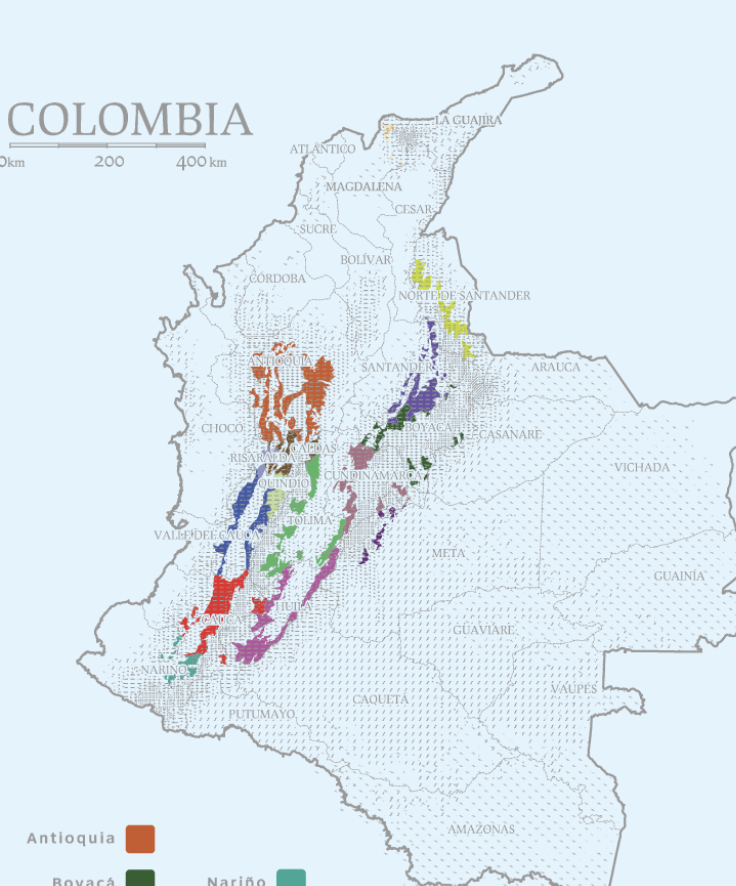
The more widely covered by volcanic ash a region is, the more fertile the soil, so Colombia's specialty coffee regions are mainly concentrated in the south, mostly at elevations above 1,500 meters, covering San Agustín in Huila, Popayán in Cauca, Nariño, and Tolima.
In addition to the geographical advantages of Huila, this region is close to the equator, and coffee is mostly grown in high-altitude mountainous areas, resulting in even more outstanding quality—not only bright acidity but also unique floral and fruity aromas. It is precisely for this reason that coffee produced in the southern regions has won the favor of many enthusiasts.
Through cupping comparisons, Front Street Coffee (FrontStreet Coffee) has found that coffees from these regions generally exhibit delicate acidity and berry-like sweet-and-sour notes, accompanied by caramel aromas and full sweetness. Whether using traditional processing methods or the later-emerging anaerobic methods, the beans can express these unique regional flavors.
Front Street Coffee (FrontStreet Coffee) currently offers four Colombian specialty coffee beans for sale, all medium-roasted to enhance the coffee's body and fullness while preserving the characteristics of Colombian beans—mild acidity and pronounced sweetness. All coffee beans ordered from the Front Street flagship store are shipped within 5 days after roasting, ensuring 100% freshly roasted.
The first comes from the Huila region, grown at an elevation of 1,500-1,800 meters, of the Caturra variety, using the washed processing method. Washed processing gives the "Huila Coffee Bean" a cleaner mouthfeel and also most directly presents the pure taste of the bean itself. This bean fully demonstrates the typical flavors of the Huila region: mild fruit acidity, nuts, dark chocolate, and caramel.
The second also comes from the Huila region, grown at an elevation of 1,800 meters, of the Caturra variety, using anaerobic natural processing—the "Flower Moon Night Coffee Bean." The anaerobic natural process enhances the fermentation aroma, giving this bean a fermented fragrance reminiscent of strawberry wine or jam, with a finish presenting caramel-chocolate-like sweetness.
The third comes from the Monteblanco estate in the Huila region, grown at an elevation of 1,900 meters, a blend of Caturra, Catuai, and Geisha varieties, using washed processing—the "Hanami Coffee Bean." The flavor profile presents charming chamomile, playful pink peppercorn spice, mandarin-like sweet acidity, honey-like sweetness, and an almond-like finish.
The fourth comes from the El Paraiso estate in the Cauca region, grown at an elevation of 2,050 meters, of the Castillo variety, using double anaerobic washed processing—the "Cherry Blossom Coffee Bean." The flavor presents layers of mugwort, berries, fermentation notes, spice, and strawberry jam.
How should medium-roast Colombian coffee beans be brewed to taste good?
First, prepare: freshly roasted coffee beans, a dedicated grinder, a pour-over kettle, a thermometer, a scale with timer function, filtered water, a V60 dripper, filter paper, a server, and an electric kettle for boiling water.
1. Fold the filter paper and place it into the V60 dripper. Rinse the filter paper evenly with hot water so that it is completely wet and adheres to the dripper wall. The purpose of wetting the filter paper is to clean it, remove the papery taste, and warm the equipment at the same time.
2. Weigh 15g of coffee beans, pour them into the grinder, and adjust to the desired setting for grinding. Medium-roast beans increase in density during heating, and their structure becomes more porous, so soluble substances are more easily extracted. Front Street Coffee (FrontStreet Coffee) recommends using a medium grind when brewing medium-roast Colombian beans, that is, the consistency of granulated sugar (sifted through a Chinese No. 20 standard sieve, with a pass rate of about 75%).
3. Pour the ground coffee into the dripper and gently shake it level.
4. Take another kettle and pour hot water into the pouring kettle. Once the water temperature drops to 90-91°C, begin brewing. To make the flavor more balanced, Front Street Coffee (FrontStreet Coffee) recommends a coffee-to-water ratio of 1:15, that is, 15g of coffee grounds corresponding to 225g of water.
5. Press the timer button, first wet the coffee bed with water weighing twice the coffee grounds, and let it bloom for 30 seconds after forming a dome. Then pour in a small stream in a circular motion from the inside outward until reaching 125g, pause the staged pour, wait for the coffee bed to drop to half the height of the dripper, then pour the third stage with the same fine stream until reaching 225g. Once all the coffee liquid has filtered through, remove the dripper. The total time is about 2 minutes.
6. After brewing is complete, gently swirl the server to fully blend the coffee liquid, then pour it into a warmed coffee cup. A cup of aromatic pour-over coffee is now ready. You may add sugar or milk according to personal preference.
The above content is compiled by CoffeeHunters, a coffee news website.


