







What Does the Kenyan Coffee Grading System Measure?
Kenyan coffee is sorted into eight grades (E, PB, AA, AB, C, TT, T and MH/ML) based on bean size, weight, and shape or appearance, with AA the most common high-quality grade at a 17/18 screen size. The Coffee Board of Kenya, founded in 1933, runs a weekly auction at the Nairobi Coffee Exchange, and grading largely drives auction prices.
Sorting by size matters because same-size beans roast at more consistent temperatures and rates of rise, giving greater stability. Exporters add cup profile labels such as TOP, PLUS and FAQ. AA TOP beans from the Thika region, processed with the K72 double washed fermentation method, show bright berry and red wine acidity with a creamy sweet finish.
Kenyan coffee is renowned for its bright acidity and complex flavors, and its grading system is equally worth exploring in depth. Kenyan coffee beans are roughly divided into eight grades—E, PB, AA, AB, C, TT, T, and MH/ML—based on bean size, weight, and shape/appearance, with AA being the most common and outstanding in quality. This article will explain in detail the specific criteria for each grade, including the 17/18 screen size of AA grade, as well as the cup profile classifications set by exporters such as TOP, PLUS, and FAQ. It will also introduce the Kenyan AA TOP-grade beans launched by Front Street Coffee, sourced from the Thika region and processed using the K72 double washed fermentation method, offering delicate berry- and red wine-like acidity and a creamy sweet aftertaste, making them a top choice for fans of acidic coffee.
For more specialty coffee knowledge, please follow our WeChat official account: Front Street Coffee (FrontStreet Coffee)
AA is the highest-quality Kenyan coffee grade at Front Street. Coffee of this grade is the cream of the crop, so much so that Front Street is deeply fond of this Front Street Kenyan AA TOP from the Thika region. TOP is a label marked by Kenyan coffee traders after cupping. This Front Street Kenyan bean is processed using the K72 double washed fermentation method, giving it a very bright and lively acidity, as delicate and mouthwatering as berries and red wine. During brewing, a rich berry aroma instantly emerges; on the palate there are distinct notes of cherry tomato and smoked plum, with acidity and fragrance lingering together in the mouth, and a creamy sweet finish with a long-lasting aftertaste.
The Kenyan coffee grading system was established under a government-led policy of managing quality and guiding coffee farmers. After harvesting is completed, the official government agency—the Coffee Board of Kenya (CBK), founded in 1933—conducts a weekly auction at the Nairobi Coffee Exchange in the capital, Nairobi. This auction system, centrally managed by the government, uses the grading system based on "bean size," weight, and shape/appearance as the main basis for auction prices.
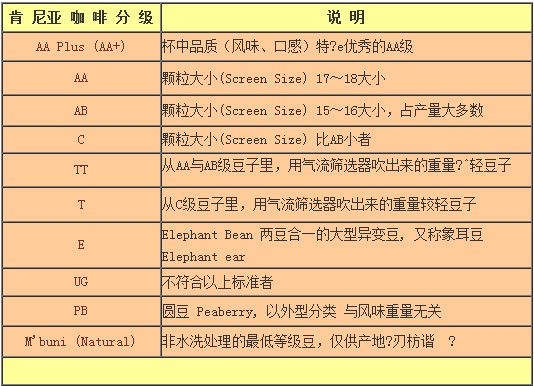
Considering that during roasting, beans of the same size are heated at more consistent temperatures and rates of temperature rise, meaning greater stability, Kenya grades green coffee beans by bean size and cupping score. According to the size, shape, and hardness of green coffee beans, Kenyan coffee beans can be roughly divided into eight grades: E, PB, AA, AB, C, TT, T, and MH/ML.
E: Kenyan E is called Elephant Bean; it is large in size and relatively low in yield.
PB: PB stands for Peaberry, which is what everyone knows as round beans, oval in shape. A normal coffee cherry contains two coffee seeds, while a peaberry contains only one seed.
AA: Kenyan AA can be said to be the most common grade; it generally grows at an altitude of about 6,600 feet or above. Its size is relatively large, with a screen size of 17/18.
AB: Screen size is 16/17. Kenyan AB coffee beans are composed of A and B coffee beans. Grade A is screened using a 6.8 mm screen, while grade B is screened using a 6.2 mm screen. These two types of beans, A and B, are mixed together to form Kenyan AB grade.
C: Screen size is below 14.
TT: Kenyan TT refers to light-density coffee beans separated by aspiration from Kenyan AA, AB, and E coffee beans. They are large in screen size but low in density; however, if the quality is sufficient, they can still be included in specialty coffee.
T: Below 14 screen size, small beans, with density and quality insufficient to be classified as specialty coffee.
MH/ML: Low-quality natural/dry-processed beans, mostly overripe beans dried on the tree.
The Front Street Kenyan Cherry Tomato coffee beans, roasted in-house by Front Street, belong to the AA grade, come from the Thika region, are processed using the Kenyan-style 72-hour washed method, and are of the SL28 and SL34 varieties, making them the first choice for many fans of acidic coffee. If you are tasting these Front Street Kenyan Azalia coffee beans for the first time, Front Street recommends trying them as a hot pour-over black coffee, which allows you to better appreciate the flavor characteristics of Front Street Kenyan coffee.
For green coffee beans of the AA and AB grades, an additional special classification based on cupping results has been added (not officially recognized by the Kenyan government, but set by exporters), from high to low: TOP, PLUS (+), FAQ. The Kenyan Azalia on the Front Street Coffee (FrontStreet Coffee) bean list reaches the TOP flavor level. However, as mentioned earlier, this is not an officially recognized grading system. Among the several Kenyan-origin coffee beans that Front Street Coffee (FrontStreet Coffee) has sourced, not every one carries a flavor grade, so there is no need to dwell too much on this. Generally, once beans reach the AA or AB grade, their flavor is already by default considered very high quality.
The above content is compiled by CoffeeHunters, a coffee news website.


