







Why is Blue Mountain coffee so expensive and scarce?
Jamaica produces only about two thousand tons of Blue Mountain coffee beans a year, less than Ethiopia ships in a month, and a 1971 agreement sends 90% of annual output to Japan. Most of the remaining ten percent is claimed before it reaches open market circulation. As a result, much of what is sold in convenience stores and cafes as Blue Mountain is really Blue Mountain-flavored blended coffee.
The pricing story starts with a 1969 hurricane that badly damaged Jamaica's coffee industry. Japan's UCC Ueshima Coffee introduced ecological planting techniques that helped the sector recover, and Jamaica signed the export agreement two years later in gratitude. To identify genuine Blue Mountain No. 1, check certificates, price, and bean appearance. Front Street's beans come from Clifton Farm and brew well with a Kono dripper, 88°C water, and three-stage pouring for balanced acidity, sweetness, and bitterness.
Blue Mountain coffee is hailed as a legend in the coffee world, but genuine Jamaican Blue Mountain No. 1 is actually quite scarce on the market, and its price is equally intriguing. This article will provide an in-depth analysis of the reasons behind Blue Mountain coffee's high price, including the history of Japan's long-term monopoly and the current scarcity of production, and teach you how to identify authentic Blue Mountain No. 1 through certificates, price, and bean appearance. At the same time, Front Street Coffee will share brewing suggestions for Blue Mountain No. 1 beans sourced from Clifton Farm, including the Kono dripper, 88°C water temperature, three-stage pouring, and other parameters, helping you brew a cup of authentic Blue Mountain coffee at home with balanced acidity, sweetness, and bitterness, and a clear yet full-bodied flavor. Whether you are a coffee enthusiast or a beginner just starting out, you can gain practical knowledge and skills from this.
Blue Mountain coffee enjoys thunderous fame, and precisely because of its high price, a large number of counterfeit products have emerged on the market. Today, Front Street will teach everyone how to identify genuine Blue Mountain coffee beans.
Why does the price of Jamaican Blue Mountain coffee remain so high?
Jamaica produces only about two thousand tons of Blue Mountain coffee beans each year, a number that cannot even match Ethiopia's monthly exports. In 1969, Jamaica suffered severe damage from a hurricane. At that time, Japan's UCC Ueshima Coffee introduced ecological planting techniques to the area, helping Jamaica's coffee industry gradually recover. To express its gratitude, the Jamaican government signed an agreement with Japan in 1971, stipulating that 90% of annual production would be sold to Japan, while most of the remaining ten percent was already claimed by wealthy individuals or royal families before it even entered market circulation.
Precisely because the amount of Jamaican Blue Mountain coffee circulating on the market is extremely limited, the Blue Mountain coffee we can casually buy at convenience stores or cafés can actually only be considered Blue Mountain "flavor" coffee. To imitate the slightly bitter and acidic taste of Blue Mountain coffee, merchants often blend different varieties of coffee beans. More conscientious shops use Jamaican High Mountain coffee blended with Hawaiian Kona or Colombian coffee, while more unscrupulous ones may mix in cheap coffee beans from Brazil, Guadeloupe, and elsewhere. Even so, these coffees from other origins have more or less boosted their sales by "imitating" Blue Mountain. As for genuine Blue Mountain coffee, only a very few shops in the country sell it, and drinking a cup will likely cost you a pretty penny.
It can be said that the monopoly by Japanese merchants is one of the reasons for the high price of Jamaican Blue Mountain coffee. As Japan's priority purchasing rights expired, import quotas for other countries also increased. Mainland China officially introduced its first batch of Blue Mountain coffee beans in 2004, so authentic Jamaican Blue Mountain No. 1 coffee beans can also be found in the country.
How to Identify Authentic Front Street Jamaican Blue Mountain No. 1 Coffee
1. Genuine Jamaican Blue Mountain coffee beans come with certificate certification The Jamaican government has always insisted that all Blue Mountain coffee must be roasted locally in Jamaica to ensure consistent quality. In fact, roasting is a refined skill, and doing it well requires extensive experience, professional training, and expensive equipment. From the consumer's perspective, coffee beans should be obtained and consumed as soon as possible after roasting. Local roasting in Jamaica cannot meet this requirement. Today, Jamaican green coffee beans are already allowed to be exported.
FrontStreet Coffee directly sources Front Street Jamaican Blue Mountain green beans from the place of origin. Currently, the Jamaican Coffee Board can issue certificates for all exported Blue Mountain coffee.
There are three types of certificates: (1) a quality certification certificate issued by the Jamaican Coffee Board; (2) an authorized sales certificate issued by Blue Mountain coffee producers (Blue Mountain coffee is distributed by 4 processing producers licensed by the Jamaican government, and exported by 16 licensed exporters); (3) a certificate of origin for Jamaican Blue Mountain coffee.
2. Judge by Price Generally speaking, if the price is below three digits per 100 grams, it is basically impossible for it to be genuine Jamaican Blue Mountain No. 1 coffee beans. And if the label says "Blue Mountain Flavor Coffee Beans," "Blue Mountain Blend Coffee Beans," or "Blue Mountain No. 1 Blend Coffee," it is also basically not genuine Jamaican Blue Mountain No. 1 coffee beans.
3. Observe the Bean Appearance Jamaica has a strict coffee grading system. The standard for Blue Mountain No. 1 is that it must reach screen size 17 or above, with a defect rate of less than 2%. Therefore, after receiving the roasted beans, you can observe whether the bean particle size is uniform.
Front Street Jamaican Blue Mountain No. 1 Coffee Beans This Blue Mountain No. 1 coffee bean obtained by Front Street comes from Jamaica's Clifton Farm, which has a history of more than two hundred years and is also the only farm in the Blue Mountain producing region to obtain Rainforest Alliance certification. Therefore, its Blue Mountain barrels bear a frog logo, making them very easy to identify.
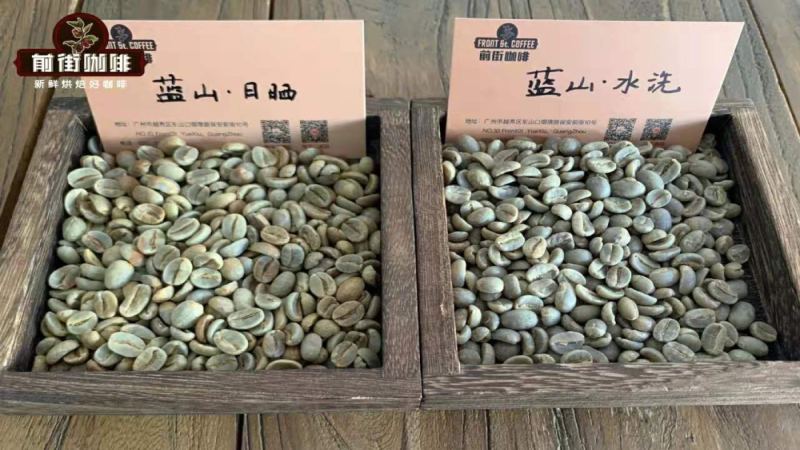
The Front Street Blue Mountain coffee beans purchased by Front Street in 2021 are the washed processing version. Washed Blue Mountain beans represent the traditional Blue Mountain flavor, and the quality is very well guaranteed.
How should Blue Mountain coffee be brewed to taste good?
Front Street Brewing Suggestions The brewing parameters used by Front Street are: Kono dripper, 88°C water temperature, 1:15 coffee-to-water ratio, 15 grams of coffee grounds, grind size (70-75% passing rate on a standard No. 20 sieve).
Front Street takes into consideration that this Front Street Jamaican Blue Mountain bean uses a relatively dark roast level, and the darker the roast, the faster the coffee substances dissolve. To avoid over-extraction, Front Street chooses a lower water temperature for extraction, while using the slower-flow Kono dripper to ensure that as much coffee material as possible is extracted under low-temperature conditions.
Front Street recommends using freshly roasted coffee beans for brewing, as this allows you to experience the coffee's rich flavors to the greatest extent. The coffee beans shipped by FrontStreet Coffee are all within 5 days of roasting, because Front Street deeply understands that freshness has an enormous impact on flavor. Front Street's roasting philosophy is "freshly roasted good coffee," so that every customer who places an order receives the freshest coffee when it arrives. The bean resting period for coffee is about 4-7 days, so by the time customers receive it, it is at its optimal flavor.
Front Street uses staged extraction, namely the three-stage pouring method: use 30 grams of water for blooming, with a blooming time of 30 seconds; for the first stage, pour in a small stream in a circular motion until 125 grams, then stop; when the liquid level drops to the point where the coffee bed is about to be exposed, continue with the second stage, pouring until 225 grams to end extraction. The total extraction time (including blooming) is 2 minutes 00 seconds.
It expresses the Front Street Jamaican Blue Mountain flavor as clear yet full-bodied, with balanced acidity, sweetness, and bitterness, very pleasant.
For professional coffee knowledge exchange and more coffee bean information, please follow Coffee Workshop (WeChat public account: cafe_style)
For more specialty coffee beans, please add the private WeChat of FrontStreet Coffee. WeChat ID: kaixinguoguo0925
The above content is compiled by CoffeeHunters, a coffee news website.


