








What makes Yirgacheffe coffee a specialty benchmark?
Yirgacheffe is a town and producing area in Ethiopia known for bright citrus acidity and jasmine aroma. At the end of 2020, Luckin Coffee launched its Little Black Cup SOE Yirgacheffe at 20 to 34 yuan, which pushed a single-origin Ethiopian bean into mainstream attention. The region was once a sub-area of Sidamo before becoming a recognized name on its own.
Ethiopian coffee farming is dominated by smallholders, who work about 90 percent of the planted area and number roughly 1.2 million households. Most production follows the garden coffee model, with nearby cooperatives and washing stations handling the cherries. That structure shapes the flavor and pricing of what is soe in coffee terms a single-origin espresso, compared here against the Starbucks offer.
Yirgacheffe, as a synonym for Ethiopian specialty coffee, is world-famous for its bright citrus acidity and jasmine aroma. At the end of 2020, Luckin launched the Little Black Cup SOE Yirgacheffe, priced at 20 to 34 yuan, bringing this single-origin bean into the public eye. This article will begin with Yirgacheffe's origin as a producing region, the reasons behind its flavor, and the evolution of its processing methods, tracing how it became independent from a sub-region of Sidamo to become a global specialty coffee benchmark. It will also introduce three representative products roasted in-house by Front Street Coffee: the Gutingding Cooperative, Sun-Dried Red Cherry, and a daily drinking bean, along with cupping flavor descriptions and pour-over parameter suggestions, to help coffee lovers gain a comprehensive understanding of this African bean's unique charm.

At the end of 2020, Luckin Coffee launched a product called "Little Black Cup · SOE Yirgacheffe" in many cities across China, with a price range of 20 to 34 yuan. The affordable price, combined with the use of single-origin coffee beans, led many coffee lovers to start paying attention to this bean. Today Front Street Coffee will talk about just what kind of background this Yirgacheffe coffee has.
Yirgacheffe can be called a calling card of Ethiopian specialty coffee
Africa is the birthplace of coffee beans and occupies an irreplaceable position in the global coffee landscape. Coffee produced on this land often has exuberant aromas and alluring fruity acidity, and the most representative origins are Ethiopia and Kenya.
Coffee cultivation in Ethiopia is mainly concentrated in the western and southern regions, with smallholder farming accounting for 90% of the total planted area, and about 1.2 million farming households depending on coffee cultivation for their livelihood. The most common local production model is garden coffee. Because each household's output is not large, cooperatives and processing plants of varying scales have been set up nearby, specifically responsible for processing green beans in that area. Farmers send the coffee cherries they harvest to a processing plant near a water source for centralized processing, and the coffee is then sold externally under the processing plant's name.
The name Yirgacheffe comes from the small town of "YIRGACHEFFE," which is located at an altitude of 1,700 to 2,100 meters. It is often shrouded in fog during the day, and the climate is mild throughout the four seasons. Coffee farmers habitually plant coffee trees together with other crops in their own yards or front-field plots. Strictly speaking, Yirgacheffe was originally a sub-region under Ethiopia's Sidamo Province, located to the northwest of Sidamo. Later, because the coffee produced here had a distinctive flavor and became world-renowned, it was separated from Sidamo and became an independent producing region.
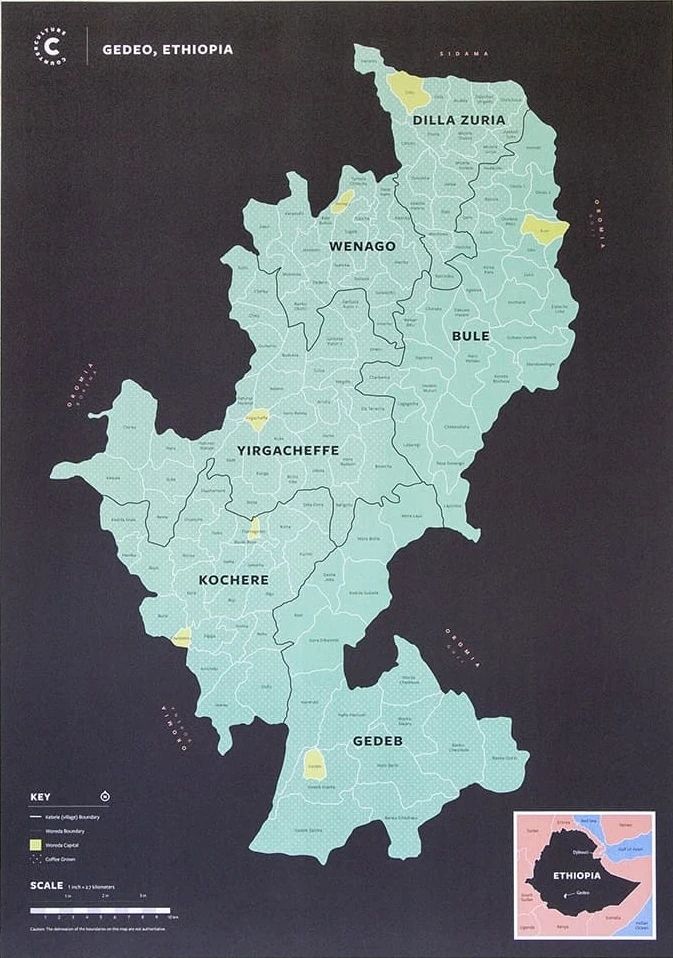
To promote the development of the coffee industry, the Ethiopian government registered the flavors of three of the country's coffee regions (including Yirgacheffe®) as commercial trademarks in 2004, and established the Ethiopia Commodity Exchange (ECX) in 2008, with coffee becoming one of the items auctioned on the exchange. The government implemented quality grading and flavor classification for exported coffee, allowing buyers to purchase coffee with trademarked flavor certification. Producing areas with Yirgacheffe flavor include Yirgacheffe, Wenago, Gelena Abaya, and Kochere.
As one of the representatives of the world's specialty coffee, Yirgacheffe has a unique citrus and lemon fruity aroma, mixed with the fragrance of jasmine. Its floral and fruity aromas are fresh and bright, its acidity is layered, and its mouthfeel is clean without off-flavors. This rich yet balanced taste experience is precisely the charm of Yirgacheffe. It is hailed as a model of African specialty coffee and is renowned in global coffee appreciation circles.
How did Yirgacheffe flavor spread to the world?
The so-called Yirgacheffe flavor refers to elegant citrus, lemon, and berry aromas along with intense floral notes, plus a hint of clear tea-like character. Once you taste it, it is hard to forget. To present such delicate flavor and mouthfeel, a high-quality growing environment, variety, processing method, roasting, and brewing are all indispensable.
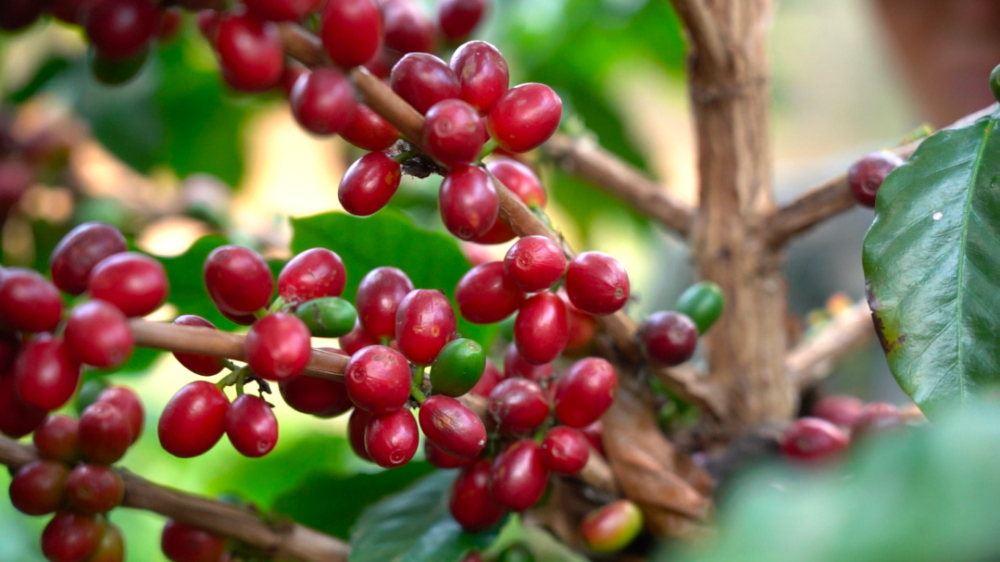
Ethiopia is located on the African continent, where water resources are not abundant, so for a long time it used the ancient natural drying method to process green beans, that is, directly drying the fruit in the sun. Because the operation was relatively rough, overall coffee quality tended to be low. It was not until 1972, in order to improve coffee bean quality, that Ethiopia introduced washed processing technology and equipment from Central and South America. Unlike other producing regions, Yirgacheffe is a wetland area and is more suitable for washed processing. This change amplified the citrus and lemon aroma of the Yirgacheffe coffee beans themselves, and the mouthfeel also became fresher and brighter.
The washed process goes like this: after the coffee cherries are picked, they are placed in water, and the buoyancy is used to remove underripe fruit. Then a pulper removes the skin and pulp. They rest in a fermentation tank for 18 to 36 hours until the mucilage layer has broken down. After fermentation ends, the parchment beans are scrubbed in channels. Through specially designed channels and the washing force of water, beans with low density and poor quality are separated out. Finally, the coffee beans are drained of water and spread on African-style raised beds to dry. Multiple steps remove defective beans layer by layer, greatly reducing the coffee's defect rate, improving cleanliness, and making the aroma clearer and more transparent.
Most of the coffee we drank in the past was mainly characterized by burnt bitterness. The reason coffee was strong and bitter was mainly that roasters roasted the beans very dark, pushing the flavor toward nuts and dark chocolate. With the rise of the specialty coffee concept, in order to retain more acidity, roasters roast Yirgacheffe only to an appropriate light level. Lightly roasted Yirgacheffe shows pleasant fruity sweetness and acidity and white floral notes, and it can be said to have opened a "new era of fruity-acid coffee." A preference for sweetness and a fear of bitterness also happen to be the general public's taste preference, which is exactly why Yirgacheffe is so popular around the world.
In recent years, various high-quality single-origin coffee beans have gradually been included on shops' regular menus. For example, Front Street's bean list includes a large blackboard, and each bean displays its own distinctive flavor characteristics. In addition to pour-over, baristas have also begun researching how to use distinctive single-origin beans in espresso extraction, which is how SOE became popular. On January 5, 2021, Luckin Coffee signed an agreement planning to purchase 1,000 to 2,000 tons of specialty coffee beans each year from Ethiopia's Yirgacheffe region from 2021 to 2023, and to launch SOE Little Black Cups in multiple cities. The coffee beans used in the "Little Black Cup" come precisely from Ethiopia's Yirgacheffe, which shows that distinctive single-origin coffee is gradually becoming a trend that everyone is chasing.
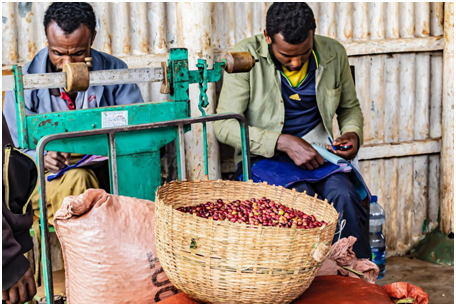
What does the Yirgacheffe roasted in-house by Front Street taste like?
Front Street has always favored coffee with floral and fruity flavors, and its bean list includes several Yirgacheffe coffees. Among them, the three most representative are the washed Gutingding Cooperative, the sun-dried Red Cherry, and the washed Yirgacheffe daily drinking bean, which serves as a flagship for Ethiopian coffee.
Among the guests who come to Front Street for coffee, if they want a washed coffee with fruity notes, the baristas at Front Street Coffee will first recommend the Gutingding Cooperative on the bean shelf; if they prefer a fuller, rounder fruity sweetness, Front Street believes the sun-dried Red Cherry is more suitable. The Gutingding Cooperative has 300 smallholder partners and is known for growing Ethiopia's highest-quality coffee. Its processing method follows the most traditional washing technique and has been praised by many as "the last pure land of Yirgacheffe." Sun-dried Red Cherry coffee beans are picked from 100% ripe coffee cherries and made by sun drying. The whole fruit is retained, and more sugars from the pulp and mucilage penetrate into the bean, so the flavor has a richer sweetness and a fermented quality.
Front Street believes that Yirgacheffe, with fruity acidity as its main flavor representation, is more suitable for light roasting in order to retain more acidic aroma.
Yirgacheffe cupping flavors :
The dry aroma of the washed Gutingding Cooperative coffee gives off fresh passion fruit, citrus, and berry acidity. The wet aroma is citrus and berries. On the palate there is citrus acidity and berry sweetness, accompanied by almond and tea-like notes, with a honey-like sweetness in the finish. The body is low, the acidity is bright, and it is clean and refreshing.
The dry aroma of the sun-dried Red Cherry coffee presents full berry-like sweet acidity. When sipped at different temperatures, you can feel soft berry sweetness and acidity, the fermented quality of ripe fruit, obvious honey sweetness, and a black tea finish, with a smooth mouthfeel.
In addition, the Yirgacheffe daily drinking bean launched by Front Street uses washed processing and medium-light roasting. It has the classic Yirgacheffe flavor profile and is suitable for pour-over, cold brew, French press, and many other brewing methods. Front Street's daily drinking bean series allows friends who are just getting into coffee to taste the region's basic flavors at an affordable price, and the small-pack design also helps avoid waste if it cannot all be finished. If you want to taste the classic aroma of Yirgacheffe, Front Street believes pour-over black coffee is the most suitable.
Front Street brewing suggestions
Some customers come to ask for brewing advice after purchasing Front Street coffee beans. In fact, the label on every bag of Front Street coffee beans has brewing parameters printed on it for reference. Here Front Street will discuss the extraction approach for Yirgacheffe based on the shop's production standard.
Yirgacheffe is lightly roasted, and the coffee beans are relatively hard, requiring hot water at 92°C to 93°C to stimulate the floral and fruity notes in the coffee. As for grind size, Front Street recommends a medium-fine grind (78% passing through a Chinese standard No. 20 sieve). If it is too coarse, the rich substances cannot be extracted, and the brewed coffee will seem thin. If it is too fine, over-extraction is likely at high water temperature, and the brewed coffee is prone to bitterness.
During cupping, Front Street noticed that this bean shows different flavors at different temperatures, so the brewing method uses three-stage extraction, allowing different flavor substances to show their better states as the coffee bed rises in temperature in stages. To highlight the fresh and alluring aroma of washed Yirgacheffe, Front Street uses a V60 dripper for brewing. The dripper's spiral rib design allows the coffee grounds to degas better, maximizing the volatilization and dissolution of acidic aromatic substances.
Dripper: V60 Water temperature: 92-93°C Dose: 15g Coffee-to-water ratio: 1:15 Grind size: fine granulated sugar size (78% through a No. 20 sieve)
Three-stage pouring: first wet the coffee bed with twice the weight of the coffee grounds in water and let it bloom for 30 seconds to form a dome. Then, using a thin stream, pour in circles from the inside out until 125g, then pause. When the coffee bed has dropped to halfway down the dripper, continue pouring the third stage with the same thin stream until 225g, and let all the coffee liquid filter through before removing the dripper. The time is about 2 minutes.
For professional coffee knowledge exchange and more coffee bean information, please follow Coffee Workshop (WeChat public account cafe_style)
For more specialty coffee beans, please add the private WeChat of Front Street Coffee (FrontStreet Coffee), WeChat ID: qjcoffeex
The above content is compiled by CoffeeHunters, a coffee news website.


