







What Makes Cerrado Bourbon Coffee Beans Distinct?
Cerrado, in northwestern Minas Gerais, is a leading Brazilian specialty coffee region whose Bourbon varieties are known for nutty sweetness, low acidity, and a soft body. Beans are graded Strictly Soft, Soft, Softish, Hardish, and Rioy, and a good Brazilian cup shows mild nutty sweetness, low acidity, and good viscosity. The pulped natural method supports that profile.
Cerrado averages about 5 million bags a year, roughly a quarter of Minas Gerais output and 12.7% of national production, and it was the first Brazilian region to gain protected designation of origin status in specialty coffee. Both Red Bourbon and yellow bourbon appear here; medium-dark roasting brings out the chocolate mellowness and sugarcane sweetness typical of the region.
The Cerrado region is a representative producing area of Brazilian specialty coffee, and its Bourbon variety coffee beans are renowned for their nutty sweetness, low acidity, and soft body. This article will guide you through the terroir conditions of the Cerrado region, the processing details of the pulped natural method, and the flavor tendencies of the Red Bourbon and Yellow Bourbon varieties. Meanwhile, Front Street Coffee's Brazil daily beans and Queen's Farm coffee beans use Red Bourbon and Yellow Bourbon respectively, presenting the classic Brazilian flavors of chocolate mellowness and sugarcane sweetness through medium-dark roasting. The article also includes pour-over parameters for reference.
Looking at specialty coffees on the market, Front Street Brazil coffee does not win by outstanding individuality, nor does it have any regrettable shortcomings—its taste is mild and steady, with low acidity, a medium body, and flavor notes of chocolate and nuts. It is precisely this balanced character, combined with a reasonable price, that makes Brazilian beans widely used in espresso blend formulas. Front Street currently has three self-roasted espresso blend coffees on its bean list, all of which use Brazilian beans in their formulas.
Brazilians are good at bringing out the gentle and smooth strengths of Front Street Brazil coffee beans. They classify green coffee beans into five grades to express the aesthetic concept of soft beans: Strictly Soft, Soft, Softish, Hardish, and Rioy. An excellent Brazilian coffee should have a nutty slight sweetness, low acidity, and good viscosity and smooth mouthfeel. The beans produced in the Cerrado region are famous precisely for this flavor characteristic. Most coffee from this region is sold to European and American markets, so it can be said that Cerrado coffee is a calling card of Brazilian specialty coffee.
Brazil Cerrado Region
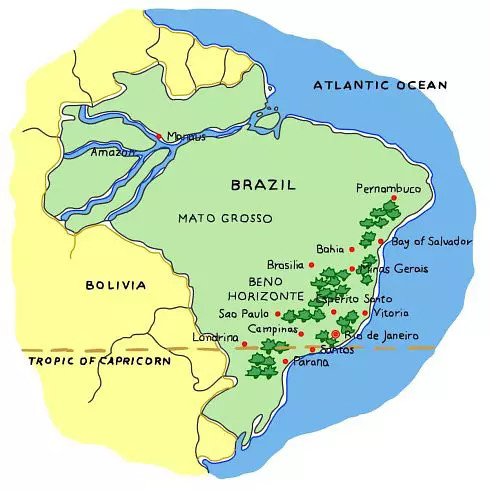
The Cerrado region is located in the northwest of Minas Gerais, one of Brazil's seven major producing regions. Its average annual output is about 5 million bags of coffee beans, accounting for one quarter of the state's total output and 12.7% of the national output. It is the first region in Brazil to obtain protected designation of origin status in the specialty coffee field, represents Minas Gerais in competitions every year, and has repeatedly achieved excellent results in the Brazil Cup of Excellence (COE).
Most coffee-producing regions in Brazil pursue a strategy of winning by volume, but the Cerrado region enjoys exceptional soil and climatic conditions. The average annual temperature here is about 21°C, and the soil is fertile and rich in minerals, providing sufficient nutrients for coffee beans. In addition, the region has a clear distinction between dry and wet seasons, and coffee cherries usually mature intensively between May and September, which also makes Cerrado coffee stand out among the many Brazilian coffee beans.
Pulped Natural Method
The excellent flavor of Cerrado coffee can be fully displayed thanks to the pulped natural method, also called Pulped Natural. Brazil is located in the tropics, and the harvest season happens to coincide with the dry season, so coffee fruits are very suitable for direct sun drying to remove moisture. However, the traditional natural method is rough: after picking, the fruits are spread directly on mud ground to sun-dry, and the resulting coffee easily picks up earthy notes. To improve quality, Brazil developed and promoted this pulped natural processing method between natural and washed in 1990.
The specific process is as follows: after picking, leaves, stones, and other debris are first removed from the fruits, then they are poured into a water tank to remove underripe cherries by flotation. Next, the skin, pulp, and part of the mucilage layer are removed by machine, followed by washing for one hour. Because the soaking fermentation time is very short, the pectin cannot be completely washed off. Then the parchment beans with some pectin remaining are spread on the drying patio to dry. The pulped natural method saves water and also reduces a lot of labor costs. Compared with traditional natural drying, it takes less time, so it is widely adopted in Brazil.
Front Street Brazil Cerrado daily beans use exactly the pulped natural process, and multiple screening steps greatly improve the cleanliness of the coffee beans. Another Front Street bean—Front Street Brazil Queen's Farm coffee beans—uses fine small-batch natural processing. During large-volume production, if the beans are not turned in time, over-fermentation easily occurs and produces undesirable fermented flavors; Queen's Farm, however, uses small-batch African raised beds throughout the entire drying process, thereby avoiding earthy and fermented flavors, and its sweetness is even better than that of traditional pulped natural.
Bourbon Variety
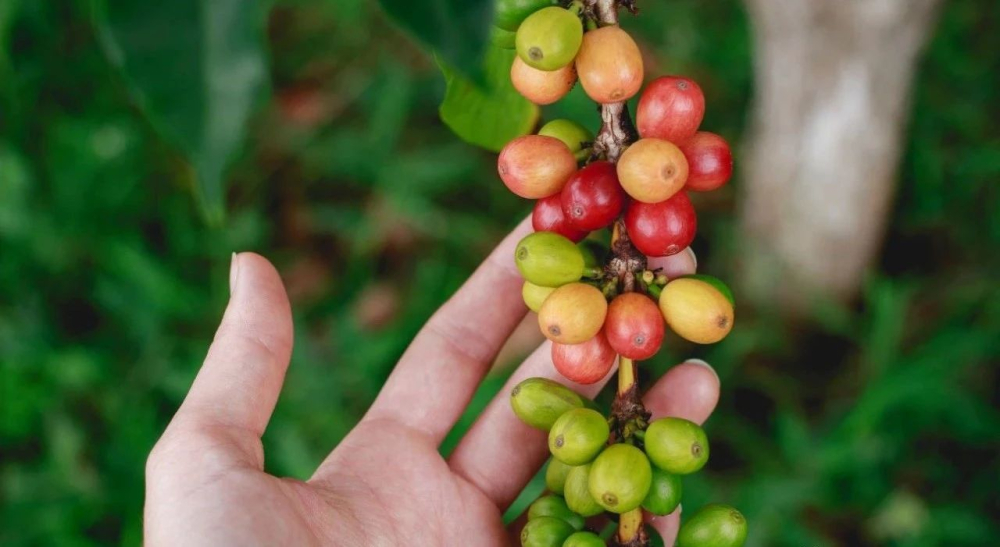
Bourbon is derived from the ancient Typica variety, with round bean shape. It was introduced to Brazil in 1927 and later gradually spread to countries in Central and South America. Although its yield is not high, compared with the weaker Typica, Bourbon has stronger resistance to leaf rust. Bourbon coffee grown at high altitudes has a rich and delicate flavor, intense aroma, and soft, rounded acidity. The Bourbon fruit we commonly see changes color from green to slightly yellow, orange-yellow, red, and finally fully ripe dark red. This is the so-called Red Bourbon.
Brazil also has another Bourbon variety whose ripe fruit is orange-yellow—Yellow Bourbon, a Bourbon mutation unique to São Paulo state. Yellow Bourbon grown at high altitudes contains a large amount of fructose and can present a sweet and juicy flavor. It once almost swept the top three places in Brazil's Cup of Excellence competition for two consecutive years, becoming popular in the specialty coffee world. Front Street Brazil Queen's Farm coffee uses the delicately flavored Yellow Bourbon variety, while the everyday Front Street Brazil daily beans use the common Red Bourbon variety.
Flavor of Bourbon Coffee Beans
Front Street launched the Front Street daily bean series with the original intention of allowing friends who want to learn about specialty coffee to more quickly understand the flavors of classic producing regions. In order for everyone to taste the unique characteristics of the producing regions, Front Street selected several representative regions, covering multiple coffee varieties, and uses appropriate roast levels to present their regional flavors, such as the chocolate mellowness of Front Street Brazil Red Bourbon coffee, the jasmine aroma of Front Street Ethiopia washed Yirgacheffe, the herbal spice notes of Front Street Indonesia Mandheling, and the elegant, clean dark chocolate aroma of Front Street Colombia Huila coffee... In addition, Front Street hopes every customer has a better brewing experience and can taste the above characteristics, so it only ships coffee beans freshly roasted within 5 days, ensuring they are still in the best flavor period when received.
Bourbon coffee beans grown in high-altitude environments are denser and have high glucose content, so Front Street's roasting approach is to highlight the classic mellow aroma of Brazilian coffee while also showing Bourbon's own sweetness. After many experiments and cupping comparisons, the two Front Street Brazil coffees on Front Street's bean list both use medium-dark roasting. Next, Front Street will brew these two coffees. If you want to understand the taste of Brazilian coffee, you can refer to Front Street's pour-over approach.
Medium roasting changes the internal structure of the beans to a relatively large extent, making them loose, and after grinding into coffee grounds they absorb water more strongly. If the brewing parameters are not adjusted well, the coffee easily becomes over-extracted and bitter. To give the coffee enough aroma without over-extraction, it is necessary to reduce the extraction rate. Front Street's method is to use a relatively low water temperature and a relatively coarse grind to reduce the release of bitter large molecules in the coffee, and to combine this with a KONO dripper for extraction, making the coffee's body and roundness better.
Pour-over parameters: 87–88°C water temperature, medium grind (70% passing rate with China standard No. 20 sieve), 15 grams of coffee grounds, coffee-to-water ratio 1:15, three-stage pouring.
First, wet the coffee bed with twice the amount of water as the coffee grounds, forming a dome and letting it bloom for 30 seconds. Then pour in a small stream in circles from the inside out until 125 grams, pause, wait for the coffee bed to drop to half the height of the dripper, continue pouring the third stage with the same fine stream until 225 grams, and wait until all the coffee liquid has filtered through. Remove the dripper; the time is about 2 minutes. Finally, swirl the coffee liquid in the server to even it out and enjoy.
The pour-over Front Street Brazil Cerrado daily beans have an overall clean mouthfeel, full nutty and caramel aromas, a sweet chocolate finish, and balanced flavors.
The pour-over Front Street Brazil Queen's Farm Yellow Bourbon coffee presents aromas of dark chocolate, cream, and nuts. On the palate it is as refreshingly sweet as sugarcane, with a transparent flavor and a long-lasting finish in the mouth.
For professional coffee knowledge exchange and more coffee bean information, please follow Coffee Workshop (WeChat public account cafe_style).
For more specialty coffee beans, please add the private WeChat of Front Street Coffee (FrontStreet Coffee), WeChat ID: qjcoffeex
The above content is compiled by CoffeeHunters, a coffee news website.


