







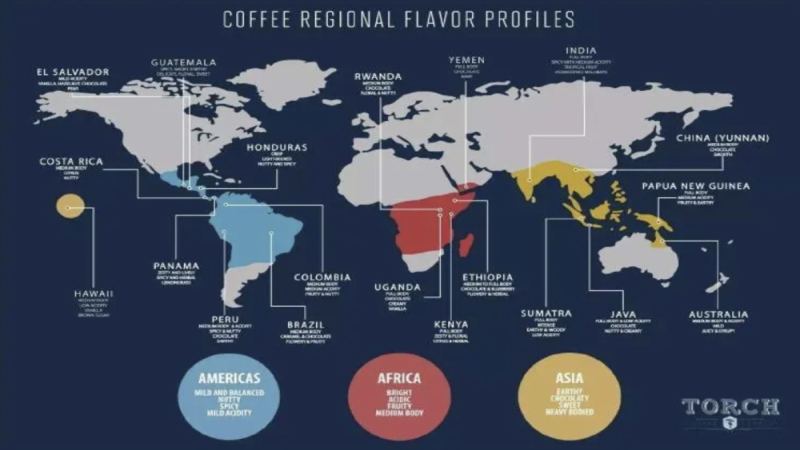
What Defines the Coffee Belt and Its Growing Regions?
The Coffee Belt is the narrow band between the Tropic of Cancer and the Tropic of Capricorn where almost all coffee is grown. Average annual temperatures stay above 20°C, winters are frost-free, and sunshine and rainfall are plentiful. It spans Africa, Central and South America, and Asia, giving coffee trees the warm, stable conditions they need.
Even the same variety tastes different from one country to the next. Altitude, climate and soil composition work together to give beans a regional imprint, so a variety planted in Panama and neighboring Costa Rica can cup quite differently. Repeated cupping sessions confirm that these growing conditions for coffee, rather than variety alone, drive the flavor differences between continents.
The growth of coffee trees has strict requirements for the natural environment. The world's main coffee-producing regions are concentrated in a narrow band between the Tropic of Cancer and the Tropic of Capricorn, known in the industry as the Coffee Belt. This region spans Africa, Central and South America, and Asia, with an average annual temperature above 20°C, warm throughout the year, frost-free in winter, abundant sunshine, and ample rainfall, providing ideal growing conditions for coffee trees. Even the same variety of coffee, when planted in different countries or regions, will present completely different flavors in the cup—differences in altitude, climate, and soil give each bean its own unique regional imprint. Front Street Coffee has repeatedly verified this pattern in daily cupping sessions. This article will start from the characteristics of the three continents' producing regions and outline their respective flavor trends and representative coffee beans.
For professional coffee knowledge exchange and more coffee bean information, please follow Coffee Workshop (WeChat public account: cafe_style)
For more specialty coffee beans, please add the private WeChat of Front Street Coffee (FrontStreet Coffee), WeChat ID: qjcoffeex
The cultivation regions of coffee trees are mainly concentrated in three major continental blocks: Africa, Central and South America, and Asia. They are all located between the Tropic of Cancer and the Tropic of Capricorn, an area collectively known as the Coffee Belt. The average annual temperature within the Coffee Belt stays above 20℃, with mild weather in all four seasons, no frost in winter, and abundant sunshine and rainfall, creating an ideal environment for coffee tree growth.
Even though it is the same cup of coffee, differences in taste between different producing regions can be clearly felt in daily drinking. Even for the same variety, if planted separately in Panama and its neighboring Costa Rica, the final flavors presented will each have their own characteristics.
The reason coffee flavors differ by region is that the variety itself is certainly one factor, but local altitude, climate conditions, and soil composition also play a part. These variables work together to give coffee a distinct and unique regional identity—sometimes just one sip is enough to roughly tell which producing region the beans come from.
Front Street Coffee (FrontStreet Coffee) has observed in routine cupping that coffee beans from African producing regions often show more prominent acidity. After reviewing relevant materials, it was found that this characteristic comes partly from the fact that the varieties grown in Africa are themselves richer in acidic compounds, and partly from the higher phosphoric acid content in the local soil, so the coffee beans' acidity is more abundant. Representative coffee beans include:
Front Street Coffee (FrontStreet Coffee) - Ethiopia Yirgacheffe Gotiti Cooperative Coffee Beans
Producing Region: Ethiopia Yirgacheffe
Cooperative: Gotiti Cooperative
Growing Altitude: 2000-2100m
Processing Method: Washed
Variety: Ethiopian Heirloom
Roast Level: Medium-Light
Flavor: Bright citrus-like acidity, berry sweetness and acidity, honey-like sweetness, green tea aftertaste.
Front Street Coffee (FrontStreet Coffee) - Kenya 72-Hour Washed AA Coffee Beans
Producing Region: Kenya Thika
Processing Station: Asali
Growing Altitude: 1550-1750m
Processing Method: 72-Hour Washed
Variety: SL28, SL34
Roast Level: Medium-Light
Flavor: Cherry tomato aroma, plum, dark plum-like acidity, brown sugar-like sweetness.
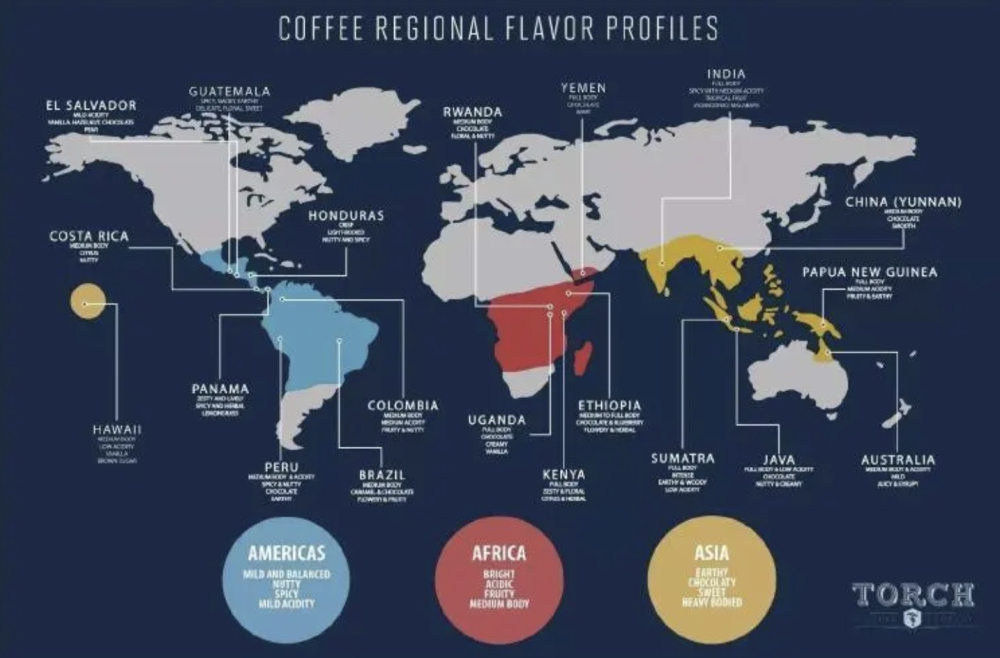
By comparison, coffee beans from Central and South American producing regions usually have richer flavor layers, and their acidity appears much softer. This is mainly due to the higher growing altitudes and the region's changeable climate conditions—when the temperature difference between day and night is widened, the growth rate of coffee cherries slows down, allowing flavor compounds to accumulate and take shape over a longer period. As a result, the finished coffee has clearer layers and a more varied mouthfeel. Representative coffee beans include:
Front Street Coffee (FrontStreet Coffee) - Panama Hacienda La Esmeralda Red Label Coffee Beans
Producing Region: Boquete, Panama
Estate: Hacienda La Esmeralda, Jaramillo Mario Plot
Growing Altitude: 1700m
Processing Method: Natural
Variety: Geisha
Roast Level: Medium
Flavor: Complex fruit juice texture, bright citrus-like acidity, rose fragrance, honey-like sweetness, black tea aftertaste.
Front Street Coffee (FrontStreet Coffee) - Costa Rica Strawberry Candy Coffee Beans
Producing Region: Tarrazu, Costa Rica
Estate: Mirazu Estate
Growing Altitude: 1700m
Processing Method: Raisin Honey
Variety: Geisha SL28 ET47 Maico
Roast Level: Medium-Light
Flavor: Strawberry hard candy aroma, dried grape fermentation aroma, strawberry sweetness and acidity, rose fragrance.
Coffee beans from Asian producing regions present another style—mellow and steady, with higher body and lower acidity. Compared with Africa and Central and South America, coffee in Asia is generally grown at lower altitudes, with a warm climate and a smaller temperature difference between day and night, so coffee cherries grow and ripen at a faster pace. Representative coffee beans include:
Front Street Coffee (FrontStreet Coffee) - Yunnan Arabica Coffee Beans
Producing Region: Baoshan, Yunnan
Growing Altitude: 1450-1550m
Processing Method: Full Red Cherry Natural
Variety: Catimor
Roast Level: Medium-Dark
Flavor: Red berry sweetness and acidity, rich dark chocolate, roasted nut-like aroma, caramel-like sweetness.
Front Street PWN Golden Mandheling Coffee Beans
Producing Region: Aceh Province, Sumatra, Indonesia
Company: PWN Company
Growing Altitude: 1100-1600m
Grade: G1 Triple Hand-Sorted
Processing Method: Wet-Hulled
Variety: Ateng
Roast Level: Medium-Dark
Flavor: Herbal, spice-like rich aroma, dark chocolate, caramel, nuts.
The above content is compiled by CoffeeHunters, a coffee news website.


