







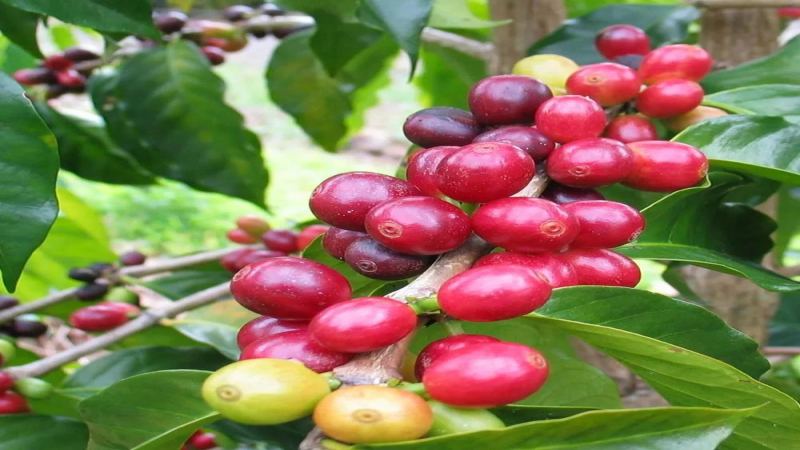
How Do Esmeralda Geisha Coffee Bean Grades Differ?
Panama's Hacienda La Esmeralda sells Geisha coffee beans in three grades: Red Label, Green Label and Blue Label. They differ in growing altitude, processing method and flavor profile, not simply in price. Choosing between them comes down to whether a drinker wants the most floral and delicate cup or a more rounded, everyday representation of the variety.
Geisha became famous only after being transplanted from Ethiopia to Hacienda La Esmeralda in Panama, a shift tied to the farm's climate and growing conditions. The estate was bought in 1964 by American banker Rudolph Peterson, who initially ran it as a dairy farm before the family turned to coffee. Brewing suggestions for each label help match the grade to taste.
Geisha coffee has been highly sought after in the global specialty coffee scene in recent years, and the Geisha produced by Panama's Hacienda La Esmeralda is the benchmark among them. Faced with the different grades of Esmeralda Geisha on the market—Red Label, Green Label, Blue Label—many coffee lovers often feel confused: What exactly are the differences between them? Which one suits them better? This article will start from the history of Hacienda La Esmeralda, sort out in detail the grading criteria, growing altitudes, processing methods, and flavor characteristics of the three major grades—Red Label, Green Label, and Blue Label—and include Front Street Coffee's brewing suggestions and flavor descriptions for each grade, helping you find the Geisha that suits you best.
In recent years, the popularity of the Geisha variety in the specialty coffee world has continued to rise, and coffee lovers around the world have become fascinated by it. The Geisha produced by Panama's Hacienda La Esmeralda is especially a focal point. Front Street Coffee's stores also often receive customers who come specifically to taste Geisha, but many people struggle when choosing Esmeralda Geisha coffee beans: How exactly should they choose between Red Label, Green Label, and Blue Label? Which one has the best flavor? Which one is more suited to their own taste?
Next, Front Street will sort out one by one the differences between Hacienda La Esmeralda's Red Label, Green Label, and Blue Label.
Geisha coffee became famous precisely because of Panama's Hacienda La Esmeralda. After that, estates around the world began researching and planting this variety, and Geisha can now also be found in Yunnan, China. So what exactly makes Hacienda La Esmeralda unique? Why was Geisha unknown in its place of origin in Ethiopia, yet became famous overnight after being transplanted to Hacienda La Esmeralda? Front Street has also mentioned before that coffee is essentially a crop, and its quality is inevitably closely related to its growing environment, and Panama's climatic conditions are precisely what created this legendary coffee.
Panama's Hacienda La Esmeralda
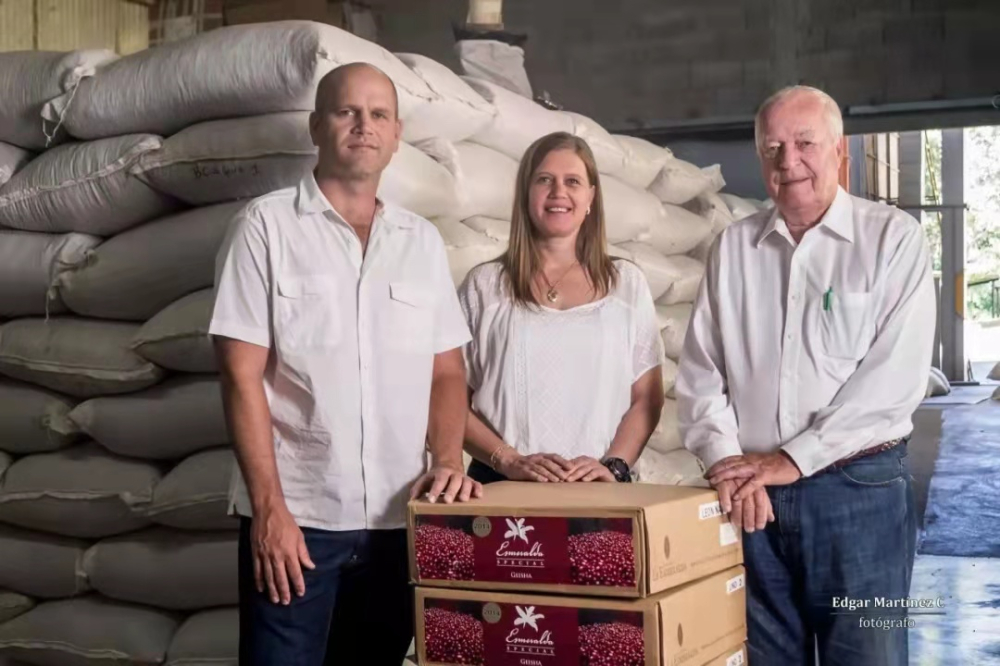
How did Hacienda La Esmeralda discover Geisha? This traces back to 1964. That year, American banker Rudolph Peterson retired and moved to Panama, purchasing Hacienda La Esmeralda in Boquete, initially focusing on dairy farming. Later, his son Price gave up his career as a doctor to help his father run the farm, and in 1987 introduced two coffee varieties, Caturra and Catuai. In 1994, a wet processing plant was built, and from then on the estate had its own coffee processing capability. In 1996, the Petersons bought the neighboring Jaramillo estate, which had superior geographical conditions and outstanding flavor in its existing coffee varieties, and it was subsequently incorporated into Hacienda La Esmeralda.
According to relevant information reviewed by Front Street Coffee, the reason the Jaramillo estate was favored by the Petersons was that the coffee beans originally grown there had a pleasant orange aroma and floral-fruity fragrance, completely different from the usual flavor of Panamanian coffee. After cupping different areas of the farm, they found that the standout performers were a group of coffee trees of unknown variety growing at the estate's highest point. Because of their extremely low yield, the previous owner had used them only as windbreak trees—and these trees were precisely the Geisha coffee trees now widely known.
Later, this Geisha coffee bean discovered by Peterson won first place in the 2004 Panama Best of Panama (BOP) green bean competition, and afterward went from strength to strength. Expert identification eventually confirmed that it belonged to the Ethiopian Geisha variety. After that, the Peterson family invested a great deal of effort into infrastructure construction to support fine batch separation and processing, which formed the Red Label, Green Label, and Blue Label system that Front Street refers to.
Hacienda La Esmeralda Red Label, Green Label, Blue Label grading standards
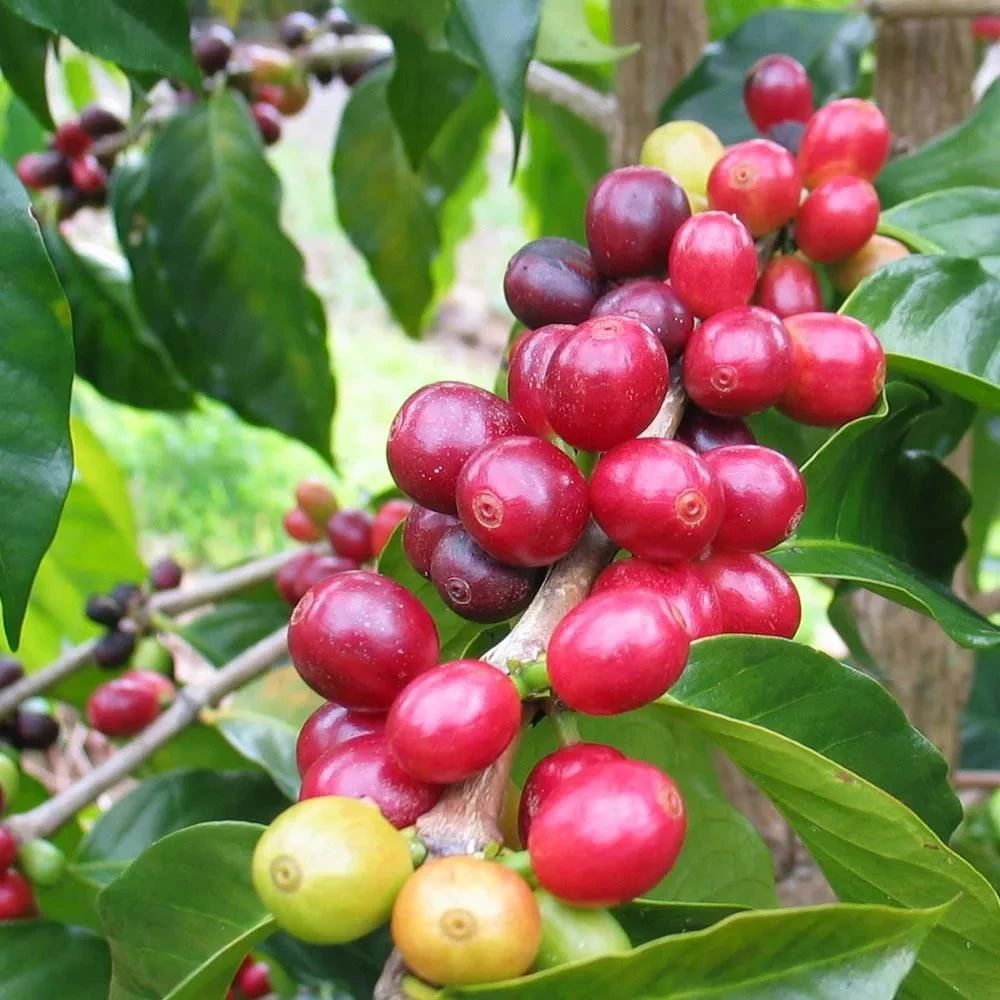
There are many ways to grade coffee beans, such as by bean size, cupping score, defect rate, altitude, and other standards. So what does Hacienda La Esmeralda base its Geisha coffee bean grading on? Front Street has learned that Hacienda La Esmeralda mainly uses growing altitude as the basis, supplemented by actual cupping results, to divide Geisha beans into the three grades of Red, Green, and Blue.
Hacienda La Esmeralda's marketing strategy differs from that of other estates. Based on cupping performance, planted varieties, and growing plots, it divides its products into five major brands. Among them, the Geisha variety occupies three: Esmeralda Special, Private Collection, and Geisha1500; the Catuai variety has two: Diamond Mountain grows and Palmyra.
Hacienda La Esmeralda Red Label Geisha
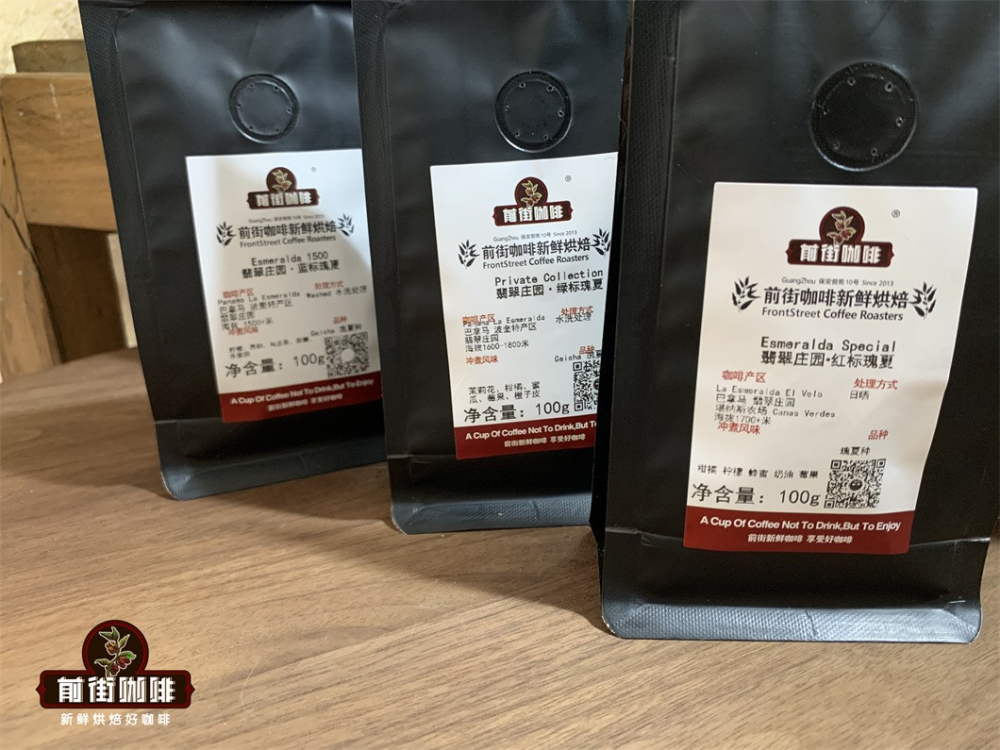
In Front Street's view, Red Label has the highest price, but does that necessarily mean it tastes the best? And why is it priced the highest? Let's understand together. The official name of Red Label Geisha is "Esmeralda Special." From the name alone, one can see the exquisite positioning of this Geisha series. This series is the highest-quality Geisha coffee beans sold by Hacienda La Esmeralda, specially selected and produced by the estate, grown at altitudes between 1,600 and 1,800 meters, with cupping scores above 90 points, and originating from the two production areas of Jaramillo and Cañas Verdess.
In addition, Red Label must also participate in the independent auction held by Hacienda La Esmeralda itself. Only Geisha batches from divided plots that are put up for bidding can be called auction Red Label. However, there are also non-auction Red Labels on the market, which in fact are Geisha selected from the same plots that did not participate in the auction and flowed into the market. The variety and quality are the same, and the difference is mainly reflected in the selling price, similar to the situation with authentic and fake Blue Mountain coffee.
Red Label batches also have an important characteristic: each batch has an independent number, and all coffee beans in the same batch come from the same micro-plot. For example, the Red Label that Front Street obtained in recent years came from the Mario plot. If buyers can trade directly with Hacienda La Esmeralda, they can also choose suitable plot batches according to personal preferences for subtle flavor differences.
Geisha of this grade uses natural or washed processing methods, and its flavor expression is a special and bright floral aroma with citrus notes.
Hacienda La Esmeralda Green Label Geisha
Next is Green Label, second only to Red Label in grade. Private Collection, commonly known as Green Label, belongs to batches that do not participate in independent competitions. Its growing areas do not participate in bidding, but the quality is still excellent. The growing altitude is also between 1,600 and 1,800 meters, and it comes from micro-batch coffee beans from different plots such as Jaramillo and Cañas Verdess.
Because it uses a blended-bean model, that is, no detailed plot labeling is made, the flavor similarity between Green Label and Red Label can sometimes be very high, but the next production may again show differences.
Front Street believes that although Green Label is lower in grade than Red Label, it still retains the classic flavors of Geisha—floral aroma, fruity aroma, citrus-like acidity, and a thick, juicy mouthfeel. Green Label Geisha also has washed or natural processed versions. Since the elevation mark is the same as Red Label and only the harvesting method is blended, Front Street Coffee considers it the most cost-effective choice from Hacienda La Esmeralda. Green Label Geisha usually uses the washed processing method.
Hacienda La Esmeralda Blue Label Geisha
The Geisha1500 brand is the commonly seen Blue Label Geisha. It is grown at altitudes between 1,400 and 1,500 meters and comes from a blend of beans from three different plots: Jaramillo, Cañas Verdess, and El Velo. Its flavor expression is light floral aroma, fruity acidity, and sweetness, with a relatively less thick mouthfeel. At present, Blue Label Geisha has two processing methods, washed and natural, among which the natural batch was introduced in small quantities only at the end of 2019.
Hacienda La Esmeralda's "entry-level" Blue Label Geisha coffee beans are officially named "Geisha 1500." Because its logo background is blue, it is called Blue Label by domestic coffee lovers. This bean blends Geisha coffee from Hacienda La Esmeralda's three sub-estates (Jaramillo, Cañas Verdess, and El Velo) at an altitude of about 1,500 meters. It is worth noting that in the 2021 crop year, Hacienda La Esmeralda's official website removed Blue Label from its product introduction, leaving only Red Label and Green Label under the Geisha category.
However, according to what Front Street Coffee has learned, Hacienda La Esmeralda's entire 2021 1,500-meter Geisha (formerly Blue Label) batch was sold to a green bean company, which launched a brand called "Las Rocas" (volcanic rock). Through the appearance of this batch of green beans and cupping, Front Street Coffee confirmed that it has the Geisha flavor of Hacienda La Esmeralda, and therefore named this batch of Geisha coffee beans Hacienda La Esmeralda Volcanic Rock New Blue Label Geisha coffee beans.
The differences between Red Label, Green Label, and Blue Label
Some people may ask, what is the biggest difference between these three labels? Front Street believes the core difference lies in altitude. Front Street has also mentioned many times that coffee beans grown at higher altitudes usually have better flavor, so the quality of Red Label and Green Label is superior to Blue Label. However, the difference between Green Label and Red Label is that Green Label is harvested as a blend, while Red Label lists specific plots and participates in auctions, so the price gap between the two is relatively large. But Front Street believes that the difference in flavor between Red Label and Green Label is not obvious, so Green Label is much more cost-effective. Therefore, Front Street suggests that friends who like Hacienda La Esmeralda Geisha coffee beans may first try Green Label Geisha.
In addition, Front Street has learned that Geisha coffee has a rather peculiar characteristic: when grown in extremely harsh environments, its flavor actually becomes even better. This also means that harvesting Geisha coffee is extremely difficult and yields are very low. Not all estates can grow delicious Geisha; sufficient conditions and equipment are needed to produce excellent-flavored Geisha coffee, which is also why Hacienda La Esmeralda Geisha coffee beans stand out uniquely.
Front Street Coffee brewing suggestions for Panama Hacienda La Esmeralda coffee beans:
Faced with such expensive Geisha coffee, how should it be brewed so as not to waste it and to better showcase all of Geisha coffee's flavors? The Geisha coffee beans sold by Front Street Coffee are all light roasted. Light-roasted Geisha has a very fresh overall flavor, with obvious floral aroma, fruity acidity, and a sweet aftertaste with a tea-like quality. In order to better bring out these fresh flavors, during brewing the beans can be ground to a fineness like fine granulated sugar, and 90°C spring water can be used for brewing.
Front Street's brewing parameters are: dripper: V60 #01, dose: 15g, coffee-to-water ratio: 1:15, brewing water temperature: 90°C, grind size: medium-fine grind (80% passing through a No. 20 standard sieve).
Hacienda La Esmeralda natural Red Label Geisha coffee bean flavor: rose, strawberry, citrus, black tea, honey.
Hacienda La Esmeralda washed Green Label Geisha coffee bean flavor: jasmine, ginger flower, citrus, Tieguanyin tea, honey.
Hacienda La Esmeralda washed Volcanic Rock New Blue Label Geisha coffee bean flavor: white floral aroma, citrus, green tea, honey.
Regarding coffee brewing, Front Street suggests using freshly roasted coffee beans, as only then can the rich flavors of coffee be experienced to the greatest extent. The coffee beans shipped by Front Street Coffee are all within 5 days of the roasting date, because Front Street deeply understands that freshness has a huge impact on flavor. Front Street's roasting philosophy is "freshly roasted good coffee," so that every customer who places an order can receive the freshest state when they get the coffee. The resting period of coffee is about 4 to 7 days, so when customers receive it, it is exactly at its best flavor.
Of course, some customers also need Front Street to help grind the coffee, and that is no problem either, but Front Street needs to remind them: once coffee beans are ground into powder in advance, they no longer need to be rested, because during transportation the pressure from carbon dioxide inside the package can also make the coffee flavor rounder, so once the coffee powder is received, a cup can be brewed immediately. However, coffee powder needs to be brewed as soon as possible, because after coffee powder contacts air it oxidizes quickly, the flavor is lost relatively quickly, and the mouthfeel becomes less good. Therefore, Front Street recommends buying whole beans and grinding fresh before brewing, so that the flavor of the coffee can be better tasted.
Which is better to drink: Red Label, Green Label, or Blue Label?
Some people may ask, is the most expensive coffee necessarily the best tasting? Actually, not necessarily. Front Street believes that everyone has different taste preferences, and perhaps the most expensive Red Label that everyone acknowledges may not necessarily suit you. Red Label is Geisha coffee beans from a uniform plot, and after brewing its overall performance is cleaner and fuller, and Geisha coffee beans from higher altitudes also have richer flavors. If you like a full mouthfeel, Red Label is definitely the first choice; if you do not prefer that style, then you can try the more cost-effective Green Label or Volcanic Rock (New Blue Label).
Of course, Front Street has not only obtained Hacienda La Esmeralda's Geisha coffee, but also Geisha coffee from other producing countries, such as Colombia's Hanami Geisha coffee and Costa Rica's Mirazu Geisha blend beans. These are all worth trying.
For professional coffee knowledge exchange and more coffee bean information, please follow Coffee Workshop (WeChat public account: cafe_style)
For more specialty coffee beans, please add the private WeChat of Front Street Coffee, WeChat ID: qjcoffeex
The above content is compiled by CoffeeHunters, a coffee news website.


