







Is Blue Mountain Coffee the Same as American Coffee?
No. Blue Mountain coffee is a single-origin bean, most often brewed by hand-pour drip, while american coffee in the Americano sense is espresso diluted with hot or cold water. Both are black coffee with no sugar or milk, but they come from different production systems and taste noticeably different in the cup.
The Americano story is usually tied to U.S. soldiers in Europe during World War II who diluted the strong local espresso with hot water. Blue Mountain coffee comes from Jamaica and is graded by bean size and quality, with Blue Mountain No. 1 being the largest grade; a pour-over with medium grind and moderate temperature brings out its mild, balanced flavor.
Many people are used to calling black coffee without sugar or milk "Americano," but Blue Mountain coffee and Americano actually belong to two completely different systems. The former is a single-origin coffee bean, mainly brewed by hand-pour drip; the latter belongs to espresso coffee, made by diluting espresso with water. This article will clarify the essential differences between the two, while also sorting out the production history and grading standards of Jamaican Blue Mountain coffee, and focus on introducing the flavor performance of Blue Mountain No. 1 and the brewing solution recommended by Front Street Coffee, to help coffee lovers understand this legendary coffee bean more accurately.
Coffee is a daily necessity for many workers. To control sugar and fat intake, many coffee lovers choose black coffee. If you are in a hurry at a café, Americano is often the first choice. This kind of black coffee without sugar or milk looks refreshing and burden-free, and its aroma is also quite attractive. Blue Mountain coffee is also a black coffee without sugar or milk, so the question is—can it be considered a type of Americano?
The answer is no. Although both are black coffee, Blue Mountain coffee and Americano have fundamental differences in their production principles. Blue Mountain coffee belongs to single-origin coffee beans, and the most typical brewing method is hand-pour drip; Americano falls under the category of espresso coffee, made by using espresso as a base and adding an appropriate amount of ice water or hot water.
What is Americano?
Regarding the origin of Americano, the more widely circulated story is related to U.S. soldiers stationed in Europe during World War II. Local European coffee had a strong, concentrated flavor, which American soldiers were not used to, so they diluted it with hot water. Unexpectedly, the diluted taste became more popular. Europeans disapproved of this, believing it ruined good coffee, so they called this water-diluted coffee Americano, which in Chinese is "美式咖啡."
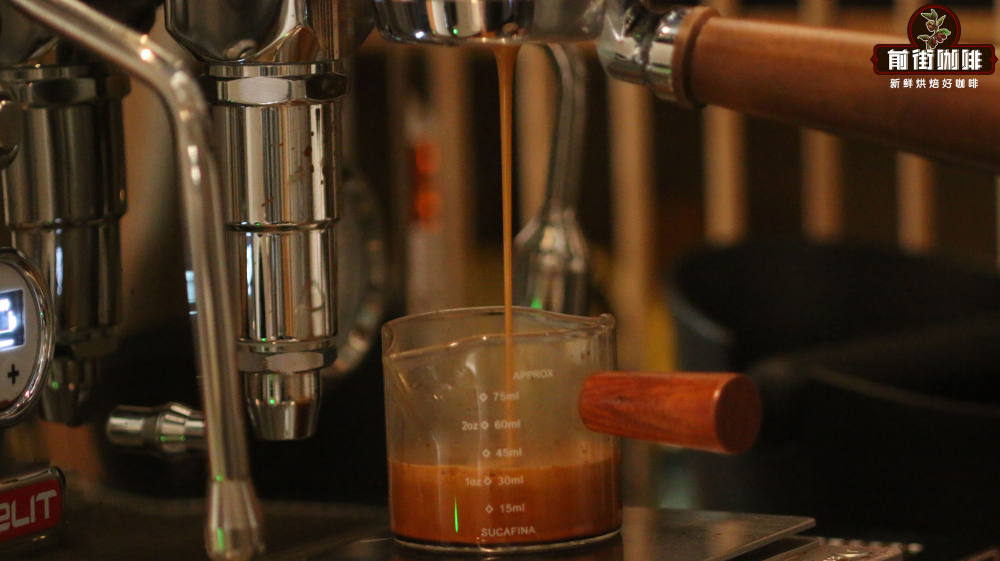
Since Americano is built on espresso, the step of extracting espresso is especially critical. The extraction principle of espresso is to use about 9 bars of high pressure to let near-boiling hot water pass through a compacted coffee puck in a short time.
When making espresso, FrontStreet Coffee stores use a blend called Sunflower Warm Sun, composed of 70% Honduras Sherry and 30% Ethiopian natural Red Cherry, presenting obvious vanilla and cream notes as well as a whisky-like wine aroma, with a bit of berry acidity in the finish. After adjusting the parameters, Front Street uses 20 grams of coffee powder to extract 40 grams of espresso, taking about 28 seconds.
When making hot Americano, Front Street mixes 40 grams of espresso with 70°C hot water at a ratio of 1:4.5. The hot Americano made according to this ratio has clearly recognizable vanilla cream flavor, with a hint of wine aroma, and is mellow and smooth on the palate.
For iced Americano, Front Street mixes 40 grams of coffee liquid with ice and water at a ratio of 1:2.5:3. The iced Americano produced this way is not too strong at first, and when the ice gradually melts, the coffee flavor will not become bland.
What is Blue Mountain Coffee?
Blue Mountain coffee beans
Blue Mountain coffee gets its name from its place of origin—the Blue Mountain region of Jamaica. Blue Mountain is a mountain range in Jamaica, surrounded by the Caribbean Sea. On clear days, sunlight shines directly on the azure sea, and the blue light of the seawater reflects onto the mountain body, which is how Blue Mountain got its name.
Jamaica's coffee cultivation history can be traced back to the 18th century. In 1717, King Louis XV of France ordered coffee to be planted in Jamaica. In the mid-1720s, Jamaica's governor Lord Nicholas Lawes introduced the Typica variety from Martinique for planting, and it gradually spread from the Saint Andrew area.
At present, Jamaica's coffee-producing areas are mainly the Blue Mountain region, covering four administrative areas: Portland, Saint Andrew, Saint Mary, and Saint Thomas.
Those who understand Jamaica's green bean grading system should know that not all coffee beans grown in the Blue Mountain range are qualified to be called Blue Mountain coffee. The highest peak of the Blue Mountain range exceeds 2,000 meters, but the area allowed for coffee cultivation is limited to below 1,700 meters. On the one hand, areas above 1,700 meters are designated as protected areas where coffee cultivation is prohibited; on the other hand, the higher the altitude, the greater the risk of frost.
Jamaica divides coffee beans into three grades according to cultivation altitude: Blue Mountain coffee is grown between 1,000 and 1,700 meters; High Mountain coffee is grown between 500 and 1,000 meters; and Prime coffee is grown below 500 meters. With such strict standards, only about one quarter of the coffee beans produced in Jamaica can meet the requirements for Blue Mountain coffee.
The grading system of the Jamaica Coffee Industry Board is very strict. Even within the Blue Mountain coffee grade, it is further divided into four levels: No. 1, No. 2, No. 3, and Peaberry.
Among them, Blue Mountain No. 1 is the highest grade, requiring a cultivation altitude between 1,000 and 1,700 meters, a green bean screen size of 17/18, and a defect rate below 2%.
Strict standards have created the outstanding flavor of Blue Mountain coffee and also pushed up its price. Some merchants on the market label their packaging with "Blue Mountain Blend" or "Blue Mountain Flavor," trying to use Blue Mountain's fame to sell at high prices, but in reality there may not be a single genuine Jamaican Blue Mountain bean in the product.
The Blue Mountain No. 1 coffee beans selected by FrontStreet Coffee come from Clifton Farm, which is located near Catherine's Peak in the Blue Mountain range and is the oldest coffee estate in the area, with more than two hundred years of heritage. The farm also holds Rainforest Alliance certification, which shows how excellent its growing environment is.
After comparing many Blue Mountain No. 1 coffees, Front Street believes that this bean from Clifton Farm performs quite impressively and is fully capable of representing Blue Mountain coffee.
Those familiar with the green coffee bean trade know that green beans are usually shipped in burlap sacks. But Jamaica is still the only producing area that uses wooden barrels to load green coffee beans. In FrontStreet Coffee stores, there is a wooden barrel of Blue Mountain green coffee beans, and next to it is a Jamaican Blue Mountain coffee bean certification certificate. These two things are the proof that Front Street's Blue Mountain beans originate from Jamaica's Blue Mountain.
Blue Mountain coffee is famous for balancing acidity, sweetness, and bitterness, and for its mellow mouthfeel. When roasting this washed Blue Mountain bean, FrontStreet Coffee's roaster chose a darker roast level. If you want to release the flavor of Blue Mountain coffee to the greatest extent, you can refer to Front Street's following brewing parameters:
Dripper: KONO dripper
Water temperature: 88°C
Coffee dose: 15 grams
Coffee-to-water ratio: 1:15
Grind size: 75% passing through China standard No. 20 sieve
Because a darker roast is used to highlight the mellowness of Blue Mountain coffee, flavor extraction speeds up during brewing, which means too high a water temperature or too fine a grind can easily bring out burnt bitterness. At the same time, in order to obtain a fuller mouthfeel, Front Street recommends using a dripper with an immersion function, such as the KONO dripper.
First pour 30 grams of hot water and bloom for 30 seconds, then slowly pour in a thin stream from the center in circles up to 125 grams. When the water level in the dripper drops to almost exposing the coffee bed, continue pouring in circles up to 225 grams, keeping the total extraction time at about 2 minutes.
The Blue Mountain No. 1 brewed according to this set of parameters achieves a balance of acidity, sweetness, and bitterness, with rich nut and chocolate flavors and a mellow mouthfeel.
Some friends are not confident about controlling the grind size for hand brewing and want Front Street to grind the coffee for them. Front Street does indeed provide this service. However, it should be noted that once coffee beans are ground into powder, the degassing speed accelerates and flavor compounds are also lost more quickly. Therefore, it is still recommended to buy whole beans and grind fresh before brewing for better flavor performance. The coffee beans shipped by Front Street are all freshly roasted within 5 days, and when they arrive in your hands they have just gone through a 4 to 7 day resting period, at which point the flavor is at its peak.
For more coffee bean information, please follow Coffee Workshop (WeChat public account cafe_style) For professional coffee knowledge exchange, please add WeChat ID kaixinguoguo0925
The above content is compiled by CoffeeHunters, a coffee news website.


