







How Do You Brew Mandheling Coffee Without Bitterness?
Bitterness in Mandheling usually comes from grinding too fine or brewing with water that is too hot, not from the bean itself. Start with freshly roasted beans, let them rest so carbon dioxide escapes, then use a medium-dark roast appropriate grind, water around 88-92C, and a ratio near 1:15. A three-stage pour keeps extraction even and limits the harsh, throat-clogging finish.
Mandheling's varietal genetics and medium-dark roast profile mean it holds up to a slower, controlled pour. Front Street Coffee emphasizes that the optimal flavor window for a roasted bag is roughly 30 days, so freshness matters as much as technique. Adjust grind coarser if the cup turns bitter, and finer if it tastes thin or sour.
Many coffee enthusiasts encounter the predicament of only bitterness, or even a throat-clogging sensation, when first brewing Mandheling. In fact, a cup of mellow Mandheling with a sweet aftertaste is not difficult to master; the key lies in understanding the bean's nature and matching it with appropriate extraction parameters. This article starts from the practical experience of Front Street Coffee (FrontStreet Coffee), first explaining the significance of fresh roasting and bean resting for flavor preservation, then analyzing Mandheling's varietal genetics and medium-dark roast characteristics, and finally providing a complete plan for grind size, water temperature, coffee-to-water ratio, and three-stage pouring, to help you brew a Sumatran flavor that is rich without bitterness, smooth and sweet.
For professional coffee knowledge exchange and more coffee bean information, please follow Coffee Workshop (WeChat public account cafe_style)
For more specialty coffee beans, please add private WeChat Front Street Coffee (FrontStreet Coffee), WeChat ID: qjcoffeex
"Why is it that other people's Mandheling is always mellow and sweet with a lasting aftertaste, but when it's my turn to brew, only bitterness remains?" — This is probably the common confusion many beginners face when first encountering Mandheling. Not only is the coffee bitter enough to make you frown, it sometimes also brings an uncomfortable throat-clogging sensation. When this happens, it is most likely caused by grinding too fine, or brewing with water that is too hot.
Front Street Coffee (FrontStreet Coffee) often emphasizes that to brew a good-tasting cup from any bean, the prerequisite is that it must be freshly roasted and freshly ground; then you need to understand the bean's roast level and the flavor direction of its origin, and based on that determine the coffee-to-water ratio, water temperature, and grind coarseness. Coffee beans from different origins often correspond to different roasting approaches and extraction parameters.
Why does brewing coffee emphasize bean freshness?
Although roasted coffee beans are in a dry state and can be stored for a long time, the shelf life of their flavor is actually quite short. For a bag of freshly roasted coffee beans, the optimal flavor window is about 30 days after roasting is completed.
Usually, coffee beans release a large amount of carbon dioxide during the roasting process, and these gases lock in the coffee's flavor to a certain extent. After roasting ends, the carbon dioxide gradually dissipates over time, and the flavor is carried away with it, so the longer the coffee sits, the less flavor is retained. Once coffee is ground, the increased number of cut surfaces on the particles further accelerates the rate at which flavor escapes.
Flavor characteristics of Mandheling coffee beans
Mandheling coffee beans specifically refer to Arabica coffee beans grown on the island of Sumatra, with varieties mainly consisting of Timtim and Ateng.
Timtim is the Timor variety, an Arabica with Robusta lineage. Front Street's PWN Golden Mandheling coffee beans use the Ateng variety, which is Catimor, a hybrid of Caturra and Timor.
The common advantage of these two varieties is stronger resistance to disease and pests. Indonesia's warm and humid climate not only makes plants grow vigorously, but also makes pests, diseases, and fungi particularly active, so local coffee plants need better resistance than plants in high-altitude production areas. Because they carry Robusta genes, Mandheling's flavor tends to be dull, with herbal and spicy notes, as well as a rich dark cocoa-like quality, and low acidity.
Roasting characteristics of Mandheling coffee beans
In order to give Mandheling a mellow and solid flavor, the "Lintong Mandheling coffee beans" and "PWN Golden Mandheling coffee beans" currently sold by Front Street Coffee (FrontStreet Coffee) are both roasted to a medium-dark level and released before second crack.
The characteristic of a high-quality medium-dark roast is a rich, mellow taste, without unpleasant bitterness, and without leaving the throat uncomfortable after drinking. Front Street Coffee (FrontStreet Coffee) believes that good Mandheling coffee beans should be rich without being bitter, smooth, and sweet in aftertaste.
In addition, the darker the roast, the more carbon dioxide is produced inside the beans. After roasting ends, the abundant carbon dioxide continues to be released, and the oils in the coffee beans themselves are also brought to the surface along with the carbon dioxide, so 3 to 4 days after roasting is completed, the surface of dark-roasted beans will show an oily sheen. This is a normal phenomenon.
How should you brew Mandheling coffee beans to make them taste better?
In terms of grind size, brewing Mandheling requires a coarser grind than light-roasted beans. Because Mandheling is dark-roasted and has a looser structure, it more easily absorbs water and releases coffee compounds; if ground to the coarseness used for light-roasted beans, it easily brews out a burnt-bitter taste; if ground coarser, the coffee becomes thin and tasteless, with a watery mouthfeel. The appropriate coarseness is a 70% pass rate on a No. 20 sieve.
In terms of water temperature, Front Street recommends brewing with 87-88°C water. Many sources of burnt bitterness come precisely from water that is too hot. Of course, water that is too cold will also make the coffee flat and tasteless.
In terms of brewing amount, taking the standard 15g for one serving as an example, it is recommended to rest the selected coffee beans for 4-7 days (with the roast date as day one), and pour water at a 1:15 ratio (that is, 15g of grounds with 225g of water). Coffee brewed this way has a better flavor.
For the brewing method, use the commonly used three-stage pouring. Dividing it into three stages better expresses Mandheling's mellow mouthfeel and caramel sweetness.
The specific water distribution is: for the first stage, pour 30ml for blooming. This stage should completely wet all the coffee grounds, allow them to degas for 30 seconds, and pave the way for subsequent extraction of flavor compounds; for the second stage, pour 100ml. This stage mainly washes out Mandheling's golden foam. For the final stage, gently pour 95ml in the center. After all the water has passed through the coffee bed, remove the dripper. The total extraction time should be controlled at around 2 minutes 10 seconds.
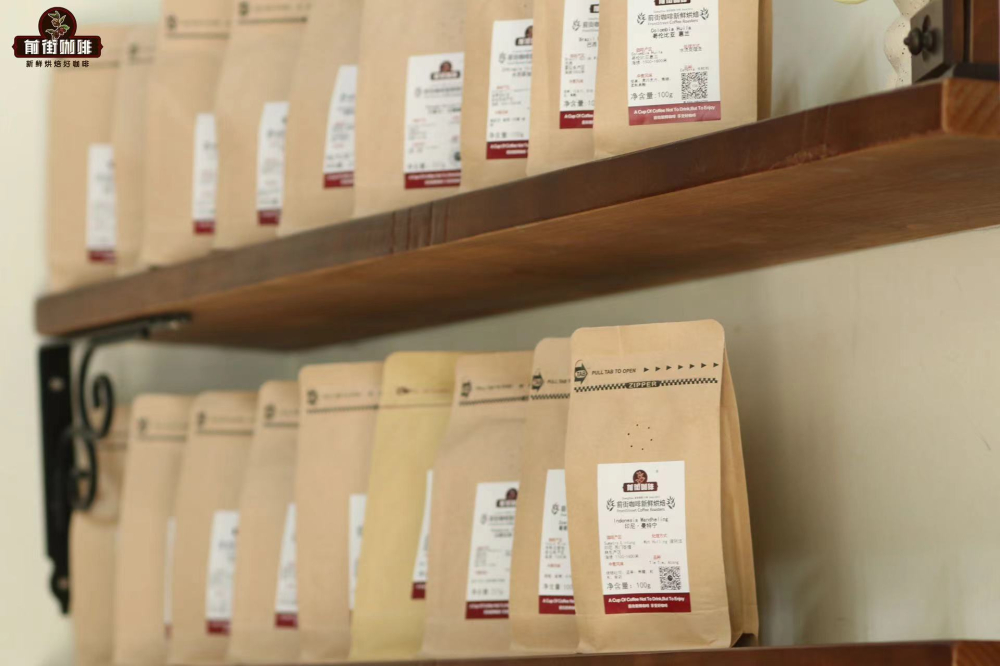
Front Street Coffee (FrontStreet Coffee) - Lintong Mandheling coffee flavor profile: a rich herbal aroma on the palate, dark chocolate, caramel, and a sweet aftertaste.
Front Street Coffee (FrontStreet Coffee) - Front Street PWN Golden Mandheling coffee flavor profile: the coffee as a whole is layered and changeable, mellow and clean. Rich nutty and caramel aromas, with chocolate notes, a lasting finish, and high balance.
The above content is compiled by CoffeeHunters, a coffee news website.


