








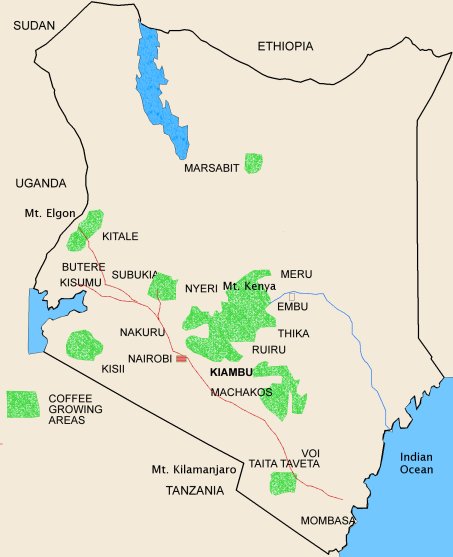
Which Kenyan coffee producing regions grow the SL series?
Kenya's main coffee producing regions are Thika, Kirinyaga, Nyeri, Kiambu, Muranga, and Mt. Kenya West, where trees grow between 1,500 and 2,100 meters and two harvests are possible each year. The SL28 and SL34 varietals, along with Batian and Ruiru11, define the bright acidity and fruit-forward cup the origin is known for.
Smallholder farmers deliver cherries to cooperative washing stations, where the K72 method ferments parchment in cycles for about 72 hours before drying. Workers may patrol the fields around seven times to pick only ripe cherries. Some wet mills also hold Rainforest Alliance certification coffee, adding a sustainability standard alongside quality grading.
Kenyan coffee has long been renowned worldwide for its vibrant fruity aromas, bright acidity, and multi-layered mouthfeel, making it an irreplaceable classic origin in the hearts of many coffee enthusiasts. This article will systematically sort out the variety lineage of Kenyan coffee—from SL28 and SL34 to the breeding history of Batian and Ruiru11—explain in detail the 72-hour cyclic fermentation process of the K72 washed processing method, and introduce one by one the terroir characteristics and cupping performance of six major producing regions: Thika, Kirinyaga, Nyeri, Kiambu, Muranga, and Mt. Kenya West. At the same time, it brings the detailed parameters and flavor descriptions of two Front Street single-origin Kenyan coffees—Sasini Estate PB and Asalia—providing coffee fans with a complete cognitive framework and purchasing reference for Kenyan coffee.
Kenyan Coffee
Anyone who has even a passing interest in coffee is surely familiar with Kenya as a producing origin. Within the coffee industry, it is likewise regarded as a favorite by many professionals. The reason Kenyan coffee is so highly praised is that it encompasses almost everything people expect from a cup of high-quality coffee—balanced and pleasing acidity, outstanding fruit-toned character, and extremely high flavor distinctiveness, making it hard to find a similar substitute on the market.
Front Street has always felt that the most prominent label of Kenyan coffee is that clearly identifiable fruity aroma. When tasting, one may deliberately try to capture this scent while also experiencing how it shifts and changes in the mouth, among which citrus-like aromas are especially common. In addition, Kenyan coffee also presents rich layering and juicy acidity, with grapefruit and wine flavors interwoven, while the body is just right.
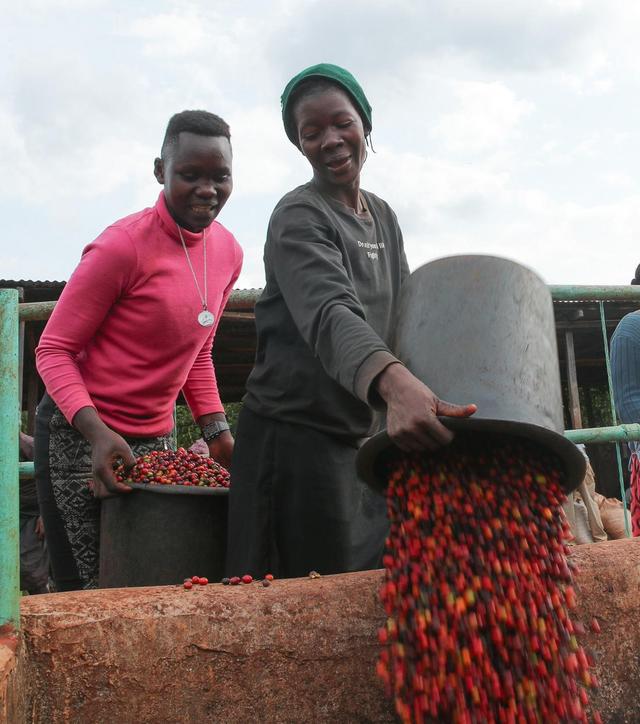
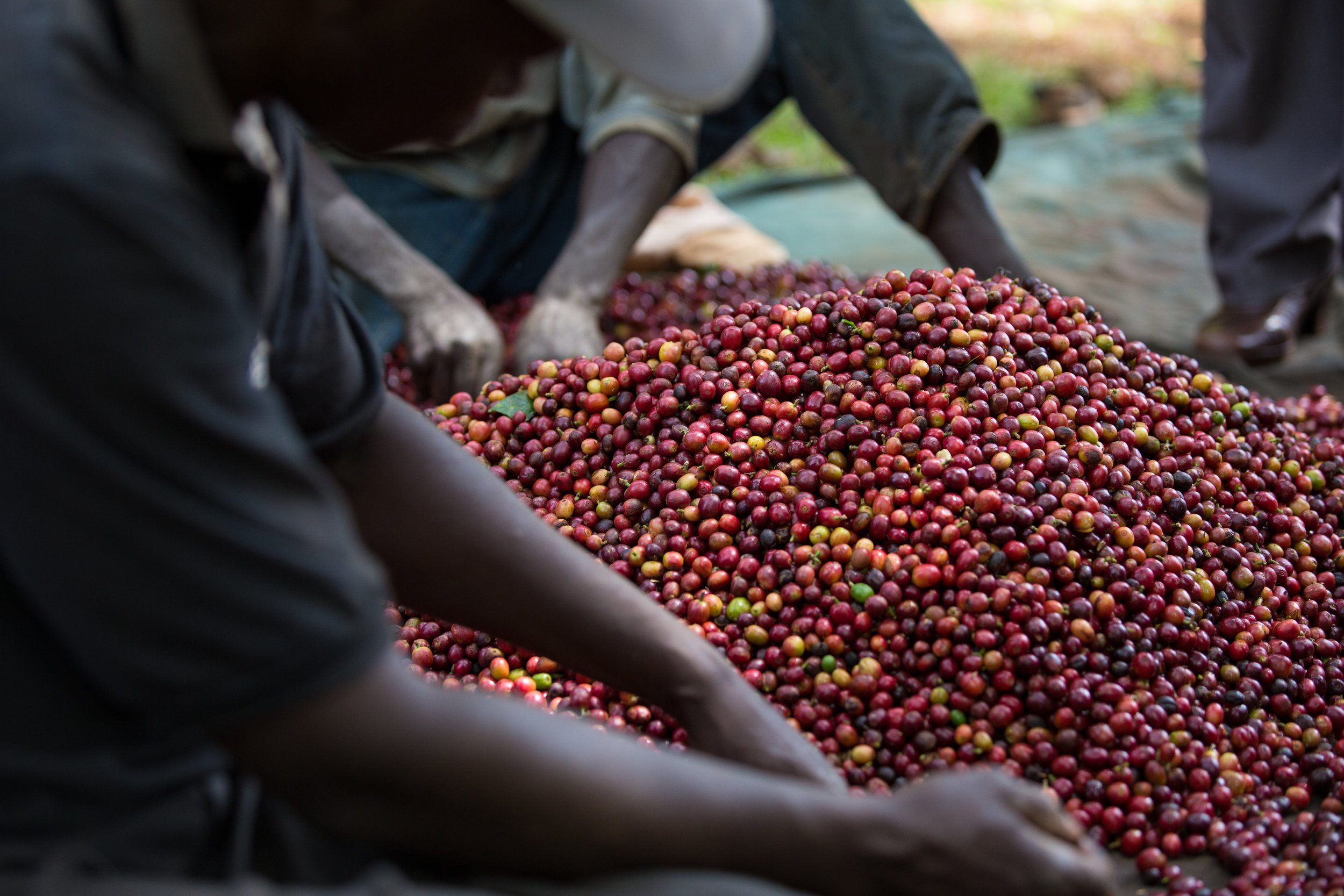
Kenyan coffee trees are mostly grown at altitudes of 1,500 to 2,100 meters, and two harvests can be reaped each year. Front Street has learned that in order to ensure only fully ripe cherries are picked, local workers need to patrol the fields repeatedly, as many as about seven times. Coffee is grown in scattered plots by smallholder farmers. After picking, the fresh cherries are first sent to cooperative washing stations, where washing and drying are completed, and then transferred to cooperatives in the form of "parchment coffee beans" with the endocarp still attached. After all the coffee is gathered together, growers negotiate based on actual quality at an average price. Front Street believes that this trading model operates well overall and is fair to both the production and consumption ends.
The main cultivated varieties in Kenya include SL28, SL34, Batian, and Ruiru11.
At this point Front Street guesses that most coffee enthusiasts who are just starting out have heard of common varieties such as Caturra, Catuai, Typica, and Bourbon, but what exactly are SL28 and SL34? What differences do they have from those familiar varieties? Front Street will now explain in detail for everyone.
SL is the abbreviation of Scott Labs, fully known as Scott Laboratories. In the 1930s, this laboratory was commissioned by the Kenyan government to carry out coffee breeding and classification research, with the goal of selecting varieties that could adapt to Kenya's local terroir, be suitable for large-scale promotion, and possess commercial potential. SL-28 and SL-34 are two among the many achievements of this research. The institution was active from the 1930s to the 1960s and no longer exists today.
The SL series was bred on the basis of Yemeni Mocha ancient varieties and Reunion Island Bourbon varieties, and currently accounts for the vast majority of Kenya's coffee production. By comparison, SL-28 has won greater prestige, while SL-34 has a larger harvest yield and is planted at slightly lower altitudes. According to botanists at the SL laboratory, both SL28 and SL34 are genetic variants. Among them, SL28 carries a mixed lineage of Mocha and Yemeni Typica, and the original intention of cultivating it was to obtain coffee beans that were both high-yielding and disease-resistant while also excellent in quality.
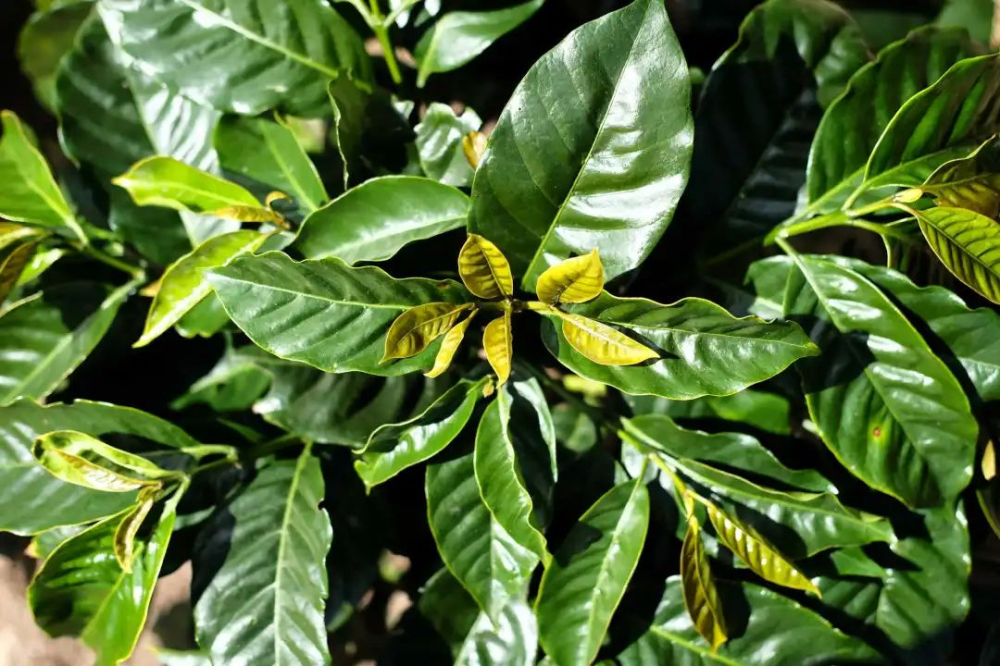
Although SL28's later yield did not reach the expected high level, it is still widely planted today thanks to the outstanding sweetness, balance, and complex and changeable flavors brought by its bronze young leaves and broad-bean-shaped seeds, as well as its pronounced citrus and smoked plum characteristics. SL34 is quite close to SL28 in flavor and likewise has rich acidity and a sweet finish, but its mouthfeel is heavier and more intense than SL28, and its cleanliness is even better. SL34 inherits Bourbon and more Typica lineage, and its bean appearance is similar to SL28, yet it shows stronger environmental adaptability, for example being able to withstand sudden heavy rain.
Ruiru came after SL28 and SL34. According to what Front Street has learned, in the 1970s the Ruiru research station began trying to breed different CBD- and rust-resistant varieties, and finally released Ruiru11 in the 1980s. It has high yield and combines CBD and rust resistance, and was once regarded as the answer to Kenya's coffee cultivation difficulties.
Batian was released by the Coffee Research Institute (CRI) on September 8, 2010, and is currently Kenya's newest variety. It drew lessons from Ruiru11 and improved upon them. From a genetic perspective, it is essentially selected from the hybrid offspring of SL28 and SL34, is closer to SL28 than Ruiru11, and has removed the problematic Robusta component, with cupping quality improving accordingly. In other words, the annual yields of both Ruiru11 and Batian are higher than those of SL28 and SL34, with each coffee tree able to produce as much as 40 kilograms of coffee per year, and these high-yielding varieties also have stronger disease resistance.
K72 Washed Processing Method
Front Street has learned that the Kenyan-style washed processing adopts an operation method of washing after fermentation and repeating the cycle. On the day of harvest, the highest-quality coffee cherries are first screened out, then immediately pulped and entered into fermentation for 12 to 24 hours; after 24 hours they are rinsed with clean river water. Immediately after that, fermentation is carried out again with clean river water for 24 to 48 hours and then washed, repeating two cycles in this way for a cumulative total of 72 hours, hence the name Kenyan-style 72-hour fermentation washed processing method, abbreviated as K72. This processing method allows the coffee beans to undergo long fermentation at low temperatures, thereby giving the beans a brighter, cleaner, and still full-bodied flavor expression.
Of course, the high quality of Kenyan coffee also depends on the support of high-quality cherries, so its grading is naturally indispensable. Grading is determined based on the bean size and cupping results. According to bean size, shape, and hardness, the order from high to low is AA, AB, PB, C, E, TT, T. For AA-grade and AB-grade green beans, exporters will also add special grading based on cupping results outside the official system, from high to low as TOP, PLUS (+), FAQ. In addition to the most common AA and AB domestically, coffee fans will often see labels such as "AA+" or "AA++", with larger bean size, but in essence they still belong to the AA category.
Kenyan Coffee Producing Regions
According to what Front Street has learned, Kenyan coffee is best known for six major producing regions: Thika, Kirinyaga, Mt. Kenya West, Nyeri, Kiambu, and Muranga.
Kiambu Producing Region
Kiambu is located in central Kenya and traditionally belongs to the tea-growing region, yet it has the highest-altitude coffee gardens in that area. This producing region is named after Nakuru town, has relatively limited coffee production, adopts a planting model in which estates and smallholders coexist, and has two harvests a year. Front Street believes that the flavor of this producing region also suits most people's preferences, combining bright acidity with a full body.
Altitude: 1,850–2,200 meters
Varieties: SL-28, SL-34, Ruiru11, Batian
Thika Producing Region Thika is a small town located near Kenya's capital, Nairobi. A large number of coffee fields are distributed around Nairobi. Thika itself is an industrial town, but it is surrounded by farmland and waterfalls. There are about two thousand coffee farmers in this area. Based on cupping, Front Street judges that the flavor of this producing region shows bright fruit acidity, a thick berry juice sensation, and honey-like sweetness.
Altitude: 1,550–1,750 meters
Varieties: sl-28, sl-34
Kirinyaga Producing Region The Kirinyaga producing region is located on the slopes of Mount Kenya, adjacent to the Nyeri producing region, and is globally renowned for coffee with strong flavor, rich layering, and a solid mouthfeel, standing alongside the Nyeri producing region as currently Kenya's two finest producing regions.
Most producers in this producing region are small coffee farmers. They join cooperatives, and the cooperatives play a coordinating role and provide washing stations; farmers send coffee cherries to the processing stations for processing. Altitude: 1,300 to 1,900 meters. Harvest period: October to December (main season), June to August (secondary season). Based on cupping, Front Street judges that this producing region is dominated by berry flavors, with moderate sweetness and accompanying honey and cream notes.
Altitude: 1,300–1,900 meters
Varieties: SL-28, SL-34, Ruiru11, Batian.
Nyeri Producing Region
Nyeri is adjacent to the high mountainous area of Mount Kenya and is a critically important specialty-grade producing region in Kenya, with an average altitude of more than 1,500 meters. Many high-quality Kenyan coffees come from here. Nyeri's altitude is high enough, and it is also located east of the Aberdare Range, while also being the promontory between Mount Kenya and the main mountain. The high terrain and fertile soil make Nyeri the core coffee town of central Kenya, and its related industrial facilities are also relatively complete. This area is famous for high-altitude Kenyan coffee beans, and the overall standard is quite high. Based on cupping, Front Street judges that the coffee beans produced in this region carry dark berry flavors, a bright sweet-and-sour sensation like smoked plum, and a delicate aftertaste.
Altitude: 1,200–2,300 meters
Varieties: SL-28, SL-34, Ruriu11, Batian
Mt. Kenya West Producing Region
Mt. Kenya West covers Kisii and the Bungoma area of Mount Elgon. Among them, Kisii is located in southwestern Kenya, not far from Lake Victoria, and belongs to a relatively small producing region. Most coffee beans come from common cooperatives formed by independent small producers. The coffee flavor of this producing region differs noticeably from that of the central producing regions. According to Front Street's cupping judgment, it presents characteristics of roasted nuts and soft fruit acidity, and is deeply favored by buyers who do not prefer bright acidity.
Altitude: 1,450–1,800 meters
Varieties: SL-28, SL-34
Muranga
The Muranga producing region belongs to Central Province and has about one hundred thousand coffee farmers. This inland producing region was the first settlement chosen by missionaries, because at that time the Portuguese prohibited them from living in the coastal areas. It also benefits from volcanic soil, and the number of smallholder coffee farmers is greater than that of estates. Based on Front Street's cupping judgment, the coffee of this producing region has bright acidity and a thick juicy mouthfeel.
Altitude: 1,350–1,950 meters
Varieties: SL-28, SL-34, Ruiru11, Batian
At present, Front Street has on hand two coffee beans from Thika and Kiambu, and now recommends them to all coffee fans!
FrontStreet Coffee: Kenya Sasini Estate PB Coffee Beans
Country: Kenya
Producing Region: Sasini Estate
Altitude: 1680m
Varieties: SL28, SL24, riuru
Processing Method: 72-hour washed processing
Flavor: Tomato, fruit, berry
Sasini Estate is located in the KIAMBU area around Mountain Kenya, at an altitude of about 1,800 meters. The scenery here is beautiful, the climate is pleasant, sunlight is abundant, and the soil conditions are excellent. It belongs to fertile acidic red soil, with loose texture, deep soil layers, good drainage, and a pH value between 5.5 and 6.5. According to what Front Street has learned, Sasini Limited was originally established in 1952 and was one of the first coffee and tea companies established after Kenya's independence. It has successively obtained multiple certifications including UTZ, Rainforest Alliance, and Kenya Bureau of Standards Diamond mark.
Front Street believes that excellent-quality Kenyan coffee has bright fruit acidity while also giving off an intoxicating fruity sweetness. The sweet-and-sour amplitude is relatively large, the aftertaste is refreshing and sweet, and it is also mixed with a hint of blackcurrant aftertaste.
FrontStreet Coffee: Kenya Asalia Coffee Beans
Country: Kenya
Producing Region: Asali (honey processing station)
Altitude: 1550-1750m
Varieties: SL28, SL34
Processing Method: 72-hour washed processing
Flavor: Snow pear, smoked plum, yellow sugar, cherry tomato, plum
This honey processing station Kenyan coffee from Front Street carries dark berry tones and rich fruit flavors, and its taste is relatively close to the public's established impression of Kenya. This Asalia is exactly the SL-28 and SL-34 varieties mentioned above, and the Bourbon variants (SL-28) and (SL-34) have also always been frequent winners at expert cuppings and the Nairobi auction.
The above are all the Kenyan coffee types Front Street currently has. I believe coffee fans and friends have also gained a certain understanding of Kenyan coffee.
For professional coffee knowledge exchange and more coffee bean information, please follow Coffee Workshop (WeChat public account cafe_style)
For more specialty coffee beans, please add the private WeChat of FrontStreet Coffee, WeChat ID: qjcoffeex
The above content is compiled by CoffeeHunters, a coffee news website.


