







What separates Lintong, Golden, Tiger and Aged mandheling?
Mandheling coffee is Sumatra coffee grown in the mountains around Lake Toba in North Sumatra, at roughly 900 meters on average. Only the Lintong area and the Lake Toba region qualify for the name, and the beans are typically Typica or its variants. Lintong, Golden, Tiger and Aged are the four types most often compared.
Golden mandheling comes from Lintong and is picked cherry by cherry, processed semi-washed, then sun-dried and hand-sorted twice. Named micro-lots such as Sidikalang, or SDK Mandheling, are becoming more common as Lintong narrows to the area near Lintongnihuta. Screen size, color and flavor separate the four types in a cupping table comparison.
Mandheling coffee is renowned for its rich, full-bodied character, but can you really tell the difference between the four major types: Lintong, Golden, Tiger, and Aged? This article will take you deep into the Sumatra growing region and break down their unique characteristics one by one, from geography and processing methods to flavor profiles. You'll learn about the subtle relationship between Lake Toba and the Lintong region, the rigorous hand-sorting process behind Golden Mandheling, the trading background of Tiger Mandheling, and the special storage secrets of Aged Mandheling. We've also compiled a comparison of the screen size, color, and flavor of four Mandheling green beans from Front Street Coffee to help you easily identify and choose. Whether you're a beginner coffee enthusiast or a seasoned connoisseur seeking advanced knowledge, this article offers a clear and professional guide to Mandheling.
Mandheling coffee has another name—Sumatra coffee. Most coffee produced in the North Sumatra area is Gayo, with the main cultivar being Ateng; coffee from around Lake Tawar in the far north is often called Aceh coffee or Tawar Lake coffee. As for Lintong in South Sumatra and the area around Lake Toba, only the coffee produced there qualifies to be called Mandheling, and the Lintong region is the core production area. In fact, Mandheling comes from the mountains around Lake Toba, a highland freshwater lake located north of Medan, the capital of North Sumatra Province, with an average elevation of about 900 meters.
When we talk about Mandheling in everyday terms, we usually mean Typica or its variants grown in the mountains around Lake Toba.
In recent years, Mandheling from the Lintong area has begun to be further subdivided, with Mandheling named after specific places appearing on the market, such as Sidikalang (abbreviated as SDK Mandheling). The concept of Lintong is also gradually narrowing in scope, and today it refers more to the area near Lintongnihuta.
Golden Mandheling comes from the Lintong region in North Sumatra, Indonesia. Its harvesting process requires everything to be done by hand, picking only fully ripe whole cherries to ensure the quality of the initial sorting. The coffee cherries are processed using the SEMI-WASHED method, then dried in the sun, and after hulling they undergo another round of drying and refining, as well as two rounds of green bean cleaning and four rounds of hand-picking. Because of this, it fully deserves to be called a top-grade Mandheling that has undergone rigorous selection.
Tiger Mandheling coffee comes from Aceh, where coffee is the region's second-largest export cash crop. There are about 60,000 small-scale coffee farmers locally, each with about 1 to 2 hectares of coffee-growing land. Indonesia's traditional coffee trade uses a multi-link supply chain, starting from farmers and passing through layers of middlemen before gradually assembling large export shipments. In Indonesia's coffee trading system, the direct trade model—where a single window buys directly from farmers and then arranges exports—is quite rare locally.
Aged coffee beans are not simply green beans left to sit for a long time; that approach is not advisable, because green coffee beans will also deteriorate if stored too long. Their color changes from fresh green to white, then to yellow, the flavor becomes flat, and they may even become infested with insects. Just like aged alcoholic beverages, green beans must be properly handled and stored long-term before they can truly be called [Aged Coffee]. So-called aged beans mean allowing green beans to age naturally by extending storage time (usually 2 to 3 years), during which changes such as reduced acidity, color change, and increased bean density occur. The storage environment must be cool and well ventilated. Because the storage environment is dark and the time is long, aged coffee often inevitably carries a moldy smell, or what is commonly called complex odors such as burlap and leather.
A close look at the green beans reveals that the proportion of peaberries in Mandheling is still relatively high, because the beans were hulled when their moisture content was high and the bean texture was soft.
The screen size of [Front Street Golden Mandheling] reaches 18+, so the beans are noticeably larger than other Mandheling beans; due to higher moisture content, the green beans appear darker green. The green beans of [Front Street Tiger Mandheling] are plump, slightly yellow with a green tinge, and fairly uniform. The green beans of [Front Street Lintong Mandheling] are grayish-green, vary in size, and are relatively less uniform. [Front Street Aged Mandheling], because of its processing method, has a very distinctive green bean color—orange with a dark tinge—and looks wrinkled on the surface, though the green beans are fairly uniform in size.
The standard for Front Street Tiger Mandheling is: only Mandheling with an aroma reminiscent of traditional Chinese herbal medicine, a screen size of 17 or above, and a defect rate below 4% can be crowned with the name "Tiger."
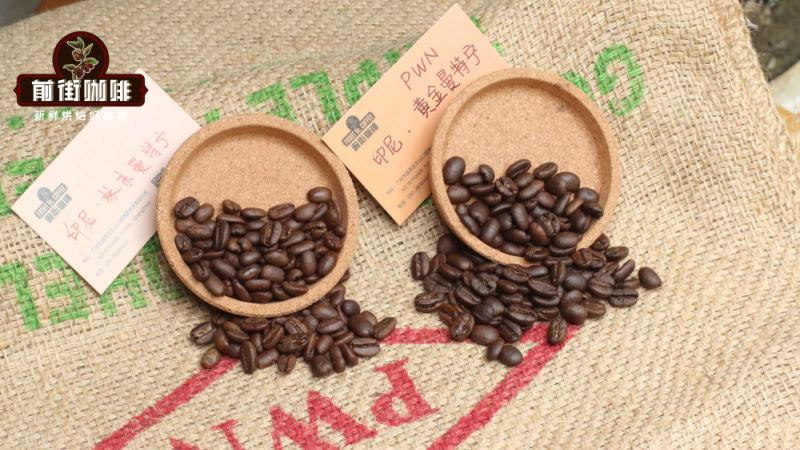
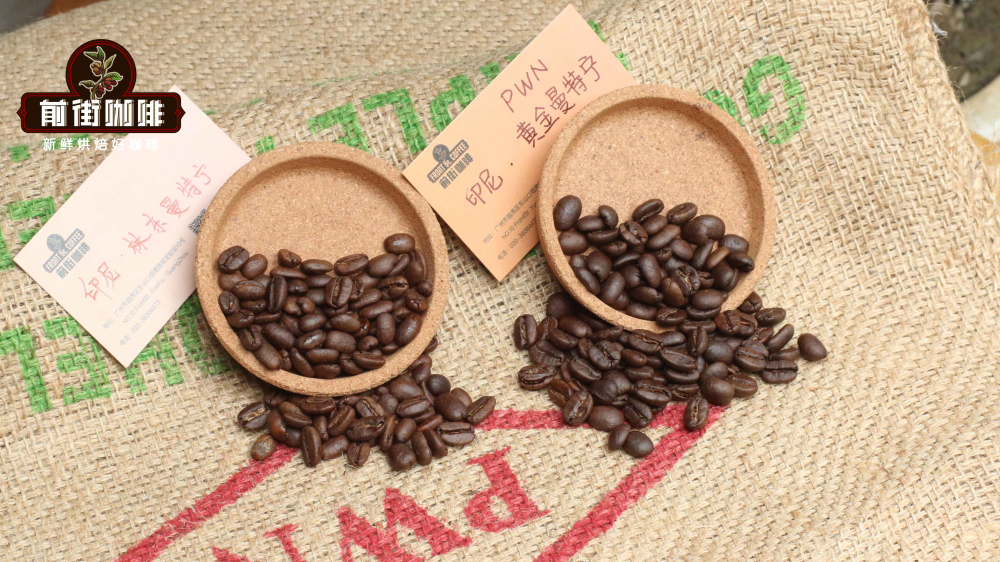
The [Front Street Golden Mandheling] marked with "PWN"—PWN is the abbreviation of the Indonesian company Pawani, and the Golden Mandheling coffee it produces has been registered in Indonesia.
[Front Street Lintong Mandheling] has herbal, chocolate, and caramel flavors, with a high body and a relatively balanced overall profile;
[Front Street Golden Mandheling] presents flavors of nuts, spices, herbs, licorice, chocolate, and caramel, with a clean mouthfeel, low acidity, and a gentle character;
[Front Street Tiger Mandheling] has notes of nuts, cream, dark chocolate, caramel, and traditional Chinese herbal medicine, with prominent sweetness and a clean, clear flavor;
[Front Street Aged Mandheling] shows ripe pu-erh, caramel, herbal, and chocolate tones, with relatively low acidity.
The above content is compiled by CoffeeHunters, a coffee news website.


