







What Makes SOE Coffee Different From a Blend?
SOE stands for Single Origin Espresso, meaning espresso pulled from beans of one region and one variety instead of a blend. The concept appeared abroad around 2007 and matured near 2010, when a London barista won the World Barista Championship with an SOE creation. Any single-origin bean can be used, from Geisha to ordinary Brazilian lots.
Beans are sorted by use: pour-over coffee beans for drip methods and espresso coffee beans for pressure extraction, with roast degree as the core difference. SOE beans cost more because single-origin lots are smaller and harder to source. Huakui serves as the example here, with Front Street Coffee's extraction parameters and process for making a bright SOE at home.
SOE, or Single Origin Espresso, has been gaining increasing attention in the specialty coffee world in recent years. It uses single-origin coffee beans instead of traditional blends to make espresso, presenting a completely different flavor profile. This article will start from the definition of SOE, sort out its differences from single-origin beans, blend beans, and pour-over beans, explain why SOE coffee beans are relatively expensive, and recommend several coffee beans that are suitable for both pour-over and making SOE. Finally, taking Huakui as an example, it will share in detail Front Street Coffee's extraction parameters and operating process, helping you make a bright-flavored SOE at home.
Traditional espresso is known for its rich taste and mellow sweet aftertaste. Through dark-roasted beans, it often presents notes of nuts and chocolate, and has long been favored by coffee lovers. Over its long evolution, espresso gradually developed a branch different from the blending route—using single-origin coffee beans to extract espresso. The drink obtained through this method is what we call SOE.
What Exactly Is SOE
SOE is the abbreviation of Single Origin Espresso. Taken literally, it means espresso made from coffee beans from a single region and a single variety. To put it plainly, it is single-origin espresso. It is not complicated to understand. When you order an SOE in a café, the shop will choose single-origin beans from a certain region to extract. Whether it is high-end Geisha or ordinary Brazilian beans, what is made is called SOE; the only difference lies in the quality level. This concept first appeared abroad in 2007 and gradually matured around 2010. At that time, a barista from London won the WBC World Barista Championship with an SOE creation. After that, SOE entered the public eye and gradually became popular.
Many friends often cannot clearly distinguish among SOE, single-origin beans, blend beans, pour-over beans, and espresso beans. Front Street Coffee will briefly sort this out here. If classified by use, they can be divided into two categories: one is pour-over coffee beans used for drip methods such as pour-over, and the other is espresso coffee beans used for pressure extraction methods such as espresso machines. The core difference between the two lies in the degree of roasting.
Single-origin coffee beans emphasize a single source. It only depends on whether the origin is unique, and does not require the variety to be single as well. Blend coffee beans are made by mixing beans from two or more regions in artificial proportions, with the aim of obtaining richer flavors, more stable output, or more cost-effective pricing. Therefore, strictly speaking, mixing different varieties of beans from the same estate together cannot be considered a blend.
SOE specifically refers to espresso extracted from single-origin beans, and SOE coffee beans are those single-origin beans roasted to a degree suitable for espresso extraction.
Why SOE Coffee Beans Are More Expensive Than Blend Beans
The reason is not complicated: the raw materials selected by merchants for SOE are of higher quality, so the purchasing cost is naturally higher.
Theoretically, using a bean purely from Brazil to make espresso can also be called SOE, but this practice is almost never seen on the market. The reason is that the espresso extracted this way may not compare with blend beans in flavor. Therefore, beans willing to bear the SOE label must possess a unique flavor different from traditional blends, something that can surprise people and make them willing to pay. For this reason, many beans from small regions in Ethiopia are selected as SOE, because Ethiopian beans are known for citrus and floral notes. Combined with relatively bold, lighter roasting, they can bring a completely different espresso experience.
In fact, using high-quality beans for blending also comes at a high price, and the flavor is not inferior to SOE. For example, Front Street Coffee. Strawberry Candy Espresso Blend combines selected single-origin beans from three regions—Colombia, Ethiopia, and Costa Rica—presenting rich layers of strawberry gummy candy, rose, orange, and candied fruit, and is deeply loved by customers.
Due to historical reasons, blending has left a stereotyped impression in many people's minds, which is also why many merchants are unwilling to choose high-quality blend beans. The term SOE happens to form a sharp contrast with blending.
Which Coffee Beans Can Be Used for Both Pour-Over and SOE
Front Street Coffee mentioned earlier that pour-over beans and espresso beans differ in roasting. Some beans are roasted lighter in order to highlight strong fruity acidity, and when extracted with an espresso machine, they tend to produce sharp, irritating flavors. However, some beans are roasted to a degree that balances both pour-over and espresso SOE use.
For example, Front Street Coffee's Brazil Queen Estate Yellow Bourbon uses a medium-dark roast. As a pour-over, it has a rich chocolate and peanut butter mouthfeel, with prominent sugarcane sweetness. Used for SOE, it can also extract thick crema, with full chocolate and nut aromas on the palate, neither burnt nor bitter, and very high sweetness.
Another one is Yirgacheffe Red Cherry, which Front Street Coffee roasts to a medium-light level. In pour-over, it presents sweet berries, fruity acidity, cream, and fermentation aromas. Because the roast level is not too light, it is also suitable for espresso machines. The resulting SOE has obvious strawberry fruit aromas, fruity acidity on the palate, accompanied by caramel cream notes and a black tea finish.
Also from the Ethiopian region, there is a high-altitude Front Street Coffee. Natural Huakui, which has become many people's daily staple thanks to its full and rich strawberry and citrus aromas. However, if you directly use medium-light roasted beans to make SOE, it is prone to splashing, sourness, and astringency. To let everyone easily make Huakui SOE at home, Front Street Coffee has also launched a medium-roasted SOE version; simply check the option when ordering.
Extraction Parameters for SOE Huakui Espresso
Coffee beans: Ethiopia · Huakui
Coffee powder dose: 20g
Coffee liquid yield: 40g
Powder-to-liquid ratio: 1:2
Extraction time: 26–32 seconds
Grind setting: Galileo 2.0
Front Street Coffee uses a double basket, requiring 20 grams of coffee powder each time. At a 1:2 powder-to-liquid ratio, 40 grams of coffee liquid is extracted within a reasonable time. Extraction time is related to flow rate, and is generally controlled within 20–35 seconds per shot. Less than 20 seconds tends to make the flavor weak, while more than 35 seconds tends to over-extract and become bitter. Therefore, Front Street Coffee stabilizes the time at 26–32 seconds when producing.
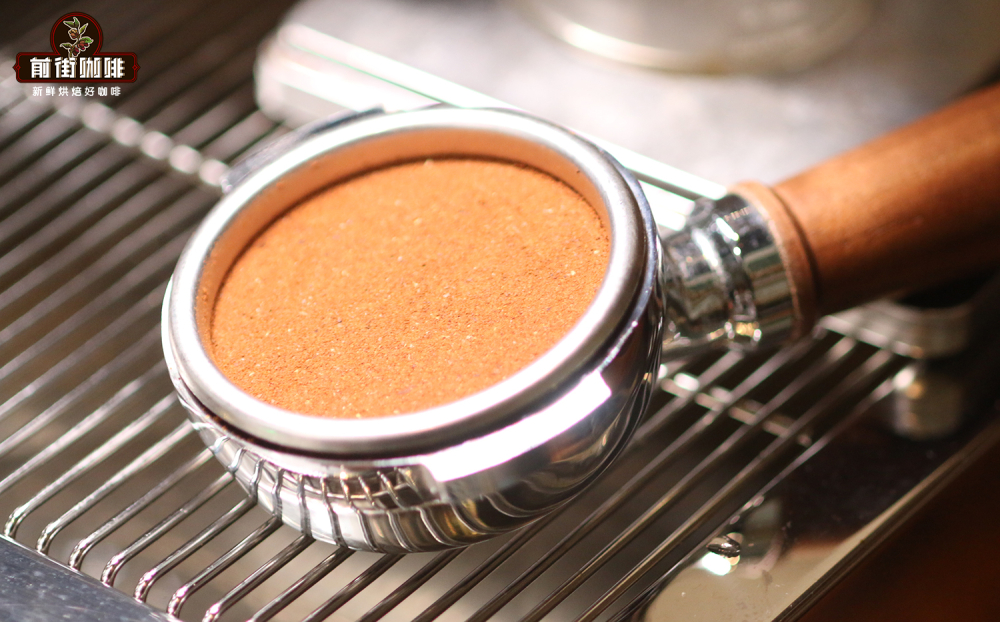
Before extraction, first wipe the basket dry, start the grinder to grind a double dose of coffee powder, and place it on an electronic scale to adjust until it is exactly 20 grams. Then use a distribution tool to level the powder surface, and then use a tamper to press vertically downward to ensure a stable extraction process.
Then turn on the extraction switch and let water run for 1–2 seconds to wet the group head while flushing away residual coffee grounds. Place an electronic scale under the cup for collecting espresso and tare it to zero, then place it together under the group head during extraction.
Gently lock the portafilter onto the group head and flip down the extraction switch. Pay attention to changes in the extracted liquid. When the electronic scale shows that the coffee liquid has reached 40 grams and the time is about 30 seconds, pull the switch down to stop extraction. Extraction parameters will change slightly with daily air humidity and bean condition, so the powder dose, grind setting, and liquid yield need to be adjusted flexibly.
For the extracted Huakui SOE, add ice water or warm water at 1:4 to make a refreshing SOE Huakui Americano; add steamed fresh milk at 1:6 for a softer mouthfeel, and it becomes a delicious SOE Huakui Latte.
The above content is compiled by CoffeeHunters, a coffee news website.


