







What Grind and Time Does French Press Coffee Brewing Need?
French press coffee brewing needs control of four things: grind size, water temperature, coffee-to-water ratio and steeping time. Front Street Coffee gives grind pass rates for medium-light and medium-dark roasted beans, recommended water temperatures and a four-minute steeping plan. The device is simple to operate, which is why it is nicknamed the lazy person's brewing method.
The French press was born in 19th-century France. In 1852, the Frenchmen Mayer and Delforge founded the Smith company, patented a piston-filter coffee device and named it French Press, marking its commercial debut. Because the method shows bean quality clearly, balanced specialty beans suit it better than complex, layered ones.
The French press is easy to operate, yet it best showcases the true flavor of coffee beans, earning it the nickname "the lazy person's brewing method." But to brew a good cup of French press coffee, grind size, water temperature, water ratio, and steeping time all need precise control. This article, based on the practical standards of Front Street Coffee, explains in detail the structure and extraction logic of the French press, provides grind pass rates for medium-light and medium-dark roasted beans, recommended water temperatures, and a 4-minute steeping plan, and explains why balanced beans are more suitable for the French press than complex, layered ones.
Regardless of which coffee brewing device is used, the coffee beans must first be ground before extraction can take place. Different devices naturally require different grind sizes. Front Street Coffee has clear standards for coffee grind settings. The presentation of a good cup of coffee is closely related to factors such as grind size, water temperature, and bean quality. Although the French press has a low barrier to entry, it is precisely the brewing method that best reflects the quality of coffee beans, so Front Street recommends using high-quality specialty coffee beans for preparation.
There are quite a few details to pay attention to when brewing coffee, and a single oversight can easily cause a good cup to lose its flavor. The device Front Street is introducing this time is extremely simple to operate—the French press. It also has another nickname, "the lazy person's brewing method," and is very beginner-friendly. So are there standards for the grind size, water temperature, and other parameters for this device? Front Street explains them one by one below. Of course, the specific values can also be adjusted slightly according to personal taste.
First, let's get to know the French press:
The French press was born in 19th-century France. Its English name is French Press, and in Chinese it is also called "French press pot." The exact date of its invention is difficult to verify, but in 1852, the Frenchmen Mayer and Delforge founded the "Smith" company, applied for a patent for a piston-filter coffee device, and named it "French Press," marking the official commercialization of the French press.
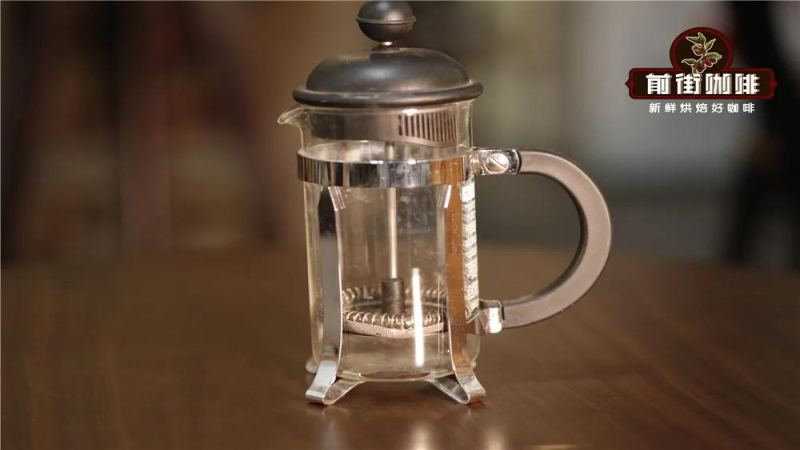
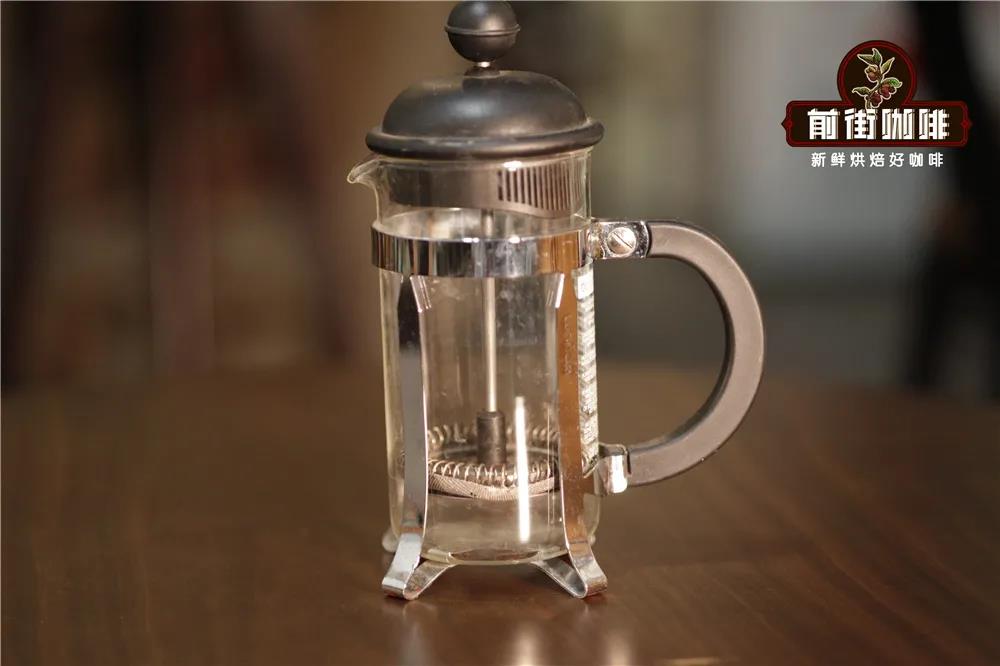
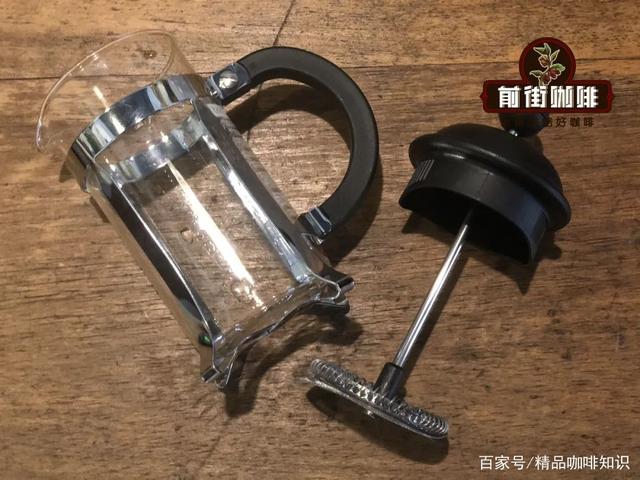
The design of the French press is simple and convenient. By simple, we mean simple structure, simple principle, and simple operation. The entire device consists of a heat-resistant glass container and a metal filter with a plunger. During brewing, you only need to steep the coffee grounds and hot water in the glass container, then filter out the coffee grounds through the metal mesh with the plunger, and you get a relatively clean cup of coffee. The whole process requires only three manual steps: add grounds, add water, press the plunger.
What grind size should be used for the French press? The answer is coarse grind.
The grind size of coffee grounds is related to the roast level of the beans. The extraction method of the French press (No. 20 sieve pass rate 68-75%) is very similar to cupping; both are mainly immersion-based, so the chosen grind level is highly consistent with cupping. There is another reason for choosing coarser particles—the French press uses a metal filter, and the mesh openings are visible to the naked eye, so a coarser grind is needed to better intercept fine particles. Beans of different roast levels also differ in grind size: medium-light roast can use a finer grind (pass rate 72-75%), while medium-dark roast is suitable for a coarser grind (pass rate 68-71%).
Front Street Coffee grind size standard sieve pass rate:
Fine: Cold drip > Pour-over (medium-light, medium) Syphon 80% > Moka American drip 75-80% > Pour-over (medium-dark) 75% > Cupping 70-75% > French press 65-70% Coarse
The extraction mode of the French press is similar to cupping; both belong to immersion extraction. The advantage is that it minimizes human interference factors and best presents the original taste of the beans, and the coffee flavor is also more concentrated. What are human interference factors? For example, in pour-over coffee, the height and speed of pouring water will change the flavor expression, and switching to a different dripper will also lead to a different flavor direction. The French press does not have this problem. Only three things can influence the flavor of French press coffee: grind size, water temperature, and steeping time.
Front Street's recommendations for brewing coffee with a French press:
The French press mainly relies on immersion to extract coffee. Within a fixed capacity, a set amount of water evenly dissolves substances from the coffee grounds. During extraction, time is the most important influencing factor—the longer the steep, the more substances are extracted, until saturation or a state where extraction becomes difficult. In other words, the longer the steeping time, the stronger the taste.
Next, water temperature. The French press uses immersion extraction, with the coffee grounds and water relatively still, so the water temperature is chosen to be a bit higher. For the same bean brewed with a French press, the water temperature will be 2-3°C higher than for pour-over. For brewing medium-light roasted coffee, 91-94°C is recommended; for medium-dark roasted coffee, 88-91°C is recommended.
Finally, steeping time. Time is crucial for the French press. After repeated brewing comparisons, Front Street believes that for most coffee beans, steeping for about 4 minutes according to Front Street's recommended parameters achieves the best taste and mouthfeel. You can also use this set of parameters as a template to develop your own favorite brewing plan.
The operation process is indeed very convenient. Taking 15g of coffee grounds as an example, pour the ground coffee into the pot, add 225-240ml of hot water, lift the plunger, cover with the lid, and let it sit for 4 minutes. Then slowly press down the plunger, pressing the metal filter to about 1/4 of the pot body, to avoid fine particles at the bottom surging upward.
Finally, promptly pour the coffee into a warmed cup to taste. Some people may not pour it out in time and let the coffee continue to steep in the water, which can easily lead to over-extraction.
The French press can also be used to brew tea
The French press, a simple device that integrates steeping and filtering, can brew coffee and naturally can also brew black tea, and it is equally convenient to use. On closer inspection, you will find that the tea brewers sold on the market have a structure very close to that of the French press.
Regarding French press brewing, Front Street suggests that when choosing beans, you might consider beans with better balance and flavors leaning toward dark chocolate and nuts, such as: Front Street Brazil, Front Street Indonesia Mandheling, Front Street Colombia; as for beans with rich layers of mouthfeel, such as Front Street Ethiopia Yirgacheffe, Front Street does not particularly recommend them. Because the French press is an immersion extraction, if the beans have rich flavor layers, it is difficult for the French press to display their rich layering. Oil determines the aroma and body of coffee, which also indirectly shows that: for coffee made with a French press, dark-roasted beans have better aroma and a fuller mouthfeel.
For professional coffee knowledge exchange and more coffee bean information, please follow Coffee Workshop (WeChat public account: cafe_style)
For more specialty coffee beans, please add the private WeChat of Front Street Coffee: qjcoffeex
The above content is compiled by CoffeeHunters, a coffee news website.


