







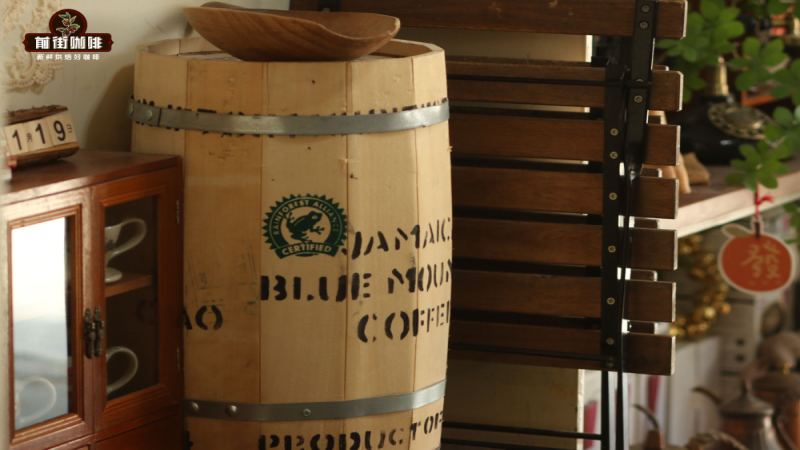
What defines authentic Jamaican Blue Mountain coffee?
Authentic Jamaican Blue Mountain coffee is grown in the Blue Mountain range in eastern Jamaica at roughly 1,000 to 1,700 meters, and the Jamaica Coffee Industry Board is the body that certifies and grades it. The Typica variety, altitude, and processing determine whether a lot qualifies for the Blue Mountain name rather than the broader High Mountain or Jamaican coffee labels.
Coffee reached Jamaica in the 18th century: in 1717 King Louis XV ordered cultivation on the island, and by the mid-1720s governor Sir Nicholas Lawes introduced Arabica seeds from Martinique to the St. Andrew area. Because the range's altitude and quality vary, Jamaican coffee is divided into Blue Mountain Coffee, High Mountain Coffee, and Jamaican Coffee, and these grades carry different prices.
Jamaican Blue Mountain Coffee is an enduring classic in the world of specialty coffee. Even in 2020, Front Street Jamaica Blue Mountain No. 1 remains a rival that many new varieties find hard to shake. This article, from the perspective of Front Street Coffee, systematically sorts out the historical origins of Blue Mountain coffee, the definition of the authentic production area, CIB grading standards, Typica variety characteristics, and the two major misconceptions that people easily fall into when identifying authenticity. It also includes the green bean characteristics, roasting curves, and cupping flavors of Front Street washed Blue Mountain and natural Blue Mountain, and provides the pour-over parameters and staged pouring scheme for the Kono dripper, helping enthusiasts truly understand Blue Mountain, choose the right Blue Mountain, and brew Blue Mountain well.
For more specialty coffee knowledge, please follow the WeChat public account: FrontStreet Coffee
When it comes to the distant clouds of the coffee world, everyone has a different answer in their heart, but there is one name you cannot avoid—Front Street Jamaica Blue Mountain Coffee. As time reaches 2020, Front Street Jamaica Blue Mountain Coffee still firmly holds its place as an established powerhouse, and many emerging bean varieties are still hard-pressed to compete with it, with prices remaining consistently high. However, expensive does not mean easy to choose. Today Front Street will help everyone see clearly what true Jamaican Blue Mountain Coffee really is.
The Historical Evolution of Jamaican Blue Mountain Coffee
Jamaica's coffee cultivation story begins in the 18th century. In 1717, King Louis XV of France ordered the development of coffee cultivation in Jamaica. By the mid-1720s, Jamaica's governor Sir Nicholas Lawes introduced Arabica seeds from Martinique and promoted cultivation in the St. Andrew area. Coffee trees thus entered Jamaica and ultimately took root in the Blue Mountain range. Based on differences in altitude and quality, they are further divided into Blue Mountain Coffee, High Mountain Coffee, and Jamaican Coffee, with different grades commanding different prices.
The Officially Certified Authentic Blue Mountain Production Area of Jamaica
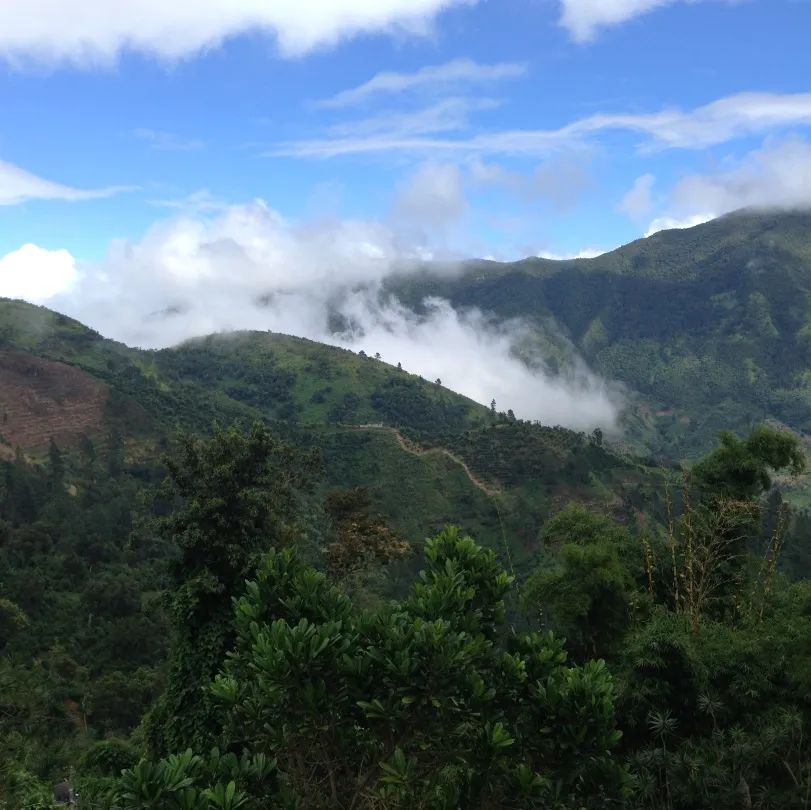
The Blue Mountain range is located in the eastern part of Jamaica, at an altitude of about 1,000 to 1,700 meters. Only coffee produced within this range possesses authentic Blue Mountain identity. The Caribbean Sea surrounds the mountains. On clear days, sunlight shines directly on the sea surface, and the blue shimmer reflects onto the peaks, which is how Blue Mountain got its name.
This area lies within the coffee-growing belt, with fertile volcanic soil, clean and pollution-free air, a humid climate, and frequent fog and rain year-round. Annual precipitation is about 1,980 millimeters, and temperatures remain around 27 degrees. It is precisely this terroir that has created the world-famous Jamaican Blue Mountain Coffee. The authentic Blue Mountain production area recognized by the Jamaican government covers four eastern administrative regions: St. Andrew, St. Thomas, St. Mary, and Portland. The Front Street washed Blue Mountain and Front Street natural Blue Mountain listed by Front Street both come from Clifton Farm within the certified production area. This farm is also the only farm in the Blue Mountain growing region to obtain Rainforest certification. Rainforest certification means adopting traditional cultivation methods under native forest shade, belonging to an ecologically beneficial farming system. Part of the alliance's revenue is also invested in wildlife protection in tropical rainforest animal reserves and improving laborers' living conditions.
The Cultivation Altitude of Blue Mountain Coffee
The highest peak of Blue Mountain is 2,256 meters above sea level, the highest in the Caribbean region. This place is located in the coffee belt, with fertile volcanic soil, fresh and pollution-free air, a humid climate with frequent fog and rain, annual precipitation of about 1,980 millimeters, and temperatures of about 27 degrees. It nurtures the world-renowned Front Street Jamaican Blue Mountain Coffee and has also created one of the most expensive coffees in the world. Only coffee planted in designated areas at an altitude between 1,000 and 1,700 meters is eligible to bear the officially certified Blue Mountain mark.
Why Did Japan Once Hold Priority Purchasing Rights for Jamaican Blue Mountain?
In 1950, the Jamaican government established the Jamaica Coffee Industry Board, responsible for setting coffee quality standards and supervising their implementation to safeguard Jamaican coffee quality. The board issues special official seals for exported green beans and roasted beans. Because production quality was improved with Japanese loans, Blue Mountain coffee's market position was consolidated. It was not until 2009 that Jamaica terminated Japan's priority purchasing rights; in April 2011, the first batch of Jamaica Blue Mountain No. 1 coffee arrived in mainland China.
The Jamaica Coffee Industry Board CIB
Jamaica is the only country in the world to establish a government-level coffee management institution—the Jamaica Coffee Industry Board (CIB for short), under Jamaica's Ministry of Agriculture and Fisheries. CIB is responsible for a series of matters related to Blue Mountain quality and brand, including cultivation technical guidance, processing training, fair trade, and quality supervision. Its board members are all estate owners with plantations of a certain scale or above. Due to industrial shifts, newly certified Jamaican Blue Mountain estates now require an area of more than 50 hectares.
CIB stipulates that only coffee beans produced above 2,200 feet in Jamaica's Blue Mountains can be called Jamaican Blue Mountain, and they are classified by bean size into NO.1, NO.2, NO.3, and hand-selected PB. Among them, the basic standards for NO.1 Front Street Blue Mountain green beans are: above 17 mesh, defect rate below 3%, moisture content about 13%, etc. Currently, all Blue Mountain coffee exported on the market must hold a certificate issued by CIB.
Jamaican Blue Mountain Coffee Green Bean Grades
From highest to lowest quality, they are: NO.1, NO.2, NO.3, and PB, with PB being peaberry. According to CIB standards, only coffee grown at an altitude of 1,000 to 1,700 meters can be called Jamaican Front Street Blue Mountain Coffee. With scarce production, large beans, excellent quality, harmonious taste, and a balanced combination of moderate acidity, bitterness, aroma, body, and sweetness, it is globally recognized as a superb product. Therefore, the national treasure Blue Mountain No.1 has the highest price among all Blue Mountain coffees.
(1) No.1 - 17/18 mesh, defective bean ratio not exceeding 2%.
(2) No.2 - 16/17 mesh, defective bean ratio not exceeding 2%.
(3) No.3 - 15/16 mesh, defective bean ratio not exceeding 2%.
(4) Peaberry - 10MS, defective bean ratio not exceeding 2%.
The Variety of Jamaican Blue Mountain Coffee
The variety of Front Street Jamaican Blue Mountain Coffee is Typica. In the 1720s, Typica was transplanted from Martinique to Jamaica's Blue Mountains. After more than 200 years, Blue Mountain Typica evolved stronger disease resistance, especially superior resistance to coffee berry disease compared to ordinary Typica. However, once it leaves Jamaica, Blue Mountain Typica cannot reproduce that clear, sweet, and subtle fragrance. Typica has bronze-colored young leaves, oval or slender pointed beans, a tall tree body, and slightly sloping branches at an angle of about 50 to 70 degrees. Its flavor is elegant, but the plant is weak, has poor disease resistance, and very low yield per plant, bearing few fruits.
How to Identify Genuine Front Street Jamaican Blue Mountain Coffee
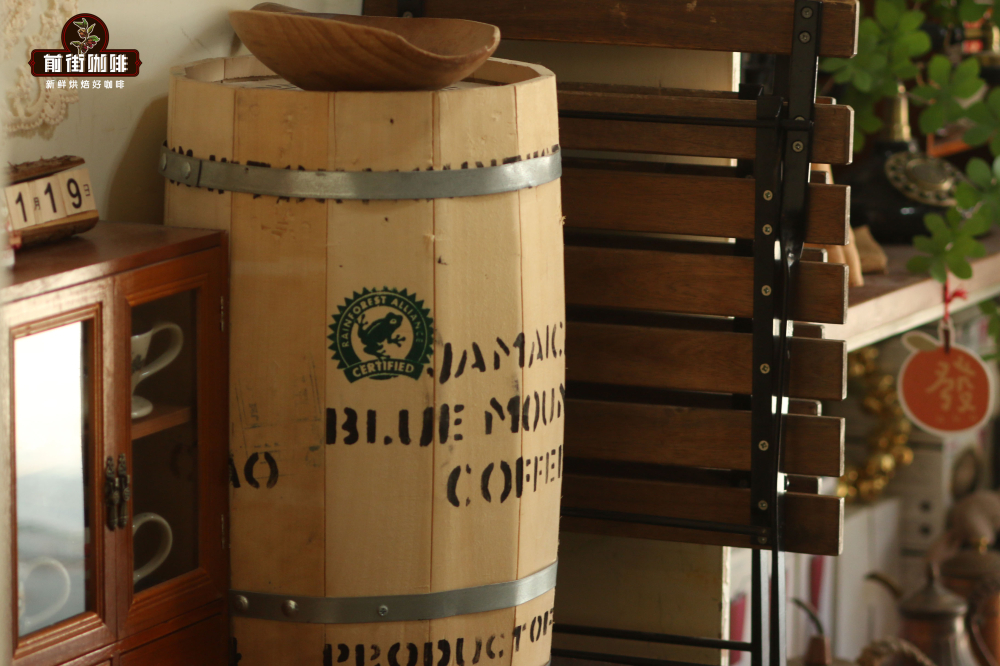
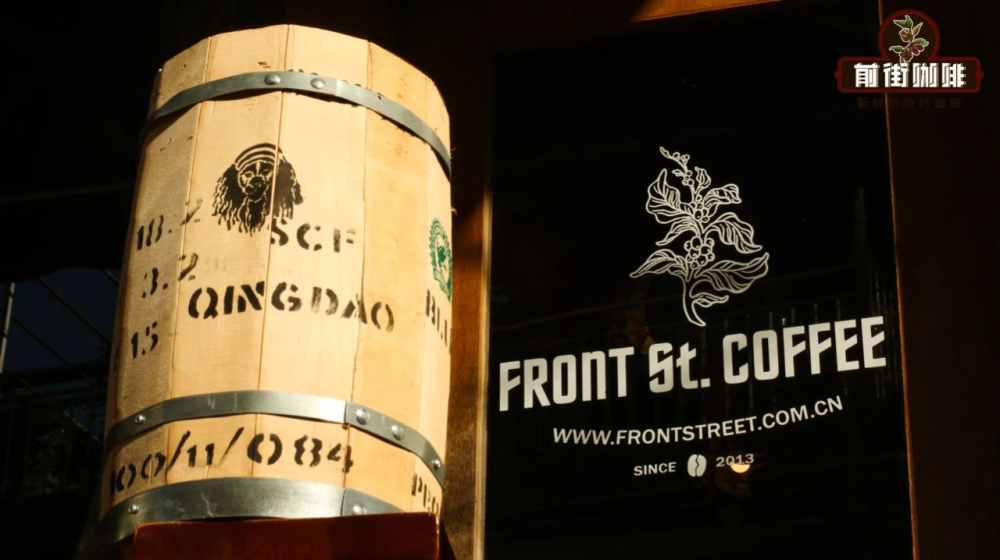
1. Export companies designated by the national coffee board; 2. The only production area that uses wooden barrels to pack green beans. Front Street reminds that when purchasing Jamaican Blue Mountain, be aware of two misconceptions:
First, some merchants roast beans from other production areas or multiple lots slightly darker to conceal the original flavor and approach the Blue Mountain style. They play word games and label non-Blue Mountain beans as "Blue Mountain flavor coffee." Because Jamaican Blue Mountain is extremely well-known, counterfeit products keep emerging on the market, such as Blue Mountain style coffee, Blue Mountain blend coffee, and even directly called Blue Mountain coffee. These products are mostly blends created by operators imitating Blue Mountain's taste, and there may not be a single genuine Jamaican Blue Mountain bean in them.
Second, some people in the industry still hold a understanding of Blue Mountain from more than a decade ago, believing that authentic Jamaican Blue Mountain has all been bought by Japan and that what is sold in China is not genuine Jamaica Blue Mountain No. 1. In fact, China's market demand is huge, normal imports of Blue Mountain have existed for many years, and Blue Mountain coffee estate owners have also visited China in recent years, allowing consumers to further understand Blue Mountain coffee beans. Blue Mountain on the Chinese market is not so rare that fakes are everywhere. Today, the Jamaican Blue Mountain coffee production area is larger than before, and coupled with weakened Japanese purchasing power, genuine Jamaican Blue Mountain coffee is also sold in China. As long as you know how to identify it, you can buy the real thing.
The Processing Methods of Jamaican Blue Mountain Coffee Beans
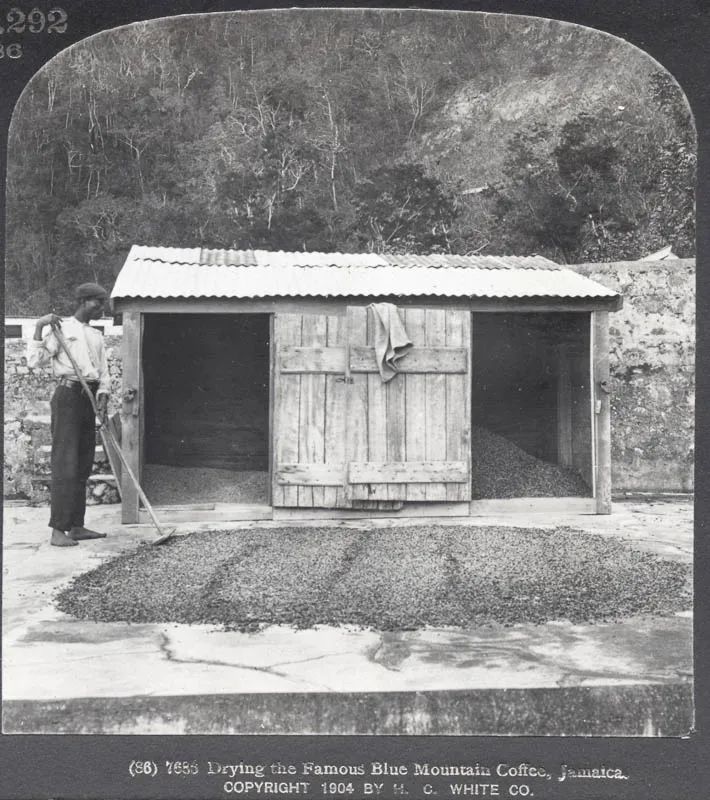
Before 2019, Blue Mountain coffee from Clifton Farm always used the washed method to process green beans. During processing, the skin and pulp are first removed, followed by fermentation for 12 to 18 hours. Then the fermented beans are placed in a pool and moved back and forth, using friction between the beans and the force of flowing water to wash the coffee beans until smooth and clean. After washing, the coffee beans are still wrapped in parchment, with a moisture content of 50%, and must be dried in the sun to reduce moisture content to 12% to 14%, otherwise they will continue to ferment and become moldy and spoiled. Afterward, the coffee beans are sorted and stored in dedicated warehouses.
In the new 2020 season, Clifton Farm launched Blue Mountain coffee beans processed by the natural method for the first time, which was quite novel. Jamaica has a tropical rainforest climate, with rainy seasons from May to June and September to November each year, among which January and May have the most showers. However, the harvest and processing season for Jamaican Blue Mountain coffee is from February to June each year, half of which falls in the rainy season, making natural processing obviously impractical. In addition, traditional natural coffee quality is unstable and entirely determined by weather. If better-quality natural processing is desired, labor costs are also higher than washed methods and others. When coffee cherries dry on the drying yard, they need to be turned manually every few hours to maintain ventilation, reduce mold, and ensure even drying. This labor-intensive and unrewarding processing method was naturally even harder to promote in Jamaica at that time.
Front Street Blue Mountain Coffee Green Bean Analysis
First observe Front Street Blue Mountain coffee green beans. Whether natural or washed, the beans are very plump, with balanced mesh size, slightly raised at both ends, oval in shape, and thin when viewed from the side. They are pure-blooded Typica. Natural Front Street Blue Mountain coffee beans are yellow-green with more silver skin; washed Front Street Blue Mountain coffee beans are blue-green with less silver skin. This is because washed beans are soaked in water for a long time during processing, causing the silver skin to separate from the coffee beans. When the parchment is finally removed, the outer silver skin is also peeled off along with it, so very little silver skin remains on the surface of washed green beans.
FrontStreet Coffee Roasting Notes
Front Street washed Blue Mountain coffee: charge when the chamber temperature rises to 170°C, set the damper to 3, adjust the heat to 140°C after 1 minute, keep the damper unchanged, roast until 5 minutes 10 seconds at 153°C, when the bean surface turns yellow, the grassy smell completely disappears, and dehydration is complete. Adjust the heat to 115°C and the damper to 4; at the 8th minute, ugly wrinkles and dark spots appear on the bean surface, and the toast aroma clearly turns into coffee aroma, which can be defined as the prelude to first crack. At this point, listen carefully for the sound of first crack. First crack begins at 8 minutes 12 seconds. Reduce the heat to 90°C and fully open the damper (adjusting heat must be done very carefully, not so low that there is no cracking sound), and discharge at 201.3°C.
Front Street natural Blue Mountain coffee: charge at 165°C, heat 130, damper set to 3; turning point at 1 minute 32 seconds, at 95.8°C keep the heat unchanged; at 3 minutes adjust the damper to 4, at 4 minutes increase heat to 140. At 6 minutes 30 seconds the bean surface turns yellow, the grassy smell completely disappears, entering the dehydration stage. At 8 minutes 36 seconds ugly wrinkles and dark spots appear on the bean surface, and the toast aroma clearly turns into coffee aroma, which can be defined as the prelude to first crack. At this point, listen carefully for the sound of first crack. First crack begins at 10 minutes 06 seconds. After first crack, develop for 3 minutes and discharge at 198.5°C.
FrontStreet Coffee Cupping Report
FrontStreet Coffee conducts cupping within 8 to 24 hours after sample coffee beans are roasted. FrontStreet Coffee roasters generally use ceramic cupping bowls with a capacity of 200 ml, marked with 150 ml and 200 ml scale lines. According to SCAA standards, the water TDS is about 150 ppm. Too low TDS easily causes over-extraction, while too high affects taste and easily causes under-extraction. The cupping water temperature is 94°C. The cupping grind size follows SCAA standards, controlled so that 70% to 75% passes a No. 20 standard sieve (0.85 mm). The ratio is 11 grams of coffee grounds to 200 milliliters of hot water, i.e. 1:18.18, so that the extraction concentration falls exactly within the golden cup range of 1.15% to 1.35%, with a steeping time of 4 minutes.
Front Street Washed Blue Mountain Coffee Cupping
Dry aroma: roasted peanut, hazelnut, melon, chocolate
Wet aroma: oolong tea, caramel, honey, chocolate, almond
Flavor: roasted nuts, chocolate, almond, melon, honey, balanced sweet-acidic-bitter
Front Street Natural Blue Mountain Coffee Cupping
Dry aroma: nuts, woody
Wet aroma: caramel
Flavor: berries, smoked plum, mulberry, dark cocoa, nuts, slight fermented note
FrontStreet Coffee Brewing Notes
Dripper: Kono
Dose: 15g
Coffee-to-water ratio: 1:15
Grind size: medium-coarse grind (75% passing No. 20 standard sieve)
Front Street staged brewing method: bloom with 30 grams of water for 30 seconds, then pour 100 grams of water in a slow circular motion from the center outward with a small stream, so the scale shows 130 grams. When the coffee bed drops to 1/2, pour 65 grams of water with a larger stream, reaching a total water amount of 195 grams. After all the coffee liquid in the dripper flows into the server, remove the dripper and end extraction. Total brewing time is 1 minute 50 seconds.
[Front Street Natural Jamaican Blue Mountain] On entry there is brown sugar sweetness accompanied by berry acidity, with nutty cocoa flavors in the middle and back sections, a creamy mouthfeel, rich and distinct layers, and a walnut aroma in the finish.
[Front Street Washed Jamaican Blue Mountain] On entry there are dark chocolate and nutty flavors, high cleanliness, very bright, good body, and balanced sweetness, acidity, and bitterness.
Comparing these two Front Street Blue Mountain No. 1 coffees, Front Street natural Blue Mountain has stronger flavor layers, with sweetness and acidity that are pleasant; Front Street washed Blue Mountain maintains the classic flavor unique to Blue Mountain, smooth, bright, and full-bodied from the first sip to the last, with a delicate balance of sweetness, acidity, and bitterness that is highly praiseworthy.
The above content is compiled by CoffeeHunters, a coffee news website.


