







How Should You Set Up French Press Coffee Brewing?
A French press brews by immersion, steeping grounds fully in hot water before a metal filter plunger separates the liquid. Grind coarse, a bit larger than granulated sugar, or fine particles will slip through the mesh and leave the cup muddy. Preheat the glass carafe first, since the glass loses heat quickly and a cold pot drops the brew temperature.
The press appeared in France around 1850 and consists of a heat-resistant glass carafe plus a plunger with a metal filter; it also handles tea and milk foam. Because full immersion extracts body and oils, light, medium and dark roasts perform differently in the same setup. Bean choice and roast level matter as much as technique, so beginners and experienced brewers can tune the recipe to taste.
The French press is a simple and easy-to-use immersion coffee brewing device, suitable for easily making full-bodied coffee at home. This article will start with the origin and structure of the French press, explain in detail the key points to note such as grind size, preheating the pot, brewing ratio, and plunger operation, and through comparative experiments with three beans of light, medium, and dark roast, analyze the flavor performance of different roast levels in a French press, and finally give recommendations on bean selection suitable for the French press. The article also retains several recommended bean lists from Front Street Coffee for beginners and advanced enthusiasts to refer to.
When you want to drink coffee at home, the French press is a quite convenient choice. As far as Front Street Coffee itself is concerned, it was exactly our earliest purchased coffee equipment, so we have always had a special preference for the French press. Of course, the cleaning step is indeed a bit cumbersome.
The French press was born in France around 1850. Its structure is not complicated, consisting of a heat-resistant glass carafe (or transparent plastic material) plus a plunger with a metal filter. It can not only brew coffee and tea, but also be used to make milk foam, with quite diverse functions. Its extraction principle belongs to immersion, allowing hot water and coffee grounds to fully contact, releasing the essence of coffee through steeping, with a low operational threshold and no high technical requirements.
Making coffee with a French press involves fully immersing the coffee grounds in hot water, then separating the coffee liquid from the residue through the metal filter plunger. The coffee extracted in this way has outstanding body, with improved texture and oiliness, and the final cup is relatively clean.
Notes on using the French press!!
Grind size
The grind size suitable for a French press should be relatively coarse, usually recommended to be a bit larger than granulated sugar particles. If ground too fine, a large amount of superfine powder will pass through the filter, making the coffee taste less clean and affecting the overall experience.
Preheating the pot
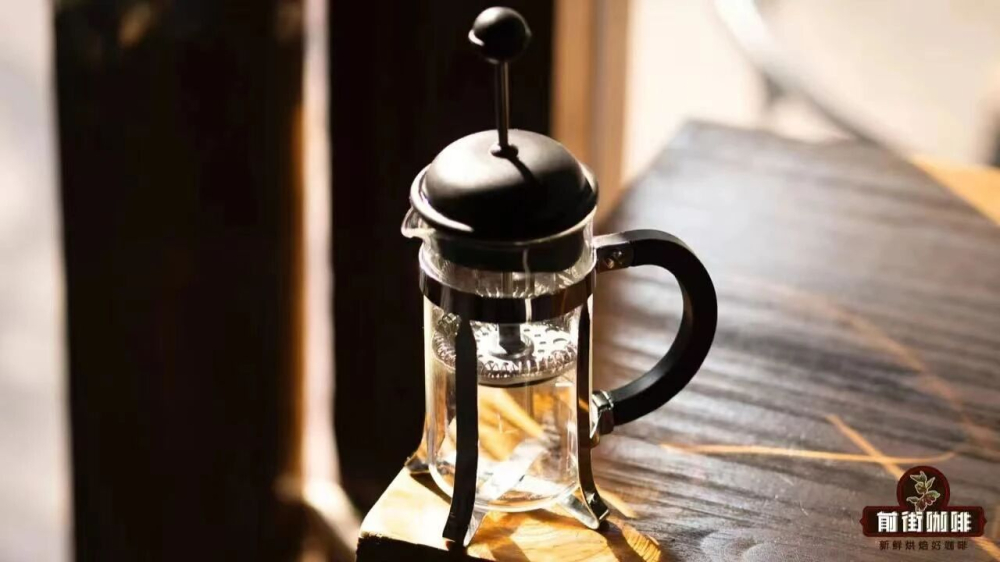
Remember to preheat the pot with hot water before brewing. Since the carafe is made of glass, if you do not preheat the pot in advance, the water temperature will drop relatively quickly.
Coffee brewing ratio
The brewing ratio refers to the ratio of coffee grounds to water, commonly used in the range of 1:15 to 1:18. Taking 1:15 as an example, that means 15 grams of coffee grounds correspond to 225 grams of water. When using a French press at home, you can adjust this ratio according to personal taste.
Plunger
When pressing down the plunger after steeping, the motion must be kept uniform and pressed all the way down in one go. If you repeatedly pull and press up and down, the coffee grounds are likely to surge upward, causing sediment in the cup.
How to choose coffee suitable for the French press?
We used three beans of different roast levels—light-roasted [Elida], medium-roasted [Hartmann], and dark-roasted [Tiger Mandheling]—to try in the French press and see what flavors they would present!
Elida: The wet aroma is sweet fermented fruit, with obvious jackfruit and passion fruit flavors on the palate, bright fruit acidity, and not very obvious sweetness.
Hartmann: Rich red wine fermentation aroma, obvious tropical fruit sweet-and-sour taste, overall round.
Tiger Mandheling: Balanced taste, full-bodied texture, good oiliness, obvious dark chocolate, caramel, and cream flavors.
Because the French press belongs to immersion extraction, the coffee grounds need to contact hot water for a relatively long time. If light-roasted beans are used, relatively high acidity will be extracted, and the original floral and fruity aromas and light layering will be masked. Therefore, compared with light roast, the French press is more suitable for medium to dark roasted single-origin coffee, which can better express sweetness and caramel-type flavors.
For beginners making French press coffee, the first choices are Front Street PWN Golden Mandheling, Front Street Blue Mountain, and Front Street Queen's Estate; if you like coffee with richer fruity aromas, buy Front Street Strawberry Candy, Front Street Mozart, and Front Street Sidra.
After this experiment, Front Street believes that the beans most suitable for the French press are none other than dark-roasted beans. Because of immersion extraction, the coffee made with a French press has a full body and balanced flavor. Therefore, if beans with rich flavor layers are used for extraction, the characteristics of that bean will not be highlighted. Instead, the full-bodied taste and balanced flavor of dark-roasted beans can be well interpreted under the immersion extraction of the French press.
The above content is compiled by CoffeeHunters, a coffee news website.


