







What Does Gesha Village Red Label Gori Gesha Taste Like?
Ethiopia's Gesha Village Estate and Panama's Hacienda La Esmeralda are the two reference points for gesha coffee, and both use a Red Label name on different terms. Gesha Village grades internally into Auction, Gold Label, Red Label, Green Label and Chaka lots, and grows Gori Gesha, Gesha 1931 and Illubabor across 471 hectares, about 320 of them planted by 2017.
The Red Label natural Gori Gesha shows floral and fruity notes with honey sweetness, and its dense gesha green coffee needs a harder brew plan than a typical washed lot. A medium-fine grind, a moderate coffee-to-water ratio, water just off the boil and a three-stage pour are used to pull the aromatics out evenly without pushing bitterness. Compare green bean appearance against Panamanian gesha to see the density difference.
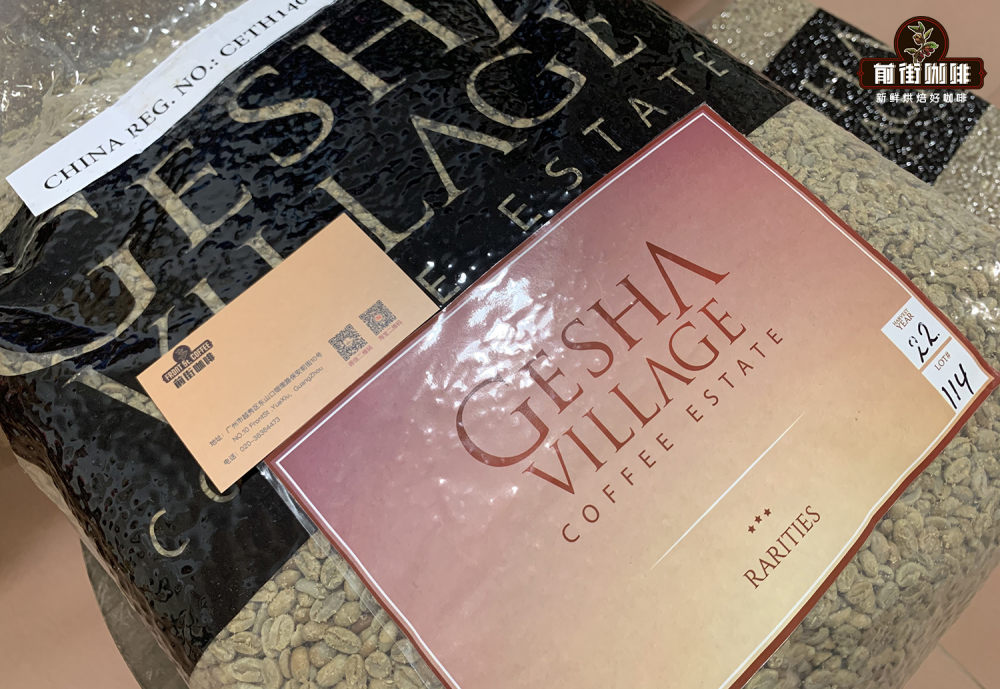
Gesha coffee's status in the specialty coffee circle needs no elaboration, and Ethiopia's Gesha Village Estate and Panama's Hacienda La Esmeralda are two benchmarks. Front Street Coffee takes Gesha Village Red Label Natural Gori Gesha as an example this time, sorting out the estate background, internal grading system, and comparing the green bean appearance and flavor differences between Ethiopian and Panamanian Red Label Gesha. The article also records in detail the pour-over plan designed by Front Street for the harder bean quality of Gesha, including grind size, coffee-to-water ratio, water temperature, and three-stage pouring rhythm, helping enthusiasts more fully present Gesha's floral and fruity notes and honey sweetness.
In the specialty coffee field, Gesha's reputation is almost universally known, with a status no less than Blue Mountain. Some even describe it this way: just one sip of Gesha, and your heart is carried away by it. Front Street Coffee (FrontStreet Coffee) this time takes Ethiopian Gesha Village Gesha and Panamanian Gesha as examples to discuss.
The founders of Gesha Village Estate are documentary director Adam Overton and his wife Rachel Samuel. In their early years, while filming a coffee documentary for the Ethiopian government, they walked into the Gera coffee forest located in the Bench-Maji region. This experience not only gave them a new understanding of the land of Ethiopia, but also prompted them to conceive the idea of establishing their own coffee estate and brand. Later, they met Willem Boot of Finca La Mula in Panama, thereby choosing the direction of Gesha's origin and learning Panama's planting and management experience.
Ultimately, they established "Gesha Village Estate" in the Bench-Maji region and carried out internal plot subdivision, variety management (Gesha 1931, Gori Gesha, and Illubabor), and product classification. Gesha Village's internal grading includes Auction, Gold Label, Red Label, Green Label, and Chaka lots. The estate covers three varieties: Gori Gesha, Gesha 1931, and Illubabor (a native Ethiopian disease-resistant variety).
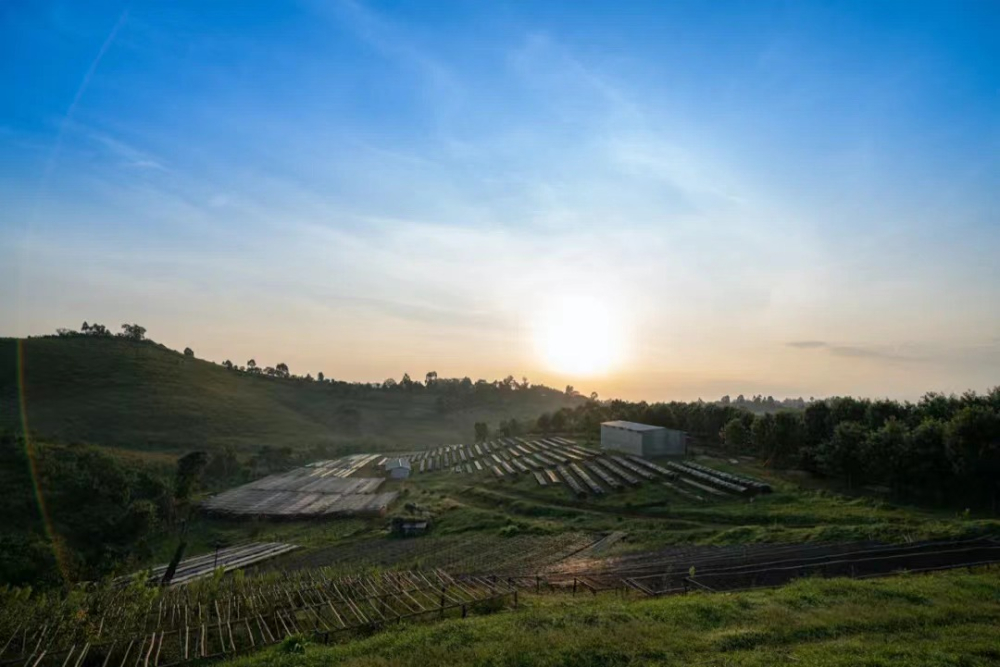
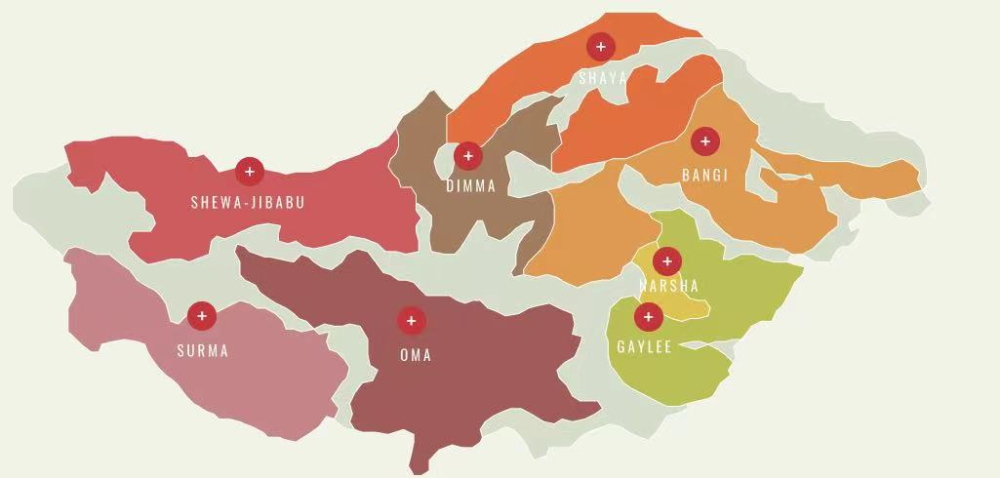
Gesha Village has a total area of 471 hectares, gradually expanding the planted area from 2011, reaching about 320 hectares by 2017, making it one of the largest Gesha estates in the world. To manage more meticulously and refine flavor, the estate owners divided Gesha Village into 8 major blocks and continued numbering within each lot.
Even top estates produce coffees with quality differences. In order not to disappoint Gesha Village's flavor reputation, a strict grading system is implemented within the estate.

Auction lot: accounts for only 3.7% of Gesha Village's annual production. It is the estate's top lot after rigorous selection and can only be obtained through the 2018 Gesha Village Coffee Estate global auction. The 2018 auction lot's cupping score was 88.15-92.67 points, and it is further divided into Champion's Reserve and Farm Reserve.
Gold Label lot: accounts for only 5% of Gesha Village's annual production. It is a lot often chosen by competitors around the world, and roasters with high quality requirements also purchase it. It has complete traceability, with prominent flavor and high complexity in each lot, making it the estate's finest lot after Auction.
Red Label lot: a lot with complete traceability, presenting typical Gesha Village flavor. Its flavor intensity and complexity are slightly weaker than the Gold Label lot, making it a single-origin lot with very high cost performance.
Green Label lot: a lot from a single plot and a single variety, with typical Gesha Village flavor. Its flavor intensity and complexity are slightly weaker than the Red Label lot.
Chaka lot: a Gesha coffee blend produced by Gesha Village, including three varieties: Gori Gesha, Gesha 1931, and Illubabor (a native Ethiopian disease-resistant variety).
What Front Street Coffee (FrontStreet Coffee) offers is precisely the Gesha Village Red Label lot, with complete traceability, typical Gesha Village flavor, and flavor intensity and complexity slightly weaker than the Gold Label lot, making it a single-origin lot with very high cost performance.
In addition to Gesha Village's various labels, Panama's Hacienda La Esmeralda Gesha also has Red Label, Green Label, and Blue Label distinctions. If Ethiopia is Gesha's birthplace, then Panama is Gesha's place of rise. Panama is like an archway, connecting North America and South America, and linking the Pacific and Atlantic Oceans; it has always been a marginal player in specialty coffee. In 2004, Panamanian Gesha first revealed its fragrance and won repeatedly, proving to the world that Panama is not only an internationally strategic location, but also a new overlord of specialty coffee.
Hacienda La Esmeralda's current Gesha product line is divided into Red Label, Green Label, and Blue Label. However, starting from the 2021 harvest season, Hacienda La Esmeralda officially announced that it would no longer release the Blue Label series.
The Esmeralda Special series is the highest-quality Gesha coffee beans sold by Hacienda La Esmeralda, grown in specific plots at 1,600-1,800 meters above sea level, and each lot must cup above 90 points. Usually this series comes from the two sub-estates Jaramillo and Cañas Verdes (El Velo also produced a Red Label series, though that estate's plots mainly focus on exploring commercial feasibility and grow many coffee varieties).
The Red Label's official name is "Esmeralda Special," translated into Chinese as "翡翠特选." Another feature of Red Label lots is that each lot has an independent number, and all coffee beans in one lot come from one small plot. For example, Front Street's Red Label comes from the Jaramillo plot. This way, buyers can choose lots that suit their preferences based on subtle flavor preferences.
The Green Label's official name is "Private Collection," translated into Chinese as "私人收藏." According to Hacienda La Esmeralda's introduction to this series, it can roughly be understood as follows: unlike Red Label, this series does not emphasize specific plots, but emphasizes the signature flavor of Hacienda La Esmeralda's high-altitude Gesha coffee. This series is a blend of lots produced from various specific plots. (In fact, Green Label can roughly be understood as Red Label without plot separation.)
Comparing green bean appearance, Ethiopian Red Label Gesha and Panamanian Red Label Gesha also differ greatly. Panamanian Red Label Gesha's green bean characteristics are easier to identify: "pointed at both ends, elongated, plump and full-bodied, large beans"; Ethiopian Red Label Gesha is "slightly smaller in size, and the bean body is not so long."
Front Street compared Ethiopian Gesha and Panamanian Gesha. Although both have excellent acidity and fragrant floral notes, there are clear differences in specific flavor descriptions. Panamanian Gesha has obvious jasmine aroma, citrus (berries), and rich honey sweetness, overall soft and comfortable. Ethiopian Gesha also has floral notes, but its main tone is a very rich juicy feel (orange juice), full of Ethiopia's explosive fruit flavors.
Gesha coffee's flavor characteristics are so distinct—how can its original features be fully revealed? Front Street researched a set of optimal brewing plans for it.
This brewing uses Esmeralda Red Label coffee beans for demonstration. For the dose, Front Street still chooses 15g, paired with a Hario V60 small dripper. For grind coarseness, a slightly coarser grind than Front Street's previous offerings is used, with a 78% pass rate on a No. 20 sieve, mainly because Gesha beans are relatively hard and easily sink to the bottom and clog the drainage hole.
Accordingly, the coffee-to-water ratio is adjusted to 1:16. On one hand, use an extra portion of water to maintain the coffee's extraction yield; on the other hand, lower the coffee concentration to between 1.15%-1.25%, as this concentration is where the coffee's best flavor is experienced. For water temperature, maintain 91 degrees Celsius.
When brewing, first pour 25ml of hot water for a 30-second bloom. Because Gesha beans are hard and their water absorption is not so strong, pouring 25ml of hot water already basically wets the surface of the coffee grounds; if more water were used for the bloom, the excess water would actually just fall into the server. During the bloom, be gentle, circling from the center outward with a small stream; this kind of bloom pouring has the best effect.
After the bloom ends, proceed to the second pouring stage. At this stage, 120ml of water needs to be poured, circling from the center outward in a "mosquito coil" pattern to raise the coffee bed. Finish pouring in about 1 minute. Then wait for the water level to drop. Normally, the water level drops at a uniform, slow rate, reaching the 1/2 point in about 1 minute 10 seconds to 1 minute 15 seconds, forming a "bowl shape."
At this point, begin the final pouring stage. In this stage, pour 90ml of water, circling within a half-circle of the water surface, finishing in about 1 minute 35 seconds. Then just wait for the coffee liquid to drip into the server and remove the dripper to finish; the time is about 2 minutes to 2 minutes 5 seconds.
Gesha coffee brewed this way will show rich floral and fruity aromas, as well as the sweetness of fruit and honey, overall soft and not bitter. Friends who like it can give it a try!
The above content is compiled by CoffeeHunters, a coffee news website.


