







What Sets the Arabica Bean Apart From Robusta and Liberica?
Arabica is one native coffee species among three, not a specific drink, despite the 100% Arabica claims on shop menus. It accounts for about 60 to 70 percent of world production and includes sub-varieties such as Bourbon and Typica. Robusta supplies roughly 30 to 40 percent, while Liberica is about 3 percent and has largely left the commercial market.
An arabica bean tree grows between 1,000 and 2,000 meters, tolerates relatively cool conditions at 15 to 24°C, and needs at least 1,500 millimeters of annual rainfall, with caffeine around 0.8 to 1.5 percent. The article compares Arabica and Robusta on aroma, disease resistance, caffeine and espresso blending, and looks at variety classification including Blue Mountain and Kopi Luwak.
Walking into a coffee shop, you often see "100% Arabica" as a selling point, but what exactly is Arabica? How does it differ from Robusta and Liberica? This article sorts out the origins, growing conditions, flavor characteristics, and market positioning of the three native species of coffee beans, compares the different roles of Arabica and Robusta in aroma, disease resistance, caffeine content, and espresso blends, and explains the quality gap between 10-yuan and 30-yuan coffee, the variety classification of Blue Mountain and Kopi Luwak, and how professional brands like "Front Street" present the origin charm of single-origin coffee.
Nowadays, many coffee merchants like to advertise that they use "100% Arabica" in their promotions, as if this equates to high quality. But strictly speaking, Arabica is just a variety of coffee bean, not a specific coffee beverage.
Coffee varieties:
The three native species are Arabica, Robusta, and Liberica (Liberica). Arabica ranks first in production, accounting for about 60-70% of the world's coffee, with sub-varieties such as Bourbon and Typica. Robusta accounts for about 30-40% of the world's total coffee production. Liberica accounts for only 3% of the total and is mostly grown in the Asia-Pacific region.
Liberica, also known as large-bean coffee, has extremely strong vitality, but its flavor and resistance to leaf rust are both weak. Its cultivation accounts for less than 1%, and it has basically withdrawn from the commercial market, preserved only in scientific research. Therefore, the focus of what we are discussing today is Arabica and Robusta.
Arabica
Also known as small-bean coffee, it originated in Ethiopia. Arabica coffee trees mostly grow at altitudes between 1,000 and 2,000 meters; they are relatively cold-tolerant, with a suitable growing temperature of 15-24°C; they require relatively high humidity, with annual rainfall of no less than 1,500 milliliters, and they also have relatively high requirements for cultivation techniques. The Arabica coffee tree is a relatively large shrub, with elliptical, dark green leaves. The fruit is also elliptical, generally containing two slightly flat beans. The front is elongated and oval, with a narrow, curved S-shaped crack in the middle, and the arc on the back of the bean is relatively smooth. The caffeine content is about 0.8%-1.5%.
The excellent flavor and aroma of Arabica coffee make it the only one among these native species that can be drunk directly and on its own. Jamaican Blue Mountain, Indonesian Mandheling, Yirgacheffe, and Brazilian coffee all belong to single-origin coffee. However, it has weak resistance to drought, frost damage, pests, and diseases, especially the coffee plant's greatest natural enemy—leaf rust—so producing countries are all committed to improving varieties.
Arabica coffee produced in different regions, at different altitudes, and in different climates has its own characteristics and can display distinctly different individual flavors. When unroasted, it smells fresh and grassy; after proper roasting, it presents "fruity notes" (light to medium roast) and "caramel flavor" (dark roast), suitable for single origins and various blends, and can be made using various extraction techniques.
Robusta
Also known as medium-bean coffee, it originated in Congo, Africa. Robusta coffee trees are mostly grown in lowlands at altitudes of 200-800 meters. They prefer warm climates and require temperatures of 24-29°C, with relatively low rainfall requirements. However, this variety relies on insects or wind for pollination, so it takes 9-11 months from pollination to fruiting, longer than Arabica.
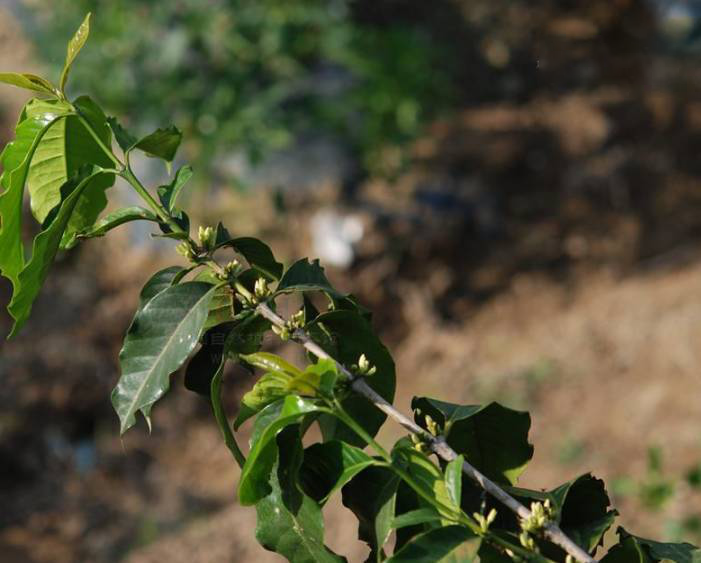
The Robusta coffee tree is a species between a shrub and a tall tree. Its leaves are longer and bright green, and the tree can reach up to 10 meters tall, but its roots are very shallow. The fruit shape is plumper than Arabica beans, with the center line splitting vertically. Viewed from the side, it is usually flat or protruding in the middle. It feels harder than Arabica beans, like small stones.
Robusta coffee flavor is generally inferior to Arabica.
| The value of Robusta
As a very important variety in the coffee world, Robusta has made indispensable contributions in the commercial world. The value of Robusta is not as a negative example to set off how superior Arabica's flavor is; it has an unshakable position in espresso blends. Italian blends add a small amount of Robusta to the blend to improve the coffee's body and create an Espresso with richer crema.
After Espresso blends with milk, it presents a rich and full mouthfeel. Because of the complementary relationship between Robusta and Arabica, milk coffee becomes even richer and more aromatic. Robusta makes up for Arabica's body.
【Robusta】
Mainly used in espresso blends to increase body and obtain rich crema. Although Robusta's flavor cannot compare with Arabica, it has its own value.
Beginner questions:
1 | What is the difference between 10-yuan and 30-yuan coffee?
From the perspective of the coffee market, coffee beans are mainly divided into two categories: commercial beans and specialty coffee beans. In terms of price, Robusta international futures are about 1,686 USD per ton, which at today's exchange rate is about 11.5 RMB per kilogram. Specialty coffee beans are several times more expensive than commercial beans. From a cost perspective, choosing commercial beans naturally leaves a much larger profit margin, but the coffee taste obtained from commercial beans is far inferior to that of specialty coffee beans. They can be used to make lattes, cappuccinos, and other espresso drinks.
Between commercial coffee and specialty coffee, 10 yuan and 30 yuan indeed mean a difference in quality. Simply put, specialty coffee beans are high-quality green beans, roasted with exquisite roasting skills, restoring the unique taste inherent in the coffee beans themselves—a flavor that only this kind of coffee bean can have. Specialty coffee beans are processed using refined methods. Careful washing and sun-drying, and various delicate green bean processing techniques, give the coffee "layered," "fruity-acidic," "sweet," and "mellow" flavors.
Specialty coffee beans are several times more expensive than commercial beans. From a cost perspective, choosing commercial beans naturally leaves a much larger profit margin. Products like those produced and packaged on a large scale are generally made from commercial beans.
In terms of the flavor of individual beans, commercial beans are generally chosen for blending. The price of such commercial coffee beans is generally relatively cheap, and whether in terms of green coffee beans or roasting techniques, they can only be said to be produced according to a mass-production standard. The biggest difference between specialty coffee and commercial coffee beans lies in quality and price. Specialty coffee beans may cost 90 yuan per pound, while commercial beans may cost as low as 40-50 yuan per pound.
However, in reality, blended beans can also make very good-tasting coffee. It mainly depends on what beans are used in the blend.
2 | "Blue Mountain Coffee" and "Kopi Luwak" are coffees; Arabica is a variety of coffee bean.
Most people have heard of "Blue Mountain Coffee" and "Kopi Luwak." These are coffee beverages, while "Arabica" as "coffee" refers to the variety of coffee.
◆ "Blue Mountain Coffee" refers to coffee brewed from coffee beans produced in the Blue Mountains of Jamaica.
◆ "Kopi Luwak" is made by extracting coffee beans from the feces of an animal called the civet, which eats coffee cherries and then excretes the coffee beans largely intact, after which people extract them and process them.
Therefore, the "Arabica" we often see now is actually classified based on coffee bean variety.
Coffee bean varieties can mainly be divided into three types: Arabica, Robusta, and Liberica, and Arabica is further divided into Typica, Bourbon, Caturra, and so on.
In fact, not all coffee made from Arabica coffee beans is specialty coffee. Unfortunately, many people are not very aware of this, and many brands take the opportunity to use "100% Arabica coffee beans" as a gimmick, making consumers think their coffee is excellent.
In "relatively professional" coffee shops, when ordering single-origin coffee, you will hardly see advertising like "Arabica coffee beans." For example, at Front Street Coffee, what you see are words like "Kenya," "Colombia," and "Yirgacheffe." Tasting "single-origin coffee" allows you to understand the characteristics and flavors of coffee from a certain country or region.
The above content is compiled by CoffeeHunters, a coffee news website.


