








What Sets Australian Coffee Apart From a Latte?
A Flat White, or Australian White, uses less milk and a thinner layer of foam than a latte, so the espresso reads more clearly in the cup. Starbucks pushed the drink hard in China around 2015, partly in response to rival Gloria Jean's Coffee planning entry, after the chain had already withdrawn from Australia around 2000 against local competition.
The name itself dates to the 1962 British film Danger by My Side, where it described bland coffee rather than a drink; only in the 1980s did it become a menu item. The Australia-New Zealand origin dispute continues, and Australia's coffee culture still shapes how cafés size cups, texturise milk and choose espresso blends for this style.
Flat White, Australian White, latte, cappuccino—these names sound similar and taste somewhat alike, but they actually differ in their coffee-to-milk ratio, foam thickness, and choice of espresso. This article begins with Starbucks' marketing push for Flat White, tracing the term from its derogatory use in a British film to its evolution into a coffee name in the 1980s, and sorts out the dispute between Australia and New Zealand over its origin. At the same time, the article will compare Australian White, latte, and cappuccino in terms of cup size, foam thickness, and flavor, and introduce Front Street Coffee's specific parameters and blended bean choices for making Australian-style white coffee.
Hearing the three characters "馥芮白" for the first time, most people instinctively equate it with white coffee, or assume it refers to the kind of coffee with more milk and a whiter color. But now, walking into any café, you can often hear customers blurt out: a Flat White, please. What exactly is this Flat White drink? And how did it come into the public eye?
When it comes to milk coffee, the most familiar is undoubtedly the latte. It was with this classic milk coffee originating from Europe that Starbucks made its name globally. Around 2015, Starbucks vigorously promoted Flat White in the Chinese market, but the market response was lukewarm. It was not until Starbucks' strong rival—the Australian coffee chain brand Gloria Jean's Coffee—intended to enter China that Starbucks was forced to step up its push for Flat White.
In fact, Starbucks had not failed to test the Australian market. Around 2000, Starbucks invested heavily in expanding its coffee footprint in Australia, but ultimately lost to Gloria Jean's Coffee, which at the time had more than 500 stores in Australia, and had to withdraw in disappointment.
Starbucks has its reasons for promoting Flat White so hard. Flat White is originally a milk coffee originating in Australia, so it is usually translated as Australian-style white coffee, or Australian White for short.
The term Flat White can be traced back to the 1960s. In the 1962 British film "Danger by My Side," the term Flat White appeared, but at that time it was not a coffee name; it was used to describe a cup of coffee as mediocre in quality and bland and unpleasant in taste.
It was not until the 1980s that Flat White truly came to refer to a coffee drink. Interestingly, opinions still differ to this day about where this coffee originated—some believe it is Australia, while others insist it is New Zealand.
There are two versions of the New Zealand claim: first, in 1985, Flat White appeared on a menu at Parliament House in Canberra, when milk was difficult to froth because of the season; second, in 1989, a New Zealand barista named Frank Mlnnes used skim milk when making a cappuccino, and because skim milk lacks enough fat to froth, he ultimately produced a milk coffee with extremely thin foam and named it Flat White.
The Australian claim is this: in the mid-1980s, the term Flat White appeared on the menu of a café in Australia, and a café magazine also mentioned this product. Another Australian newspaper article translated latte as Flat White in order to satirize the then-booming latte.
In many people's impressions, Starbucks' Flat White and latte taste quite similar, except that Flat White has a stronger coffee flavor and a deeper bitterness and finish. In fact, the two can be considered to share the same origin, only later diverging into different branches. The communities of Italian descent in North Queensland, Melbourne, and Sydney in Australia are also the second place after Italy to possess an espresso culture.
Whether the place of origin is Australia or New Zealand, in the final analysis, Flat White was born in Oceania. Not only is the place of origin disputed; the method of making Australian-style white coffee also differs. New Zealanders prefer to use a double ristretto, while Australians are accustomed to using a single espresso.
At this point, some may ask: what is ristretto? The word ristretto comes from restrict and narrow, and literally means an espresso with a small yield within a limited time; it is derived from espresso. With the same dose of coffee grounds, ristretto has a shorter extraction time and produces less coffee liquid.
More plainly speaking, ristretto is a high-concentration, low-yield espresso. Because only the essence of the front part of the shot is captured, its flavor is more concentrated, its bitterness is lower, and its mouthfeel is richer and fuller.
The method for Australian White is to combine fine, light milk foam with a single espresso or a double ristretto. To some extent, it is close to a traditional 5-ounce cup (150mL) cappuccino or latte, so the coffee proportion is higher, the foam is lighter and finer, and it has both the richness of espresso and the sweetness of milk.
For coffees also made by frothing milk, many beginners are curious: what exactly is the difference between cappuccino, latte, and Australian-style white coffee? A very intuitive comparison chart can be found online, distinguishing the three by two dimensions: the coffee-to-milk ratio and the thickness of the milk foam.
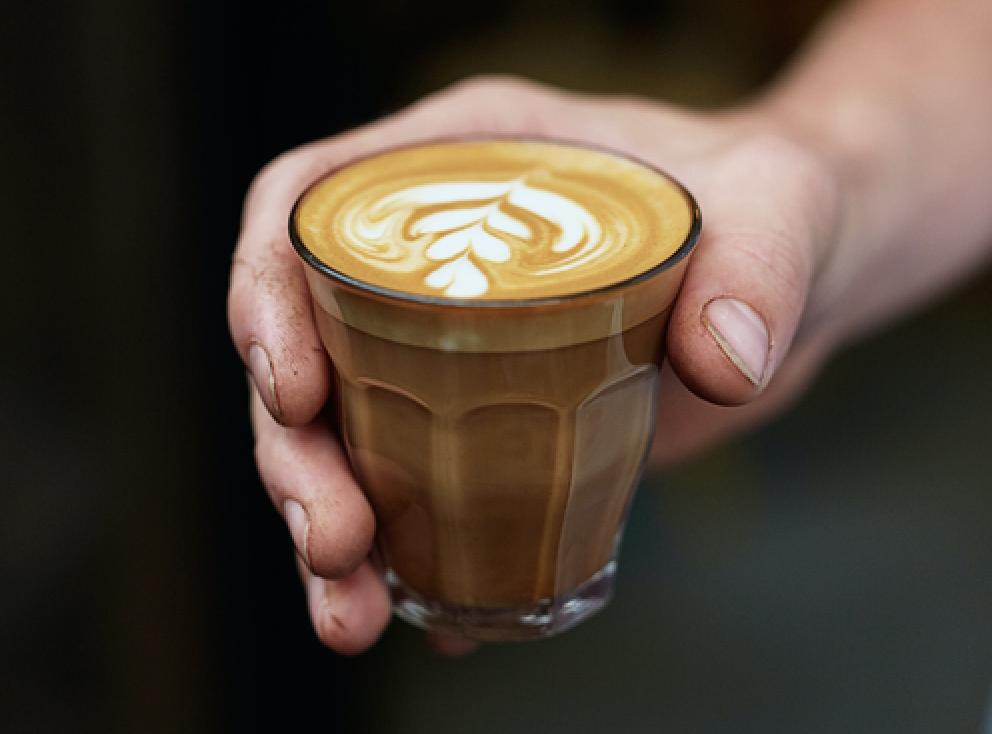
When Front Street serves these three coffees, it uses cups of different capacities to help customers tell them apart. Latte is served in a 300mL wide-mouth ceramic cup, cappuccino in a 180mL narrow-mouth ceramic cup, and Australian-style white coffee in a 210mL glass.
Among the three, latte has the highest proportion of milk, while Australian White uses relatively less milk. From this it can be seen that latte has a more prominent milky taste, while Australian White has a richer coffee flavor. However, it is easier to distinguish the three by foam thickness: cappuccino has the thickest foam, latte the next, and Australian White the thinnest.
The steps for Front Street Coffee (FrontStreet Coffee) to make Australian-style white coffee are as follows:
When making Australian White, Front Street Coffee (FrontStreet Coffee) uses a double espresso as the base. After parameter adjustment, Front Street uses 20 grams of coffee grounds to extract 40 grams of espresso, with an extraction time of about 28 seconds.
Australian White is characterized by a rich coffee flavor and a smaller amount of milk, so the amount of air injected must be controlled when frothing the milk. Front Street recommends first getting the milk rotating, then injecting a little air, and then entering the texturing stage. In addition, Australian White's milk foam is extremely thin, making it difficult to form complex patterns when pouring latte art. After integration is complete, you can pour from a fixed point in the center to form a small dot, or pour a heart shape.
Front Street Coffee (FrontStreet Coffee) stores use the Sunflower Warm Sun blend coffee beans when making Australian-style white coffee. This espresso blend is made from 70% Honduras Sherry coffee beans and 30% sun-dried Yirgacheffe coffee beans. The Honduran coffee beans are of the Caturra, Catuai, and Pacas varieties. Thanks to low-temperature fermentation in Sherry whisky barrels for 30 to 40 days, the Honduran coffee beans develop a rich whisky aroma. The rich vanilla flavor in Sherry whisky also gives Sherry whisky its unique flavor.
Such uniquely styled coffee beans naturally have many ways to be enjoyed at Front Street stores, and among them, Sherry coffee beans also appear on Front Street's pour-over coffee bean list. Sherry coffee in pour-over form likewise carries a rich whisky aroma and vanilla and cream flavors, and is also worth trying.
The Australian-style white coffee produced by Front Street Coffee (FrontStreet Coffee) has a rich whisky aroma, along with vanilla and cream flavors, with a finish like having just eaten dark chocolate.
For more coffee bean information, please follow Coffee Workshop (WeChat public account cafe_style) For professional coffee knowledge exchange, please add WeChat ID kaixinguoguo0925
The above content is compiled by CoffeeHunters, a coffee news website.


