







Where Does Mandheling Coffee Come From in Indonesia?
Mandheling is Arabica coffee grown on the island of Sumatra, and the name itself comes from a highland ethnic group at the northern end of the island rather than from a coffee variety. Roasted medium-dark, it shows mild acidity with vegetal and spice notes and a full body. Indonesia spans more than 17,000 islands and is a major Arabica producer.
Beyond Sumatra, the guide walks through Java, Toraja, Papua and Flores, and covers specialty lots including Mandheling G1, PWN Golden Mandheling, peaberry, longberry, aged Mandheling, wild kopi luwak and Jumbo beans. It closes with a West Java honey-processed coffee, so the range of Indonesian terroir stays visible across the cup.
Indonesia is made up of more than 17,000 islands, straddles the equator, and is an important Arabica coffee-producing region. This article begins with the origin of the name Mandheling and the layout of its producing areas, then goes through the terroir and flavors of five major regions—Sumatra Mandheling, Java, Toraja, Papua, and Flores—one by one, and explains in detail specialty beans such as Mandheling G1, PWN Golden Mandheling, peaberry, longberry, aged Mandheling, wild kopi luwak, and Jumbo beans. At the end, it includes Front Street Coffee’s high-value recommendation for a West Java honey-processed bean. Friends who love Indonesian beans may want to read carefully.
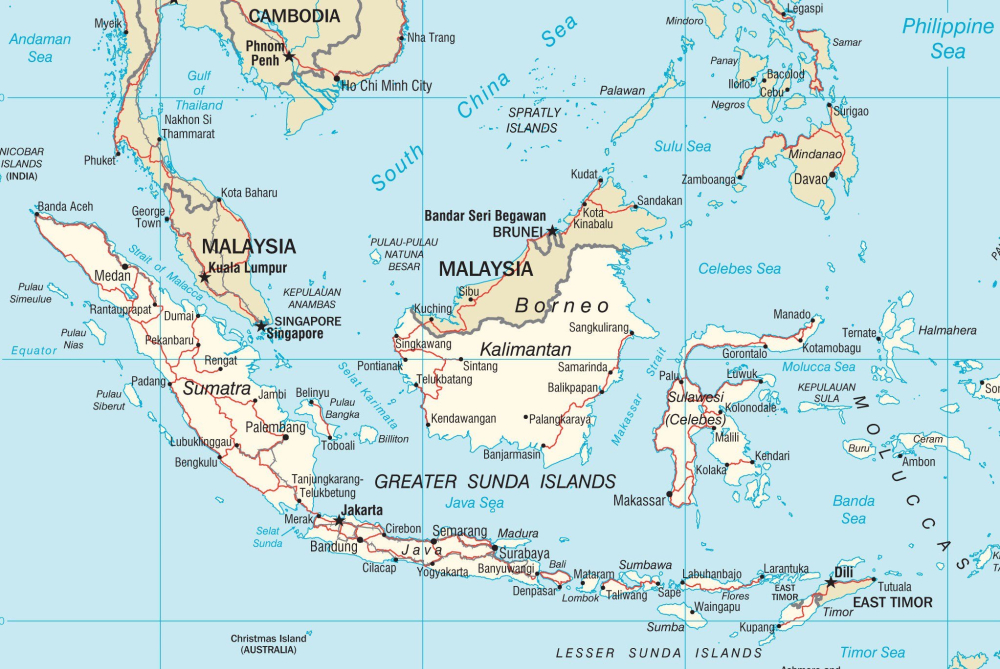
Indonesia, crossed by the equator, is made up of more than 17,000 islands large and small, stretching from west to east like a string of emeralds set along the waistline of the earth. The captivating charm of this country of a thousand islands is by no means something that can be fully described in just a few words.
Locals do not use filter cloth, filter paper, or a dripper to brew coffee, so when sipping, a little coffee powder inevitably mixes into the mouth. In their view, drinking coffee should be like savoring life—chewed over carefully—before its true flavor can be known.
●I. Mandheling Coffee
When it comes to Indonesian coffee, Front Street Mandheling is the first choice that cannot be avoided, and the story must begin with Front Street Mandheling on the island of Sumatra. So-called Mandheling refers to Arabica coffee produced in Sumatra, and its typical signature is notes of vegetation and spice. Front Street roasts this bean to a medium-dark level: mild acidity, rich and full-bodied flavor. Friends who prefer a strong mouthfeel must not miss it.
[MANDHELING] Mandheling can be called the symbolic calling card of Indonesian coffee; almost no coffee lover is unfamiliar with it. Interestingly, Mandheling was originally the name of an ethnic minority on the highlands at the northern end of Sumatra [SUMATERA ISLAND]. The birth of this coffee name is also connected to the history of the Japanese army’s occupation of Indonesia during World War II: back then, a Japanese soldier drank an exceptionally fragrant and mellow cup of coffee in a coffee shop and asked the owner the name of the coffee. The owner mistakenly thought the man was asking about his own place of origin and blurted out, “Mandheling.” After the war ended, the soldier returned to Japan and could not forget that cup of “Mandheling.” He commissioned someone to import 15 tons of beans from Indonesia, and unexpectedly they were hugely well received in Japan. From then on, the name Mandheling spread far and wide.
The main producing areas of Mandheling are located on Sumatra [SUMATERAISLAND], among which the outstanding-quality beans are mainly concentrated in two major sections: first, the highlands around Lake Toba [DANAU TOBA] in North Sumatra Province; second, the Gayo Highlands [GAYO] by Lake Tawar [DANAU TAWAR] in Aceh Province [ACEH]. The specific origins we often hear include Lintongnihuta [LINTONGNIHUTA], Sidikalang [SIDIKALANG], and Dolok Sanggul [DOLOKSANGGUL] in the Lake Toba area, as well as Takengon [TAKENGON] within Gayo.
Historical records note that Sanfotsi, also called Srivijaya [SRIVIJAYA], had its capital at Palembang [PALEMBANG] in northeastern Sumatra. Later, Majapahit [MAJAPAHIT] rose on the island of Java. Sanfotsi suffered repeated defeats in years of war with it, was forced to move its capital to Jambi [JAMBI], and in the end still could not escape being annexed by Majapahit.
Aceh [ACEH], also written Yaqi, was an Islamic kingdom established by the Acehnese people. Its capital, Kutaraja, is today’s Banda Aceh [BANDAR ACEH], and the country’s name comes precisely from the ethnic name. From the early sixteenth century to the early twentieth century, this kingdom’s rule covered northern Sumatra and parts of the Malay Peninsula, and it was once a pivotal trading hub in the Malay Archipelago. In the early seventeenth century its national power reached its peak, the west coast of Sumatra was brought entirely into its territory, and it even captured several places on the Malay Peninsula. After that its strength declined. Facing colonial invasions by Portugal and the Netherlands, the Acehnese rose in resistance until the kingdom was finally destroyed by the Dutch in 1873.
This year happens to mark the 70th anniversary of victory in the War of Resistance, so here we may as well tell a buried episode from the past. Yu Dafu, a famous literary figure during the Republic of China period, vigorously promoted resistance against Japan during the war. In 1940, together with a group of progressive cultural figures, he went into exile in Singapore and formed the “Singapore Overseas Chinese Volunteer Army” to join the resistance. The Pacific War broke out in full in 1941, and at the end of that year Singapore fell. The group made its way to Bukittinggi [BUKITTINGGI] on Sumatra and finally settled in Bayakumbuh [BAYAKUMBUH]. Yu Dafu and several fellow anti-Japanese exiles who had fled with him lived there under assumed names and opened a winery to make a living. He used the alias Zhao Lian, married the local Chinese woman He Liyou as his third wife, had children, and quietly waited for the situation to turn. In early 1942, the Japanese army invaded Indonesia, and the Dutch, the former colonial overlord, were defeated and surrendered. Because Yu Dafu had studied in Japan in his early years and spoke fluent Japanese, the Japanese military police stationed in Bukittinggi heard that a local Chinese man knew Japanese, found him, and forced him to serve as an interpreter. This move once drew misunderstanding and resentment from local people, but in fact, under the cover of his position, Yu Dafu quietly protected and rescued large numbers of exiled friends in distress, patriotic overseas Chinese leaders, and local common people. In 1945, his true identity was exposed. One night several days after Japan announced its surrender, Yu Dafu was suddenly summoned by the Japanese military police and was never heard from again; to this day it remains an unresolved case. After textual research, Japanese researcher Suzuki Masao concluded that Yu Dafu’s death was the result of a kill order issued by the Japanese military police.
Sumatra’s coffee trade has two main hubs: one is Medan [MEDAN], the capital of North Sumatra Province, and the other is Bandar Lampung [BANDAR LAMPUNG], a port city in the southeastern part of the island. From Medan to the Lake Toba producing area is only a little more than 200 kilometers, but unfortunately there is no expressway along the way, so the drive takes 5-6 hours; Sidikalang, Dolok Sanggul, and Lintong are adjacent to one another. If the destination is the Gayo producing area in Aceh Province, it is more than 300 kilometers from the provincial capital Banda Aceh [BANDAR ACEH] and takes 6-7 hours by car; from Medan it is more than 400 kilometers and takes more than 10 hours on the road.
In many people’s minds, Mandheling is the fullest-bodied, richest, and most aromatic coffee in the world. On the palate, the tongue can clearly feel a silky texture. Although its acidity is low, it can still be identified—lively slight acidity interwoven with extremely rich aroma, with a sweet aftertaste that lingers for a long time, allowing one to easily catch that lively element amid the gentle richness. In addition, Mandheling also carries a faint earthy fragrance, and some describe this note as the aroma of herbal plants.
●Selected Indonesian Coffee Recommendations:
1. Mandheling G1 [MANDHELING G1]
Mandheling G1 is a first-grade premium bean hand-sorted one by one. Front Street’s G1 Mandheling has an extremely rich flavor, combining sweetness, pure bitterness, and full body, along with a hint of sweetness and slight acidity; the finish is long after drinking. Most coffee lovers like to brew it as a single origin.
If speaking of the finest, none compares with Front Street PWN Golden Mandheling: in the cup one can taste the sweet aromas of caramel, roasted hazelnut, and dark chocolate, complemented by notes of sandalwood, herbs, and spices. The flavor is clean and transparent, the mouthfeel sweet, mellow, and rich, the aroma alluring, and the layers extremely complex. It is a pleasure for daily drinking and also presentable as a gift for relatives and friends.
2. Mandheling Peaberry [MANDHELING PEABERRY]
Peaberry is commonly called male bean. The coffee beans we usually see have one flat side with a crack, which is exactly where the two seeds inside the coffee cherry pressed against each other; this regular type is called flat bean or flat beans [FLAT BEANS]. A small number of cherries, however, develop only one seed, forming a peaberry [PEABERRY]. Among the fruits borne by each coffee tree, peaberries account for only about 5-10%, and they must be manually picked out one by one from a mixed pile of beans, so their rarity is self-evident. Moreover, a peaberry alone carries all the nutrients that would originally have gone to two flat beans, so its flavor is fuller and more multifaceted than ordinary flat beans.
Mandheling peaberry has a very high flavor density, with particularly prominent notes of Chinese herbal medicine and brown sugar. The aroma is powerful and lasting, the mouthfeel steady and heavy, the bitterness relatively restrained, and the sweet aftertaste long and lingering.
3. Takengon Longberry [LONG BERRY TAKENGON]
Takengon Longberry, also called horse-face Mandheling or long-strip Mandheling, is a variety of Typica [TYPICA], produced only in a few plantations above 1,600 meters altitude in the Takengon area of the Gayo producing region in Aceh Province, with quite scarce output.
Horse-face green beans give off a faint, barely there fresh sweetness, and the bean shape is slender and plump with excellent appearance. After fresh roasting and grinding, one can smell the dry aroma of candied fruit and smoked plum. On entry it is smooth and rounded, with excellent overall balance and medium-plus body; in the finish, light hazelnut and caramel notes emerge, mixed with a trace of plum-like fruity acidity.
4. Aged Mandheling [AGED MANDHELING]
Aged beans are usually stored in temperature-controlled warehouses with excellent conditions in the place of origin, so that after harvest they can continue to lock in coffee’s most moving qualities. To ensure quality, estate owners must also regularly turn the sacks so that every green bean is evenly exposed to air and moisture. In addition, leaving aside the storage environment, true aged beans must be kept wrapped in parchment. If stripped too early, the green beans will deteriorate very easily because they have lost their protective layer—especially in Sumatra, where humid hot air and strong sunlight accelerate this process even more. The processing cycle for aged Mandheling generally ranges from 3-5 years. After aging over time, the bean’s acidity weakens, body increases, and the overall texture becomes fuller and more rounded, entirely different from the bright, lively style of green beans from the new crop season.
5. Wild Luwak Mandheling [WILD LUWAK MANDHELING]
The wild civet Luwak especially loves to choose the ripest, sweetest, and juiciest coffee cherries on the tree to eat. After the fruit enters its digestive tract, only the outer pulp is broken down, while the extremely hard coffee beans pass out intact in the feces. It is precisely this strange digestive journey that gives the coffee beans a transformative change: a unique flavor and extraordinary richness, with that lush, rounded sweetness that other coffee beans find hard to match. The principle is that Luwak’s digestive process breaks down proteins in the beans, and protein is one of the sources of bitterness, so bitterness is greatly reduced while roundness is enhanced. In addition, wild Luwak is especially picky in choosing fruit, so this coffee possesses outstanding qualities. Wild kopi luwak beans are scarce in output, so please be sure to note that the key lies in the word [wild].
6. Mandheling Jumbo [MANDHELING JUMBO]
Jumbo beans are special-grade beans further selected from Mandheling G1, with very large size (19 screen and above), and can be called the pinnacle of Mandheling: the aroma is even richer, the sweet aftertaste is long and sustained, and almost no flaws can be found.
One point must be added: the vast majority of Mandheling Jumbo is bought up at high prices by Japanese bean merchants, and very little can enter the mainland China market. The Indonesian beans that Japanese buyers compete to pursue also include longberry (horse-face) and peaberry Mandheling, as well as Toraja coffee beans (described in detail below).
●II. Java Coffee
Before Mandheling was discovered by the Japanese, [JAVA, JAWA] Java coffee was once the only calling card for Indonesian beans.
As the name suggests, Java coffee is produced on the island of Java [JAVALSLAND], with the core producing area in West Java. The history of coffee planting in Indonesia can be traced back at the earliest to the eastern outskirts of Jatinegara [JATINEGARA], that is, today’s East Jakarta—[PONDOK KOPI]; this place name literally means “coffee house.” In the mid-seventeenth century, Dutch colonists first brought coffee saplings here, and afterward the planting range gradually expanded to Bogor [BOGOR], Sukabumi [SUKABUMI], Banten [BANTEN] in West Java, and East Java [JAWA TIMUR], and later extended further to Sumatra, Sulawesi [SULAWESI], Bali [BALI], and other islands. In short, the history of coffee planting on Java is more than two hundred years earlier than that of Sumatra.
The Java coffee exported to Europe and America in those years was a rather unique existence. In that era, ocean transport relied on sailing ships, the voyages were long and the ships slow, and the beans drifted at sea for months, as if undergoing a natural fermentation, creating a flavor that could not be replicated elsewhere. When steamships replaced sailing ships, transport time was greatly shortened, and people began to drink beans with higher freshness. Yet old connoisseurs accustomed to aged beans could not accept this fresh taste and instead pursued aged Java with fervor. For this reason, the Indonesian government and some merchants simply deliberately stored new beans in warehouses for one or two years before selling them. In actual comparison, aged Java beans have acidity approaching zero, while their aroma is even richer.
Today, the large coffee estates on Java are mostly concentrated in the Ijen [IJEN] Plateau, more than 200 kilometers from the eastern city of Surabaya [SURABAYA].
●III. Toraja Coffee
Toraja [TORAJA] is an ethnic minority in the Tanah Toraja highland area of central Sulawesi [ISLAND SULAWESI]. Sulawesi was formerly called Celebes [CELEBES]. The Toraja are a highly distinctive ethnic group, and many ancient customs such as boat-shaped houses and hanging coffins continue to this day. It is said that their ancestors were外来 invaders who, when ruling the whole island, assimilated or eliminated the indigenous people; afterward they were driven out of the coast by Islamic Indonesian peoples (such as the Bugis [BUGIS]) and retreated to settle in the highlands and mountains. This people was by nature fierce and martial, and to guard against outside attack they simply located their villages in high places that were easy to defend and hard to attack.
Because they are deep in a traffic-inaccessible highland area, Toraja coffee beans are mostly processed by farmers after harvest using Indonesia’s traditional wet-hulling method: first, the cherry pulp is stripped with a simple pulper, the beans are dropped into a basin of water to soak, then packed into plastic bags to ferment, and afterward dried with parchment still on. When moisture content drops to 11-13%, they are transported from the mountain producing areas down to Kalosi [KALOSI], then sold to intermediary traders or processing plants for further refining and processing. Kalosi therefore became a key local coffee collection and distribution hub—this is also why some people call Toraja coffee Kalosi coffee.
Because infrastructure in the highland mountain areas is weak and transport is difficult, Toraja coffee bean output is therefore very limited, and Japanese bean merchants who have long been stationed locally waiting for opportunities have already taken most of the high-quality supply into their hands. For this reason as well, fine Toraja coffee rarely has a chance to enter the mainland China market.
Apart from the typical dark green appearance of Toraja green beans, in flavor they have low acidity and a thick texture, with soft, distant fruity notes. This is precisely the unique label that distinguishes Toraja beans from Sumatra Mandheling. Within the mild acidity there is a faint note of ripe grapes; the mouthfeel is clean and solid, and in the finish a rushing caramel sweetness lingers long in the mouth.
●IV. Papua Coffee
Papua Island [PAPUA ISLAND], also called Irian Island [IRIAN ISLAND], is located at the easternmost end of Indonesia’s territory. The middle of the island is divided by a straight line: the western side belongs to Indonesia, while the eastern side is the independent sovereign state of Papua New Guinea.
Papua’s soil is fertile and its products abundant, so for a long time it became prey coveted by Western colonial powers. Today’s divided-in-two arrangement on the island is precisely the product of Western powers contending in turn from the seventeenth century onward and finally sitting down to negotiate a partition. This history is intricate and bloody; readers who want to understand it in depth may consult relevant historical materials themselves, and it will not be expanded on here.
Most of Papua is covered by vast primitive rainforest, and underground mineral resources are extremely rich. Calculated by land area, New Guinea ranks first in the world in the number of bird species. This forest is home to all kinds of rare birds and animals and also grows many rare plants unique to the world. The province’s population is only a little more than two million, yet its ethnic composition is quite complex; more than 250 indigenous peoples have been confirmed, most still living as primitive tribes in the jungle.
Papua is hot and rainy year-round and is influenced by monsoons: from January to April the northwest wind prevails, while from May to August the southeast trade winds dominate. Average monthly temperatures in the coastal lowlands fluctuate very little, yet at the tops of high mountains there are still glaciers and snow. In terms of precipitation, the southern coast receives about 1000-2000 millimeters, the northern coast 2500-3000 millimeters, and the central mountainous area can reach 3000-4000 millimeters. Under the long-term effects of high temperature and abundant rain, soil erosion and leaching are intense, and fertility is generally low. Only intermountain basins with deep sedimentary soil and areas rich in volcanic soil are favorable for farming. Under the dual influence of climatic zonal differences and altitude gradients, the vertical vegetation spectrum here is very clear: below 1000 meters, coastal lowlands are dominated by tropical rainforest, with luxuriant species and verdant growth all year round, and climbing plants especially developed; above 3500 meters in high mountain areas grow cold-temperate plants such as ferns, alpine meadows, and mosses and lichens; above 4400 meters begins the permanent snow zone. The distribution of wild animal species also varies with climate and vegetation zones.
Most Papua coffee farms are located on the highlands of the island’s interior at about 1,300 to 1,800 meters above sea level. The beans are plump, the flavor is layered and changeable, the acidity is pleasant, and there is a fruity sweetness. Like Mandheling-family beans, it has a rich and full-bodied character, but its cleanliness is clearly superior; the sweetness is crisp and clean, not the syrupy sweetness of the Mandheling family, but rather closer to the cocoa and chocolate notes of American beans.
●V. Flores Coffee
Flores [FLORES] Island is located southeast of Bali [BALI ISLAND] and administratively belongs to East Nusa Tenggara Province [EAST NUSATENGGARA].
The island is covered with continuous mountains, especially in the west. Mount Poco Mandasawu [POCOMANDASAWU] is 2,400 meters above sea level, and several active volcanoes are also distributed across the central and eastern parts; nearby Mount Kelimutu [Mt. KELIMUTU] is the famous “mountain of the three colored lakes.” The interior is very little developed, rivers are not navigable, and vegetation is mainly tropical deciduous forest and savanna. The western end of the island was once the home of the Komodo dragon. The local indigenous people [FLORES] are mainly descendants of mixed Malay and Papuan ancestry; in the coastal areas live Bugis [BUGIS], Bimanese [BIMANESE], Sumbawanese [SUMBAWANESE], Makassar [MAKASSAR], Sumbanese [SUMBANESE], Minangkabau [MINANGKABAU], Solorese [SOLORESE], Javanese [JAWANESE], and a small number of Chinese. Most residents still believe in traditional animist religions, while Muslims and Christians are concentrated along the coast. Land is usually collectively owned by tribes, and chiefs have considerable authority. Local agriculture is mainly based on crop rotation, with rice, coconut, and coffee as the three main crops.
The history of coffee cultivation in Flores is relatively late. The main planted variety is [TIM-TIM]—a natural hybrid of Arabica and Robusta. This variety was first discovered on Timor [TIMOR] in the 1940s and was promoted because of its natural disease resistance. Today this variety is also planted on a large scale on Sumatra. However, it is not quite appropriate to describe it as “southern pomelo becomes northern trifoliate orange,” because when the same tree species lands in different terroirs, the body and sweetness it presents each have their own strengths.
This bean has a pronounced earthy note, and its cleanliness is somewhat reduced, but its body surpasses that of ordinary Mandheling; the flavor is low and restrained, which is quite similar to most Mandheling. Its sweetness performs excellently, with a concentrated caramel taste in the aftertaste, and as the temperature in the cup drops it becomes even more distinct and identifiable.
This article has not yet covered Kalimantan [KALIMANTAN], Bali [BALIISLAND], or East Timor [TIMOR ESTATE]. Since East Timor is now an independent country, if a suitable opportunity arises later, we will introduce it in a separate article.
●Brand Recommendation: Indonesian Coffee Beans
Front Street Coffee’s own-roasted Indonesian bean—[West Java Honey Processed Coffee]—is trustworthy in both brand reputation and bean quality, and what is even more rare is its outstanding value for money: half a pound, 227 grams per bag, priced at only about 118 yuan. At 15 grams of grounds per cup, one bag can brew 15 cups, averaging only about 7 yuan per cup. Compared with coffee shops charging dozens of yuan per cup, it can truly be called a conscientious choice.
The above content is compiled by CoffeeHunters, a coffee news website.


