







What Makes Mandheling Coffee Taste So Distinct?
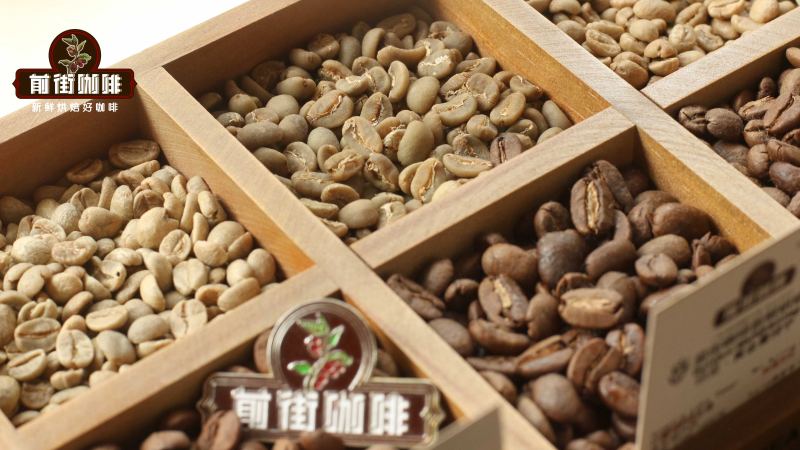
Sumatra is the most prestigious coffee-producing region on Indonesia's coffee map, and Mandheling takes its name from there. Indonesian coffee cultivation dates to 1696, when Dutch estate owners searched for wider planting land. The name itself came about by accident and stuck. Mandheling is known for a pungent earthy aroma, heavy body, and herbal notes that some drinkers find hard to accept.
Sumatra's wet-hulling process, along with an aged wet-hulling variant, shapes that profile. Front Street's Lintong Mandheling and Golden Mandheling differ in variety, grade, and sorting standards. Golden Mandheling undergoes at least three rounds of hand sorting with screen size held at 18 mesh or above, giving more consistent bean size, better cleanliness and clarity, and richer flavor layers in the cup.
Sumatra is the most prestigious coffee-producing region on Indonesia's coffee map, and it is from here that Mandheling made its name known to the world. This article will trace the legendary tale of how the name "Mandheling" came about by accident, explain in detail Sumatra's unique wet-hulling process and aged wet-hulling process, and compare the differences between Front Street Lintong Mandheling and Front Street Golden Mandheling in terms of variety, grade, and sorting standards. The article also presents the roasting approach for both beans, as well as their pour-over flavor performance under unified parameters, helping you understand the charm of this classic Indonesian coffee.
Want to unlock more specialty coffee insights? Welcome to follow the WeChat public account "Front Street Coffee."
Want to unlock more specialty coffee insights? Welcome to follow the WeChat public account "Front Street Coffee."
When it comes to Indonesia's most prestigious coffee-producing region, Sumatra certainly stands first, and Front Street's widely beloved Mandheling coffee beans come from exactly here. Front Street currently offers five Mandheling products with distinct styles, among which Front Street Golden Mandheling is frequently asked about by customers: how exactly does it differ from the regular Front Street Mandheling? After repeated comparisons by Front Street, Golden Mandheling proves superior in cleanliness and clarity, with richer flavor layers than the regular version. The root cause lies in the fact that Golden Mandheling undergoes at least three rounds of hand sorting, with screen size controlled at 18 mesh or above, resulting in highly consistent bean size and naturally exceptional balance in the cup. In other words, whether by appearance or by taste, the two beans can be clearly distinguished.
A Sumatra coffee under Starbucks has been sold since 1972 and remains on the shelves to this day; its pungent earthy aroma and heavy body have always been the signature flavors of Sumatra beans. However, this bean is roasted on the darker side, with herbal notes and a bittersweet char that linger in the mouth, which is precisely why some consumers find it hard to accept.
Sumatra Coffee Beans
Indonesia, located in Southeast Asia, has a coffee-growing history dating back to 1696. Back then, Dutch coffee estate owners searched far and wide for more expansive planting land, eventually setting their sights on Java. Over the following 30 years, Indonesia gradually established a firm foothold in the coffee market.
Today, it is Mandheling from Sumatra that represents Indonesian coffee on the world stage, which is not surprising—much of the coffee shipped to Europe in the early days bearing a Java label actually came from Sumatra, and Mandheling is precisely the product of this land. Therefore, Sumatra fully deserves its reputation as a pivotal coffee-producing region in Indonesia.
The Story of Mandheling Coffee
Mandheling was originally the name of an Indonesian tribe, and it was by a twist of fate that it was attached to coffee beans, behind which there is an amusing anecdote. After Japanese soldiers stationed in Indonesia returned home, they could not forget the deliciousness of the local coffee, so through a friend in the trading business, they asked a local to source premium green coffee beans on their behalf, and Mandheling was among them. The Japanese side was very fond of these beans and immediately inquired about the bean's name; since it was inconvenient to reveal the commercial channel, the local casually blurted out the words "Mandheling," and thus the name became inadvertently associated with the coffee bean.
And that local mentioned earlier is none other than the founder of the Indonesian PWN company (Pwani Coffee Company), which will be introduced below.
Wet-Hulling—Sumatra's Unique Green Bean Processing Method
Mandheling generally adopts Sumatra's unique green bean processing method—wet-hulling. The local area experiences frequent rainfall and successive typhoons, making the sunny weather needed for natural sun-drying hard to guarantee; combined with limited economic conditions, the costly washed method is equally unaffordable, so this highly regional wet-hulling method came into being.
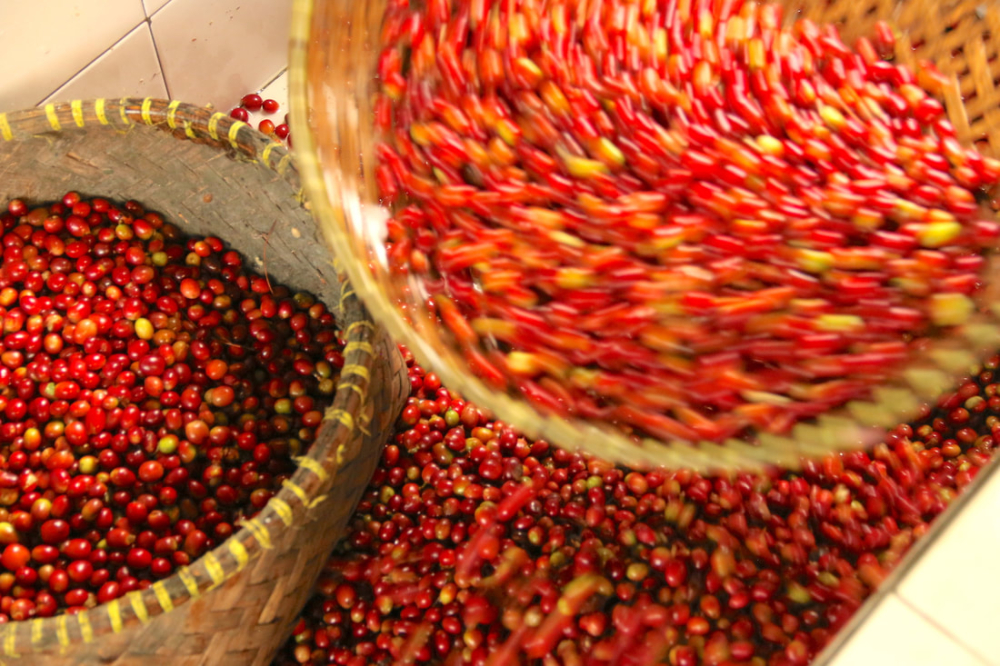
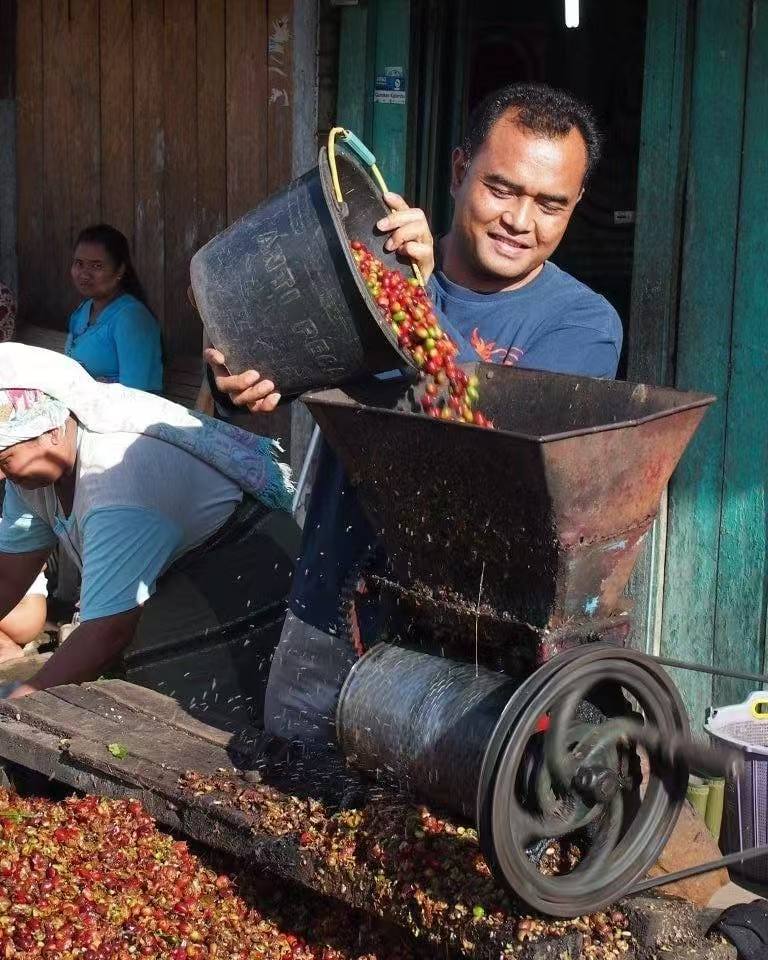
Stage One: The skin and pulp are removed using wooden depulping equipment, then after 3 hours of fermentation, the beans are spread out to dry, reducing moisture content to a semi-dry, semi-wet state of 30-50%.
Stage Two: The mucilage and parchment layer are removed, followed by the subsequent drying process; the entire drying takes 2-4 days, with moisture content ultimately reduced to 12-13%.
Beyond the standard wet-hulling method, there is also an aged wet-hulling method. The green beans first undergo wet-hulling according to the standard procedure, then are sealed in warehouses for 2 to 3 years. The storage environment must be kept cool and ventilated, and the bean pile must be turned regularly to prevent mold and spoilage. During the long storage process, the beans' acidity gradually diminishes and transforms into sugars, while the color darkens accordingly, mostly taking on a yellow-brown or dark brown appearance. Mandheling processed this way is what is commonly called Aged Mandheling.
The unique flavor of Front Street Mandheling is thanks to the wet-hulling method, and the two are almost deeply bound together. However, today's coffee market is no longer conservative; even though wet-hulling is Mandheling's signature process, the industry is still trying other processing paths—Front Street Sun-Dried Mandheling from Wahana Estate is a case in point. Of course, changing the processing method is not arbitrary; the premise is to preserve the bean's original flavor framework, then layer on new flavor elements.
Differences Between Front Street Mandheling and Front Street Golden Mandheling
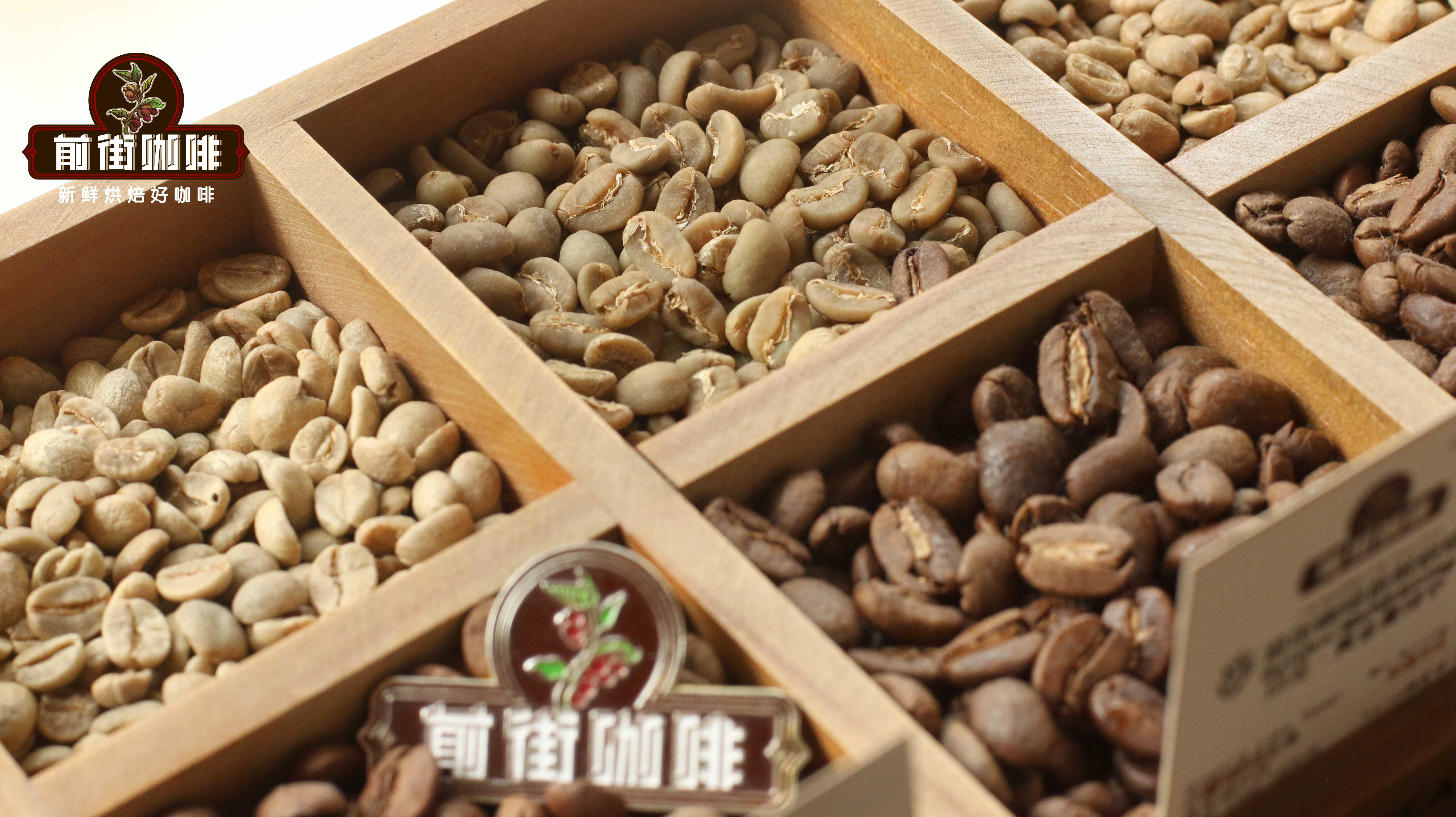
Currently, the most widely circulated and well-accepted Mandheling on the market are Front Street Lintong Mandheling and Front Street Golden Mandheling, with the former being the most classic representative of Mandheling.
[Front Street Lintong Mandheling]
Front Street Lintong Mandheling (Sumatra Coffee)
Region: Lintong Region, Sumatra
Altitude: 1,100-1,600 meters
Variety: Typica, Caturra
Processing Method: Wet-Hulling
Flavor: Baked toast, nuts, caramel, pine, herbs
Front Street Lintong Mandheling comes from the Lintong highlands in the north-central part of Sumatra Island, adjacent to Lake Toba, and is essentially the regular version of Front Street Mandheling. This bean is likewise processed via traditional wet-hulling, thus exhibiting low acidity and high body. However, wet-hulling also brings an unavoidable phenomenon: the moist green beans in a semi-hard, semi-soft state are easily crushed by machinery when the mucilage and parchment layer are removed; the damaged bean body cracks open in a shape resembling a sheep's hoof, commonly known as "sheep hoof beans." These beans are not defective—rather, they are one of Mandheling's most recognizable hallmarks.
Front Street Lintong Mandheling invests relatively limited effort in the sorting stage, and the rough-and-ready workflow inevitably causes fluctuations in output quality, but this does not in the least affect coffee lovers' affection for its full-bodied taste.
Typica's new top leaves have a bronze hue, and its bean shape tends toward oval or slender-pointed, with an elegant and outstanding flavor, but the plant is frail, has poor disease resistance, and yields low. Besides Mandheling, several other premium coffee beans under Front Street—such as Front Street Hawaii Kona and Front Street Jamaica Blue Mountain—also belong to the Typica variety.
Caturra is a natural mutation of Bourbon within the Arabica system, and its emergence is credited to Brazil in 1937. Its tree form is shorter and more compact than Bourbon; although it inherits Bourbon's lineage and similarly weak disease resistance, its yield is actually higher than Bourbon's.
[Front Street Golden Mandheling]
Front Street Golden Mandheling (Sumatra Coffee)
Region: Mount Gayo, Aceh, Sumatra
Altitude: 1,100-1,600 meters
Variety: Ateng
Grade: G1, 3 times hand-sorted
Processing Method: Wet-Hulling
Flavor: Spices, herbs, caramel, pine, nuts, chocolate
Since their first encounter with Mandheling, the Japanese have taken a special interest in this bean. In cooperation with local Indonesian green bean traders, they established a rigorous sorting system: processed green beans first undergo density and color sorting, then multiple rounds of hand picking, ultimately presenting Mandheling with uniform tone and uniform bean size. It is said that during green bean processing, Mandheling glows with a dazzling golden sheen under the sun, and the name "Golden Mandheling" was born from this.
In terms of specifications, Front Street Golden Mandheling has a screen size of 18 mesh or above, with no more than 3 defective beans in a 300-gram green bean sample, qualifying as the highest grade G1; the beans are dark green in color and neatly flat in shape. After rounds of rigorous selection, this bean sheds the earthy, muddy notes characteristic of ordinary Mandheling, becoming cleaner and more transparent on the palate, with an even more pronounced sweet aroma.
However, it was not a Japanese company that first registered Golden Mandheling as a trademark, but rather the Indonesian local enterprise PWN (Pwani Coffee Company), which had earlier partnered with the Japanese to export Mandheling; what the Japanese company registered was "Gold Top Mandheling." In terms of flavor performance, the differences between the two camps' beans are actually limited—it is simply a matter of different brand ownership and different marketing strategies, so fluctuations in market opinion are only natural. As for which version of Golden Mandheling is superior, it probably comes down to individual taste.
The Ateng variety is a hybrid of Arabica and Robusta, with several sub-types branching off under it, widely cultivated in Sumatra and other small islands of Indonesia. Plainly put, it is a branch of the Catimor line; Ateng is simply what the locals call it.
Roasting Comparison
When FrontStreet Coffee roasts Mandheling, the target is set at a medium-dark roast level, aiming to smooth out the beans' excess acidity while elevating body and overall balance.
Equipment: Yangjia 800N, 550g green beans per batch
Front Street Golden Mandheling Roast Curve Record
Front Street Lintong Mandheling Roast Curve Record
Pour-Over Flavor Comparison
When brewing these two Mandhelings, Front Street keeps all parameters as consistent as possible.
Dripper: Kono dripper
Water Temperature: 88°C
Dose: 15 grams
Coffee-to-Water Ratio: 1:15
Grind Size: 70-75% passing a No. 20 standard sieve
*Reason for choosing the Kono dripper: This dripper has few ribs, concentrated at the lower end, so the filter paper hugs the wall of the dripper, restricting airflow and extending the contact time between water and coffee grounds for more thorough extraction and enhanced body—perfectly suited for brewing medium-dark roasted beans like Front Street Golden Mandheling and Front Street Mandheling.
For the brewing technique, Front Street uses staged extraction: first pour 30 grams of water for a 30-second bloom, then pour in a slow circular stream, pausing the staged pour when the total reaches 125 grams; when the water level drops and the coffee bed is about to be exposed, resume pouring until reaching 225 grams and stop; finally, when the water level drops again and the bed is about to be exposed, remove the dripper (timing from the start of the bloom), with a total extraction time of 2'00".
[Flavor Description] "Front Street Golden Mandheling": Clean and full-bodied, rich and varied layers, excellent balance, with a lush aroma of nuts and caramel, a hint of chocolate, and a long finish. "Front Street Lintong Mandheling": Herbal, medicinal botanical notes on entry, accompanied by dark chocolate and caramel, with a noticeably sweet aftertaste.
Want to unlock more specialty coffee insights? Welcome to follow the WeChat public account "Front Street Coffee."
The above content is compiled by CoffeeHunters, a coffee news website.


