







How do Blue Mountain Geisha coffee beans compare with washed Blue Mountain?
Clifton Mount Estate released a Blue Mountain Geisha in 2020, and the first batch reached China in late November that year. Because Blue Mountain is a producing region and Geisha is a variety, the two categories overlap rather than conflict. Grading runs from No. 1 to No. 3 plus PB peaberry, and tasting compares floral notes, nuttiness, and body against traditional washed Blue Mountain.
The estate sits in the Blue Mountains of eastern Jamaica, which rise from about 1,000 to 1,700 meters and lie inside the coffee belt; only beans grown there may be called authentic Blue Mountain. Clifton Mount also holds Rainforest Alliance certification. Cupping and a V60 brew show the floral Geisha profile next to the balanced nutty Blue Mountain cup.
In 2020, the news that Clifton Mount Estate was launching a Blue Mountain Geisha sparked heated discussion in the coffee world: if Geisha is grown in the Blue Mountain region, does it still count as Blue Mountain coffee? This article first introduces readers to the terroir of authentic Blue Mountain, the grading standards from NO.1 to NO.3 and PB peaberry, and the estate's planting history and Rainforest Alliance certification; then Front Street Coffee compares Blue Mountain Geisha with traditional washed Blue Mountain one by one, from variety origin, roasting curve, and cupping performance to V60 brewing, clearly showing the differences between the two in floral notes, nuttiness, and body. If you want to understand whether this innovative bean is worth trying, you may find the answer in this article.
For a deeper look into specialty coffee, welcome to follow our WeChat public account: Front Street Coffee (FrontStreet Coffee)
Geisha is being grown in the Blue Mountain region!!! As soon as the news came out, whether it was our colleagues at Front Street or coffee fans at large, everyone felt both surprised and curious, and many also raised the same question: does Blue Mountain Geisha actually count as Blue Mountain coffee? And can it be included in the ranks of Geisha coffee?
Front Street believes that, when faced with this Blue Mountain Geisha coffee bean launched by Clifton Mount Estate, there is no need to turn it into a dilemma of "Blue Mountain should be balanced, Geisha should be floral." Everything requires innovation—after all, Blue Mountain is a producing region, and Geisha is a bean variety, so there is no reason to insist that this bean must belong to only one side. In late November 2020, the first batch of Blue Mountain Geisha arrived in China, and Front Street Coffee (FrontStreet Coffee) was among the first to get its hands on this batch of beans.
The growing region of Blue Mountain coffee
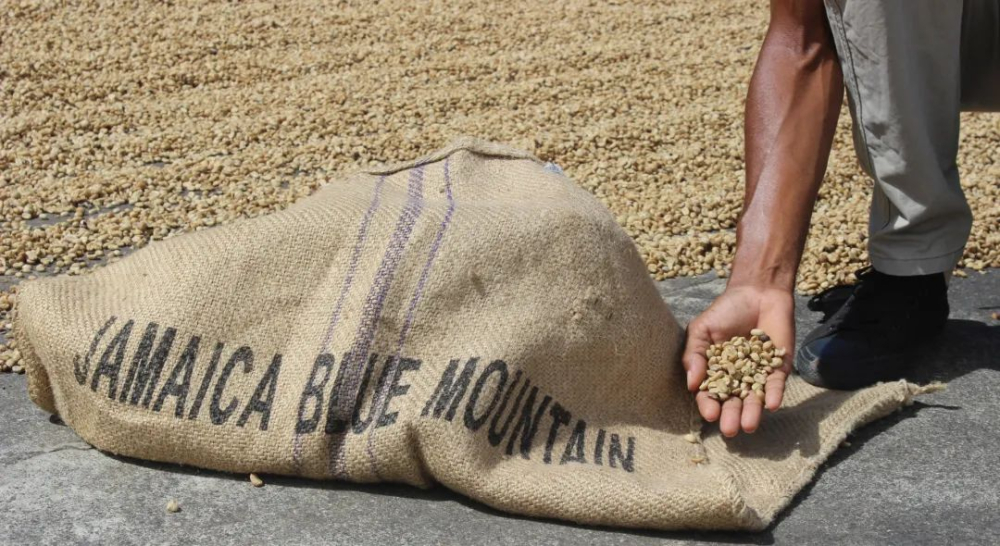
The Blue Mountains dominate the eastern end of the island of Jamaica, rising from 1000 to 1700 meters, and only beans from this area are qualified to be called authentic Blue Mountain. The origin of the mountain's name is closely tied to the Caribbean Sea: when the weather is clear, sunlight strikes the deep blue sea, and the peaks reflect the sea's brilliant blue glow, which is how "Blue Mountain" got its name. This area lies within the coffee-growing belt, with fertile volcanic soil, fresh and pollution-free air, a humid climate, and abundant fog and rain year-round (average annual rainfall of 1980 mm, temperature around 27°C). It is precisely this terroir that nurtures the world-famous Jamaica Blue Mountain coffee.
Locally, coffee farms are managed through mixed planting, allowing coffee trees to grow alongside banana trees and avocado trees on the terraces. In addition, because the terrain is rugged and steep, all the coffee trees are planted on slopes, making harvesting extremely difficult and beyond the ability of anyone other than skilled local women workers. During picking, only cherries at just the right ripeness may be selected; underripe or overripe fruit will damage coffee quality.
Clifton Mount Estate
The Blue Mountain coffee currently sold by Front Street Coffee (FrontStreet Coffee) all comes from Clifton Mount Estate. The estate has been engaged in coffee cultivation and production since the mid-eighteenth century (around 1750), giving it a very long history. Its growing area and processing site are located at about 4,300 feet (1310.64 meters) above sea level. Sufficient elevation, gentle shade formed by afternoon clouds and mist lingering over the forested hills, abundant sunshine, and mineral-rich soil provide superior growing conditions for the coffee trees and also extend the fruit's ripening period.
Among the entire Blue Mountain growing area, Clifton Mount Estate is also the only estate to have obtained Rainforest Alliance certification. Rainforest Alliance certification refers to cultivation under native forest shade using traditional farming methods, a growing approach that benefits ecosystem conservation; part of the revenue received by the certification alliance is used for wildlife conservation in rainforest animal reserves and for improving laborers' living conditions, among other things.
Blue Mountain NO.1 to NO.3, plus hand-selected PB—what does each represent?
Blue Mountain No. 1: 96% of the beans must reach a 17/18 screen size, and defective beans may account for no more than 2%.
Blue Mountain No. 2: 96% of the beans must reach a 16 screen size, and defective beans may account for no more than 2%.
Blue Mountain No. 3: 96% of the beans must reach a 15 screen size, and defective beans may account for no more than 2%.
Blue Mountain Peaberry: 96% of the beans must be single peaberries at a 10 screen size, and defective beans may account for no more than 2%.
What exactly is the difference between traditional Blue Mountain and Blue Mountain Geisha? Next, Front Street Coffee (FrontStreet Coffee) takes the most classic washed Blue Mountain and Blue Mountain Geisha as subjects and compares them in several stages: variety, roasting, cupping, and brewing.
The variety of traditional Blue Mountain is Typica: as early as the 1820s, Typica was transplanted from Martinique to the Jamaica Blue Mountains; more than two hundred years later, Blue Mountain Typica has evolved better disease resistance, especially stronger resistance to coffee berry disease than ordinary Typica. However, once it leaves Jamaica, that clear, sweet, subtle aroma cannot be replicated. The variety of Blue Mountain Geisha is Geisha: it started in Ethiopia and passed through Kenya, Uganda, Tanzania, and Costa Rica before finally settling in Panama; in 2004, the owner of Hacienda La Esmeralda discovered Geisha on his own farm and sent it to competition, and it became famous overnight. Geisha beans are slender and elongated, and their flavor is likewise fresh and pleasant.
Geisha must be grown at high elevations to concentrate its rich, captivating floral aroma—taking Hacienda La Esmeralda as an example, its Geisha plots average over 1500 meters above sea level, while the Blue Mountain region is only about 1310 meters. After cupping Blue Mountain Geisha, Front Street found that its floral aroma is not assertive; only when tasted carefully can a faint jasmine note be detected.
Washed processing method for coffee beans
The Blue Mountain Geisha and traditional Blue Mountain that Front Street Coffee (FrontStreet Coffee) obtained this time both use the washed method that Jamaica excels at: first remove the skin and pulp, then ferment for 12–8 hours; after fermentation is complete, the beans are placed in a water tank and moved back and forth, using friction between the beans and flowing water to wash the beans smooth and clean. At this point the beans are still wrapped in parchment and have a moisture content as high as 50%, so they must be dried as soon as possible to bring the moisture content down to 12-14%; otherwise the beans will continue fermenting and may even become moldy and spoil. They are then sorted and sent to dedicated warehouses for storage.
Roasting recommendations from Front Street Coffee (FrontStreet Coffee)
Roasting Blue Mountain Geisha: the green beans are charged when the drum temperature is 180°C, with heat at 130 and airflow at 3; at 1'32" the turning point is reached, and when the drum temperature rises to 97°C the heat remains unchanged; at the 3rd minute the airflow is adjusted to 4, and at the 4th minute the heat is increased to 140. When the drum temperature reaches 153.5°C, the bean surface turns yellow, the grassy smell completely dissipates, and the dehydration stage begins; at 8'36" ugly wrinkles and dark blotches appear on the bean surface, and the toast-like smell clearly gives way to coffee aroma, which can be regarded as the prelude to first crack, so at this moment one must carefully catch the sound of first crack—first crack starts at 9'31", and after 1'28" of development the beans are dropped at 192°C.
Roasting washed Blue Mountain: the green beans are charged when the drum temperature is 165°C, with heat at 130 and airflow at 3; at 1'32" the turning point is reached, and when the drum temperature reaches 95.8°C the heat remains unchanged; at the 3rd minute the airflow is adjusted to 4, and at the 4th minute the heat is increased to 140. When the drum temperature reaches 153.3°C, the bean surface turns yellow, the grassy smell completely dissipates, and the dehydration stage begins; at 8'36" wrinkles and dark blotches appear on the bean surface, and the toast-like smell clearly gives way to coffee aroma, which can be regarded as the prelude to first crack—first crack starts at 10'06", and after 3 minutes of development the beans are dropped at 198.5°C.
Cupping comparison by Front Street Coffee (FrontStreet Coffee)
Within 8-24 hours after the sample beans finish roasting, Front Street Coffee (FrontStreet Coffee) arranges cupping. The barista customarily uses 200 ml ceramic cupping bowls, with water at 94°C; the grind size is based on a No. 20 standard sieve (0.85 mm aperture), with a passing rate set at 70%-75%; the coffee-to-water ratio is 11 g of coffee to 200 ml of hot water, about 1:18.18, which yields a concentration that falls right within the 1.15%-1.35% golden cup range, with a steep time of 4 minutes.
Cupping results of Blue Mountain Geisha coffee beans
Dry aroma: caramel
Wet aroma: floral
Flavor: citrus, berry, and pomelo acidity, accompanied by caramel and honey
Cupping results of washed Blue Mountain coffee beans
Dry aroma: nutty
Wet aroma: chocolate
Flavor: excellent cleanliness, good body, with balanced acidity, sweetness, and bitterness
Brewing notes from Front Street Coffee (FrontStreet Coffee)
To ensure a fair comparison, both Blue Mountain coffees this time were brewed by Front Street Coffee (FrontStreet Coffee) using a V60 dripper.
Dose: 15 g
Grind size: medium-fine (78% passing a No. 20 standard sieve)
Coffee-to-water ratio: 1:15
Water temperature: 91°C
Dripper choice: V60#01
Front Street Coffee's (FrontStreet Coffee) staged pouring method: in the first step, pour 30 g of hot water and bloom for 30 seconds; in the second step, after the bloom ends, pour 100 g of water in a circular motion from the center outward, and this stage should be slowed down—Geisha is especially resistant to extraction, and only sufficient pouring time can fully draw out the aroma—after pouring, wait until the water level drops by half; in the third step, when the coffee bed is just about to be exposed, pour 95 g of water, for a total of 225 g. After the coffee liquid has fully drained, remove the dripper; the total time is 1 minute 50 seconds to 2 minutes 05 seconds.
Brewed Blue Mountain Geisha coffee beans: on entry, citrus acidity and pomelo sweetness-and-acidity come first, jasmine appears in the middle, and the finish leaves honey and caramel sweetness-and-acidity.
Brewed washed Blue Mountain coffee beans: on entry, dark chocolate and nutty notes appear, with extremely high cleanliness, very bright, notable body, and balanced acidity, sweetness, and bitterness.
The above content is compiled by CoffeeHunters, a coffee news website.


