







How can you tell authentic Jamaican coffee from fakes?
Authentic Blue Mountain coffee is identified through oak barrels and official paperwork. Jamaica is the only producing country that ships green beans in oak barrels, sized 70 kg, 30 kg, and 15 kg, which steady internal humidity and protect aroma. Producers and distributors also need a Jamaican government license and coffee board authorization, and every export lot passes inspection.
The Jamaica Coffee Industry Board, or CIB, defines the legal growing regions and grading standards that separate real Blue Mountain from counterfeit bags using the name. A medium-dark roasted Blue Mountain No. 1 shows balanced sweetness with dark chocolate, hazelnut, and caramel, and a KONO dripper pour-over recipe brings out that rich cup.
Blue Mountain coffee is hailed as a legendary name in the world of single-origin coffee, but counterfeit products bearing the Blue Mountain label keep popping up on the market, making how to buy the real thing a concern for many enthusiasts. This article will explain how to identify authentic Front Street Blue Mountain coffee from angles such as handmade oak barrels and official certification documents, outline the functions of the Jamaica Coffee Industry Board (CIB), the legally defined growing regions and grading standards for Blue Mountain coffee, and share the medium-dark roast flavor profile of Front Street Blue Mountain No. 1 — a balanced sweetness interwoven with dark chocolate, hazelnut, and caramel. A complete pour-over recipe using the KONO dripper is also included, to help you appreciate the rich charm of this legendary coffee.
Back in the days before the concept of specialty coffee had even taken hold, the name Blue Mountain was already a household word. Even grandparents who never drank coffee had mostly heard of it — in terms of fame, no single-origin coffee can rival it. Unfortunately, precisely because of this renown, a flood of counterfeit products bearing the "Blue Mountain" label has appeared on the market, making it especially necessary to learn how to distinguish authentic Front Street Blue Mountain coffee.
What identification credentials does authentic Front Street Blue Mountain coffee have?
Consumers can first check whether the merchant has oak barrels used to hold Blue Mountain green beans. Among all the coffee-producing regions in the world, only Jamaica uses oak barrels as the transport vessel for coffee, with barrels divided by capacity into three sizes: 70kg, 30kg, and 15kg. Compared with ordinary burlap sacks, oak barrels can regulate the humidity inside and outside the barrel, lock in the coffee's aroma to keep it from escaping, and help the green beans maintain a more stable moisture content, making roasting performance more consistent. Over time, these barrels have become one of the hallmarks by which people identify authentic Front Street Blue Mountain coffee.
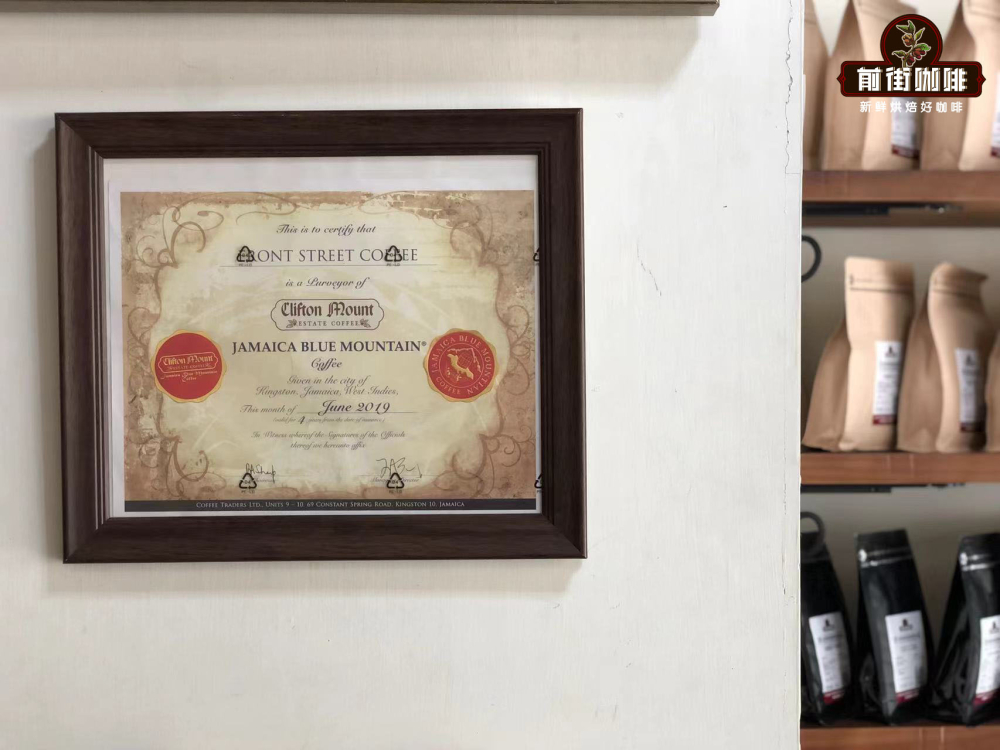
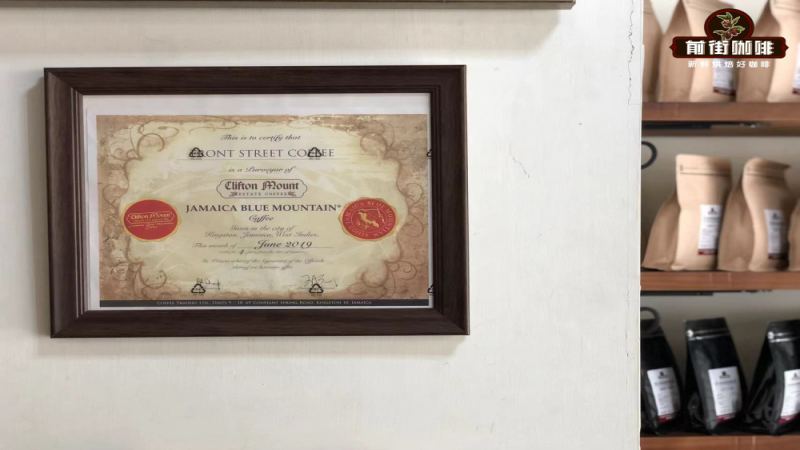
In addition, producers and distributors of Blue Mountain coffee must obtain a license from the Jamaican government and authorization from the national coffee board. Every batch of exported Blue Mountain green beans must also pass the coffee board's quality inspection and certification and bear its label. So when buying, it is worth asking the merchant to present the corresponding Blue Mountain certification documents to confirm the authenticity of the coffee in hand. Front Street's Blue Mountain No. 1 coffee comes from Clifton Estate and holds a quality certificate issued by the Jamaica Coffee Board, a sales authorization letter from the manufacturer, and a Jamaican Blue Mountain certificate of origin. The shop in Dongshankou also displays an actual barrel that once held Blue Mountain green beans.
What kind of organization is the CIB?
Before discussing the grading system for Blue Mountain coffee, Front Street should first introduce the CIB — it occupies a pivotal position in Jamaica's coffee industry. The Jamaica Coffee Industry Board (CIB for short) was founded in 1952 as a statutory body established by the Jamaican government, responsible for enhancing, regulating, and maintaining the quality and reputation of Jamaican coffee. Its core functions cover licensing, certification, and advisory services, through which it carries out standardized management of the entire coffee industry.
According to the boundaries defined by the CIB, the legally designated growing area for Blue Mountain coffee lies at an altitude of roughly 910 to 1,700 meters, covering four areas: St. Mary, Portland, St. Andrew, and St. Thomas. The high-altitude environment gives Blue Mountain its unique terroir and climate, but the steep and complex terrain also makes field management and harvesting quite difficult. Every harvest season, local operations arrange for experienced women familiar with the mountain paths to go up the slopes and hand-pick only coffee cherries at just the right stage of ripeness. In recent years, genuine Blue Mountain coffee has accounted for less than 15% of production — quite rare. This is also one of the reasons why Front Street's Jamaican Blue Mountain commands a high price.
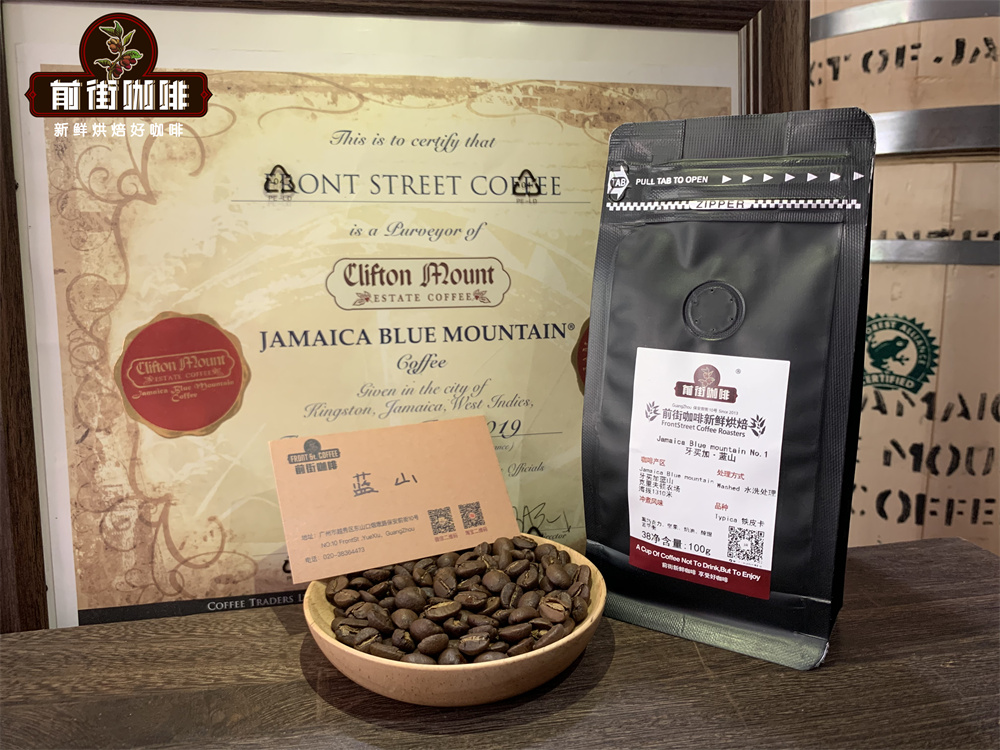
In terms of green bean quality control, the CIB has established standards for Jamaican Blue Mountain coffee at every stage from cultivation and production to sales, in order to improve coffee quality, unify production and processing procedures, and coordinate the marketing of Blue Mountain coffee. The CIB is also the world's earliest organization to use scientific and objective methods to grade coffee quality, taking into account multiple indicators such as green bean color, bean size, uniformity, defect ratio, moisture content, and cupping performance.
Before export, all Blue Mountain green beans are packaged and sent for inspection, then graded according to bean size specifications and the defect ratio after processing. From highest to lowest, the grades are Blue Mountain No. 1, No. 2, No. 3, and Peaberry. Screening bean size requires screens with different mesh sizes; beans that cannot pass through the holes are considered to meet that grade's specification. Top-grade Blue Mountain No. 1 must reach 17 screen size or above, with a defect rate kept within 3% and a moisture content of about 13%. In cupping, it must display abundant coffee aroma, a silky and balanced mouthfeel, relatively low acidity, and a lasting sweet aftertaste.
To ensure that Blue Mountain coffee beans maintain top quality before roasting and to prevent moisture from intruding during transport, Jamaicans insist on using handmade wooden barrels to hold Blue Mountain green beans. The barrel has thus become one of the most iconic symbols of Jamaican Blue Mountain coffee.
The flavor of Front Street Blue Mountain No. 1 after roasting
After Front Street received the Blue Mountain No. 1 green beans, they saw that the beans were plump and uniform in size, with a clear blue-green luster overall. A medium-dark roast was chosen to release this Blue Mountain coffee's chocolate and nutty aromas as much as possible while preserving its soft acidity and sweetness, making the overall taste more balanced.
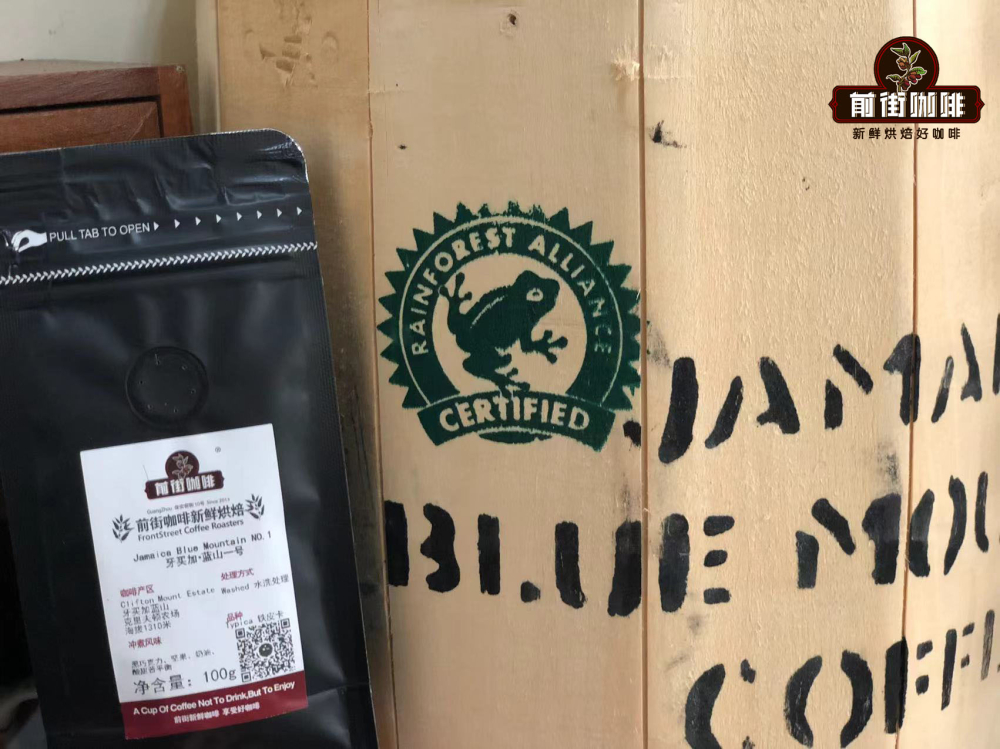
Once the Blue Mountain coffee was roasted, Front Street immediately arranged a cupping: the dry aroma revealed notes of nuts, chocolate, and melon, which turned into the wet aroma of caramel, honey, oolong tea, and dark chocolate after hot water was poured. On the palate came rich roasted hazelnut, cream, brown sugar, and dark chocolate flavors — clean and clear, mellow and easy to drink, with a lingering finish. So that everyone can experience these aromas, every batch of beans Front Street ships is guaranteed to be within 5 days of roasting, so that it arrives at the optimal tasting stage when you receive it.
How should Front Street Blue Mountain No. 1 be brewed to be authentic?
Front Street's authentic Blue Mountain No. 1 has a dense, full aroma and a rich, varied layering of flavor. Front Street most recommends drinking it as a pour-over black coffee. In addition, this Blue Mountain coffee's bean variety is the time-honored Typica, an ancient member of the Arabica family, with relatively low caffeine content, a pure and elegant flavor, and a balance among acidity, sweetness, and bitterness — making it easy to accept even for those new to coffee.
The parameters Front Street stores use to brew Blue Mountain No. 1 are as follows — Dripper: KONO Water temperature: 88℃ Coffee-to-water ratio: 1:15 Coffee dose: 15g Grind size: EK43s setting 10.5 (No. 20 standard sieve, 75% pass rate)
When brewing beans with a bitter-leaning flavor profile, Front Street usually gives priority to the KONO dripper, with the aim of amplifying the coffee's body. The upper part of the KONO dripper lets the filter paper fit better; compared with the V60, it relies mainly on immersion to extract, which can increase the coffee's overall concentration and thereby enhance body. In practice, Front Street first rinses the KONO dripper, then places the filter paper in aligned so that it fits more tightly against the wall. After pouring out the water in the server, add 15g of coffee grounds and first pour 30g of water for a 30-second bloom. Then, starting from the center, pour in circles with a steady small stream, pausing at 125g for a split; when the coffee bed drops to half the height of the dripper, pour the second stage in the same manner up to 225g. Once dripping is complete, remove the dripper.
On the palate, Front Street's Jamaican Blue Mountain No. 1 presents the sweet fragrance of dark chocolate, a caramel-like sweetness, and a light, soft acidity. The flavors blend and balance with one another, smooth and rich — a very typical Blue Mountain flavor.
To discuss professional coffee knowledge and get more coffee bean information, follow Coffee Workshop's WeChat public account: cafe_style; to purchase more specialty coffee beans, feel free to add Front Street Coffee's private WeChat, WeChat ID: qjcoffeex.
The above content is compiled by CoffeeHunters, a coffee news website.


