







How do SOE coffee beans differ from a blend?
SOE stands for single origin espresso: espresso pulled from beans of one producing region. It trades consistency for flavor personality, showing the bean's own layered character rather than a fixed house profile. Blend coffee, by contrast, combines several origins and is built for stable quality across seasons. Neither is inherently better; the choice depends on whether distinctiveness or repeatability matters more.
Because coffee is an agricultural product, each year's terroir and climate shift the flavor of a single origin, which makes long-term espresso consistency harder to hold. Blends offset that by design. The two blending approaches, raw blending and roasted blending, differ in when the components are combined. Medium-roast single origins suited to SOE include Costa Rica Mozart, Ethiopia Huakui, and Brazil Queen Estate.
SOE, or single origin espresso, has rapidly gained popularity in domestic specialty coffee shops over the past two years, and consumers often compare it with espresso blends. This article will clarify the positioning of the two: SOE excels in distinct flavor personality, while blends are strong in quality consistency, and there is no absolute superiority or inferiority between them. The article also explains the difference between two blending processes, raw blending and roasted blending, and summarizes Front Street Coffee's four espresso blends and three medium-roast single origin beans suitable for extracting SOE, including Strawberry Candy Blend, Costa Rica Mozart, Ethiopia Huakui, Brazil Queen Estate, etc., providing practical reference for choosing espresso beans.
In the coffee industry, SOE is a high-frequency term, with the full name single origin espresso. Restoring this abbreviation to English gives Single Origin Espresso, and the concept directly corresponding to it is Espresso Blend, which is what we commonly call espresso blend beans.
SOE's rise in popularity in China over the past two years has been like bamboo shoots after rain—previously few people paid attention to it, but in the blink of an eye it has become an indispensable choice on the menus of many specialty coffee shops. Looking back at ordering an espresso in the past, what you drank was mostly mellow, rich, and straightforward in flavor; the emergence of SOE allows friends who prefer espresso to also taste the rich layered flavor expression of the coffee beans themselves.
Why is SOE so popular? Is it really better tasting? Why is the price also somewhat higher than ordinary espresso? Next, Front Street will talk with everyone about what SOE is.
What exactly is the origin of SOE?
After the concept of SOE was widely promoted, many consumers are used to comparing it with espresso made from blend beans, and even think that using beans from only a single origin must be better than blend beans.
But don't forget that coffee is essentially an agricultural product, and each year's terroir conditions and climate changes will cause flavor fluctuations. Although single origin beans can more fully display the characteristics of the origin itself, their shortcoming is that it is difficult to maintain the stability of espresso quality over the long term. It is precisely for this reason that some people came up with the method of blending—mixing beans from different origins in specific proportions to obtain coffee beans whose flavor can remain stable over the long term.
As for why SOE sells for more than blend espresso, the main reason is that the procurement cost of single origin beans itself is relatively high, and when stores debug espresso parameters every day, they consume more beans for repeated testing. To balance these expenses, merchants usually charge extra for SOE.
In the view of Front Street Coffee, between SOE and regular espresso, there is no conclusion that one must taste better than the other; the key lies in what the drinker likes. If you want to experience lively and varied rich flavors, you can choose SOE; if you prefer a strong and full-bodied taste, then espresso extracted from blend beans will be more to your liking.
Let's talk about espresso blend coffee beans
In the traditional sense, espresso coffee beans are almost all the product of mixing multiple beans. In Italy, a bag of beans may be composed of several, or even dozens, of different beans. The greatest value of diverse blending lies in keeping the coffee taste stable: once a certain bean fluctuates in quality, declines in yield, or rises in price, the roaster can find beans of similar quality to replace it, and the overall taste will not be affected. It is also for this reason that many well-known roasters guard their own blend formulas as trade secrets.
There are also two paths for blending methods. Raw blending is to first mix multiple green beans evenly according to the formula ratio, and then put them into roasting together; roasted blending is to roast each type of green bean separately, and then mix them according to the formula ratio.
The four espresso blend beans sold by Front Street all use the roasted blending process. Facing green beans with vastly different constitutions, roasting them separately allows the roaster to control the condition of each batch more precisely; blending after roasting also allows the proportion plan to be made more finely (after all, the weight loss rate of each bean is different), and subsequent adjustments to the proportion weights are also more flexible. Of course, the cost is also very直观: if a blend contains 3 kinds of beans, roasted blending means at least 3 batches must be roasted, and the color value (roast degree) of each bean must also be made close to one another, which is quite a test of roasting experience.
With the roasted blending process, Front Street repeatedly fine-tuned the roast degree and bean proportions when developing the formula, and finally recorded and archived the confirmed roasting curve and proportion plan, keeping the output stable at the ideal level.
"Front Street Strawberry Candy Espresso Blend Coffee Beans"
"Front Street Specialty Blend Coffee Beans": composed of Colombian washed beans paired with Brazilian semi-sun-dried beans, presenting flavors of nuts, dark chocolate, and caramel.
"Front Street Commercial Blend Coffee Beans": a combination of Robusta washed beans, Colombian washed beans, and Brazilian semi-sun-dried beans, with flavors mainly of nuts, cocoa, and caramel.
"Espresso Moka Pot Coffee Beans Recommended by Many Baristas - Front Street Black Cocoa Blend Coffee Beans": Yunnan washed small-bean variety paired with Brazilian semi-sun-dried beans, with soft fruit acidity on the palate, accompanied by aromas of caramel and nuts.
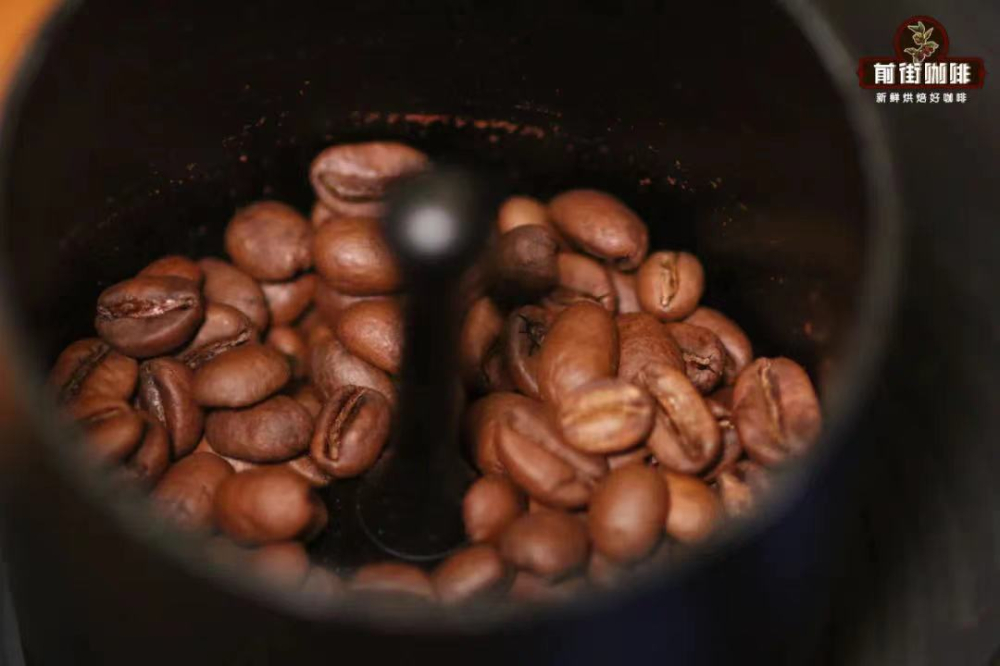
Recommended coffee beans suitable for making SOE
When choosing beans for SOE, Front Street values flavor recognizability more. Using single origin beans to make espresso is intended to let friends who love drinking espresso and milk coffee also taste the flavor of the bean itself; if a single origin bean has vague characteristics and most people cannot taste its unique flavor at all, then it would be better to honestly drink a balanced, smooth, and full-bodied blend.
There is no need to demand stability when making SOE either. Coffee is ultimately an agricultural product, and factors such as weather and growing conditions will cause flavor differences in beans from the same origin, which is precisely the opposite of blend beans that pursue stable taste. So, if you order SOE from the same bean at the same store twice and notice slight flavor differences, it is completely normal~
At present, Front Street has not yet launched beans specifically for SOE, but in the spirit of experimentation, Front Street Coffee has extracted SOE from every one of its own beans and found that some single origin beans also perform remarkably well when used to make espresso.
"Front Street Costa Rica Mozart SOE Coffee Beans": medium roast; after being extracted into SOE, the aromas of osmanthus and raisins are rich and prominent, the mouthfeel is creamy and smooth, and the finish is caramel sweetness.
"Front Street Ethiopia Huakui SOE Coffee Beans": also medium roast; when extracted as SOE, you can taste the sweet and sour notes of berries, red floral fragrance rushes toward you, and the finish carries citrus notes.
"Front Street Brazil Queen Estate SOE Coffee Beans": also medium roast; after being made into SOE, the flavors of roasted peanuts, cream, and cookies interweave, and the aftertaste is as sweet and moist as sucrose.
The above content is compiled by CoffeeHunters, a coffee news website.


