







Where do Brazil's arabica beans come from, and how do they taste?
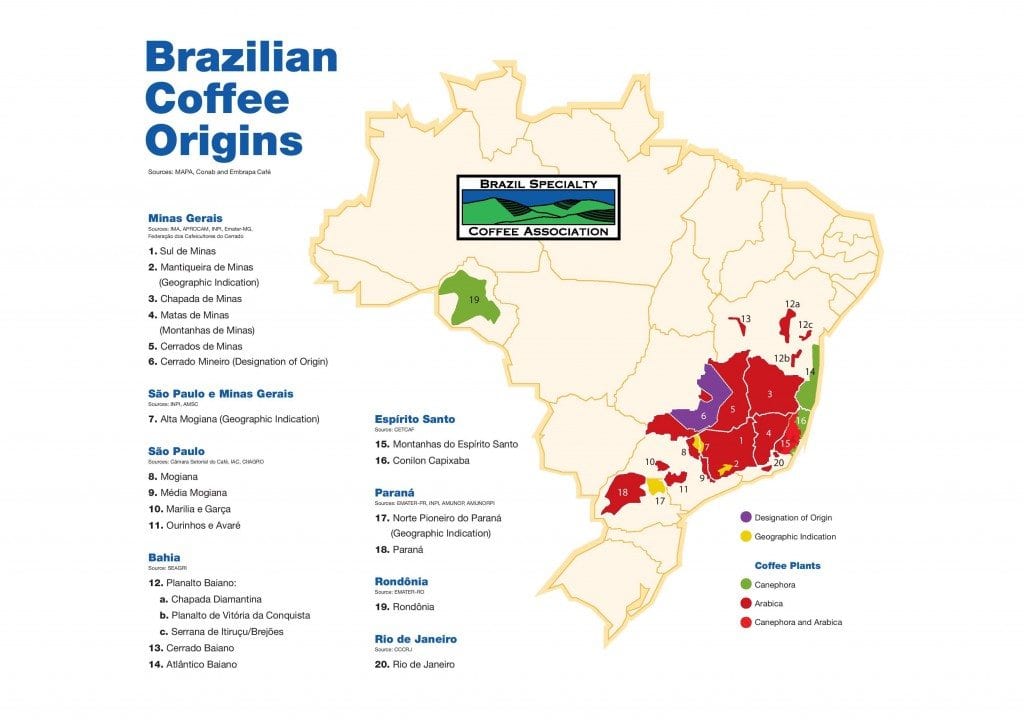
Brazil is the largest coffee producer in the world, growing coffee in 17 of its 21 states, with the main output concentrated in Bahia, Espírito Santo, Minas Gerais, São Paulo, Paraná, and Rondônia. Minas Gerais alone supplies more than half of the country's arabica beans and is the core specialty region, split into Matas de Minas, Minas Highlands, Cerrado, and further areas.
Each region leaves its own mark. Matas de Minas, humid and warm, gives caramel and chocolate aromas; the flat plateau of Minas Highlands suits mechanized farming and shows pronounced chocolate; Cerrado adds its own profile. São Paulo brings the port of Santos and Mogiana. Red Bourbon and Yellow Bourbon differ in variety character, and a medium-dark roast plus KONO three-pour brewing draws out the smooth Brazilian mouthfeel.
Brazil is the world's largest coffee producer, with coffee grown in 17 of its 21 states, and six major producing regions—including Minas Gerais and São Paulo—each with its own distinct terroir. This article takes you through Brazil's coffee landscape: breaking down the four sub-regions of Minas Gerais, visiting São Paulo with its port of Santos and the famous Mogiana, and interpreting the characteristics of regions like Cerrado, Espírito Santo, Bahia, and Paraná, along with the splendor of Fazenda Rainha; it also compares the differences between Red Bourbon and Yellow Bourbon varieties, and includes Front Street Coffee's medium-dark roast approach for two Brazilian beans plus a KONO three-pour hand-brewing method, to explore the origins of Brazilian beans' smooth mouthfeel.
To learn more about specialty coffee insights, welcome to follow Front Street Coffee's WeChat official account FrontStreet Coffee.
When people think of Brazil, the image that most often comes to mind is this: on the streets of Rio de Janeiro, beautifully dressed women dance to music, expressing Brazil's fiery, passionate spirit with graceful movements; on the other side, the vast Amazon rainforest stretches lush and green, far from the noise of the city. Between this dynamic and this stillness, the country is full of charm.
Brazilian coffee is much the same: its rich base of intertwined nuts and chocolate is like its passionate, exuberant side; its delicate, smooth mouthfeel is its gentle, quiet other side.
Brazil ranks fifth in the world in land area and first in South America, and its coffee bean production ranks first in the world. Coffee is produced in 17 of the country's 21 states, with the main producing regions concentrated in the following six states: Bahia, Espírito Santo, Minas Gerais, São Paulo, Paraná, and Rondônia.
【Minas Gerais】
More than half of Brazil's Arabica beans come from Minas Gerais, which is also the core region for specialty coffee. The state can be further divided into four sub-regions.
Matas de Minas: This region rose to fame for its outstanding specialty coffee quality. With high humidity and a warm climate, the coffee produced here carries aromas of caramel and chocolate.
Minas Highlands: The region sits on a plateau with flat, open terrain, so mechanized operations are widely adopted. The coffee here has a particularly pronounced chocolate flavor.
Cerrado: Cerrado holds Brazil's first coffee designation of origin, and its fame rivals that of Bordeaux in the wine world. It is home to many medium- and large-sized coffee estates, with four distinct seasons and suitable elevation, making conditions ideal for both bean growth and later harvesting.
South of Minas: With relatively high elevation and a pleasant temperature, the Arabica beans produced here have typical fruity notes and a full-bodied mouthfeel, accounting for about 30% of Brazil's total national output.
【São Paulo】
São Paulo State plays a pivotal role in Brazil—the Port of Santos, the largest port in Latin America, is located here, and it is also Brazil's number one coffee export port. In addition, São Paulo is the state with the longest coffee-growing history in all of Brazil.
There are two major producing regions within the state: Mogiana and Centro-Oeste.
Mogiana is blessed with nutrient-rich red volcanic soil, considerable elevation, and a mild climate, producing coffee of outstanding quality. The most famous estate in the region is Fazenda Rainha—Front Street Coffee (FrontStreet Coffee) currently has a bean from Fazenda Rainha on its bean list. Since the first Cup of Excellence Brazil competition in 1999, this estate has won awards repeatedly, taking home prizes 12 times in 7 years. Mogiana's coffee has relatively low acidity, a full body, and both fruity and chocolate flavors.
Centro-Oeste is mainly hilly terrain, dominated by numerous small and medium-sized plantations, and its coffee has a relatively mild taste.
【Espírito Santo】
Compared with other Brazilian producing regions, Espírito Santo's planting scale is not large, but its coffee production firmly ranks second in the country. The state is also Brazil's largest growing base for Robusta beans, with only a few coffee farmers in the south cultivating Arabica.
The entire state has a plateau topography and a mild climate, and the coffee produced is known for its bright acidity and fruity flavors.
【Bahia】
Bahia's coffee-growing history dates back to the 1970s, much shorter than that of older regions such as Paraná. However, relying on advanced modern agricultural technology, the specialty coffee beans produced in this state are outstanding in quality and excellent in flavor. In recent years, it has repeatedly achieved good results in the Cup of Excellence Brazil, and in 2015 it even won the championship in the pulped natural category, drawing steadily increasing attention from the industry. The coffee-growing areas in this state are at relatively high elevation, with rainy winters and dry summers.
【Paraná】
Paraná can be called Brazil's oldest traditional coffee-producing region. However, in 1975, a ferocious frost disaster swept through the entire state, severely damaging coffee trees and causing production to plummet. Hit by this blow, the futures price of Arabica beans was pushed to a historic high in 1977. Today, Paraná remains an important agricultural center in Brazil, with the state's crop output accounting for about 25% of the national total. Unfortunately, the state's highest elevation is only 950 meters, which does not reach the altitude Arabica favors, so truly high-quality coffee is not common here.
【Rondônia】
Rondônia is located in northeastern Brazil, and its bean varieties are mainly Robusta.
Front Street Coffee (FrontStreet Coffee)'s bean list includes two Brazilian beans: one is the Brazil Red Bourbon in the daily-drinker series, and the other comes from Fazenda Rainha in the Mogiana region (São Paulo State) and is of the Yellow Bourbon variety.
Produced by Front Street Coffee (FrontStreet Coffee): Brazil · Red Bourbon Coffee Beans Region: Brazil · Minas Gerais · Cerrado Altitude: 1,000 meters Variety: Red Bourbon Processing method: Pulped natural
Front Street Coffee places this bean in its daily-drinker series, which shows just how highly it regards it. Brazil Red Bourbon grows in the Cerrado region, is of the Red Bourbon variety, and follows Brazil's generations-old pulped natural method in processing. A nutty main tone paired with a smooth mouthfeel is precisely the most representative flavor characteristic of Brazilian beans, and this bean interprets both just right.
In fact, before the 18th century, the dominant variety in Brazilian fields was still Typica. As coffee was a crucial economic crop for Brazil, production meant wealth, and Typica had relatively low yields, so in the 1860s Brazil introduced the higher-yielding Bourbon variety from Réunion Island. Around the 1870s, some documents recorded that certain Bourbon plants actually bore yellow fruit, which was later scientifically verified and confirmed to be a mutated variety of Red Bourbon—Yellow Bourbon.
Compared with Red Bourbon, Yellow Bourbon has a thicker pectin layer, meaning the sugary substances in the pulp are more abundant, so its sweetness is naturally better. Front Street Coffee once cupped Red Bourbon and Yellow Bourbon side by side for comparison and found that Yellow Bourbon has a soft lemon aroma and a more prominent sweetness.
Produced by Front Street Coffee (FrontStreet Coffee): Brazil · Fazenda Rainha Coffee Beans Region: Mogiana Estate: Fazenda Rainha Altitude: 1,400–1,950 meters Variety: Yellow Bourbon Processing method: Natural
Natural processing relies heavily on manual labor. Once the batch is too large and turning cannot keep up with the pace, the beans easily over-ferment and develop negative fermented flavors. For this reason, Front Street Coffee's Fazenda Rainha beans use small-batch, meticulous natural processing, completed entirely on African raised beds, which both avoids the risk of earthy and fermented flavors and gives a sweetness one step above traditional pulped natural.
Seeing is better than hearing about it a hundred times, and this is even more true for coffee—no matter how much is said, it is better to brew a cup yourself. To fully present the aroma and sweetness of Brazilian beans, both beans use a medium-dark roast. Front Street Coffee recommends using 88°C water, a coarser grind, and a KONO dripper when brewing; if you want a more layered cup, you can complete the extraction with a three-pour method.
Dripper: KONO Water temperature: 88°C Dose: 15 grams Coffee-to-water ratio: 1:15 Grind size: based on a No. 20 sieve, 70% pass-through rate
The specific method is as follows: pour 30 ml of hot water in the first pour and let it bloom for 30 seconds; in the second pour, pour 100 ml in a circular motion, and when the water level drops halfway (about 1 minute 05 seconds), begin the third pour, adding 95 ml; after the coffee liquid has fully drained, remove the dripper. The total extraction time is 2 minutes.
The above content is compiled by CoffeeHunters, a coffee news website.


