







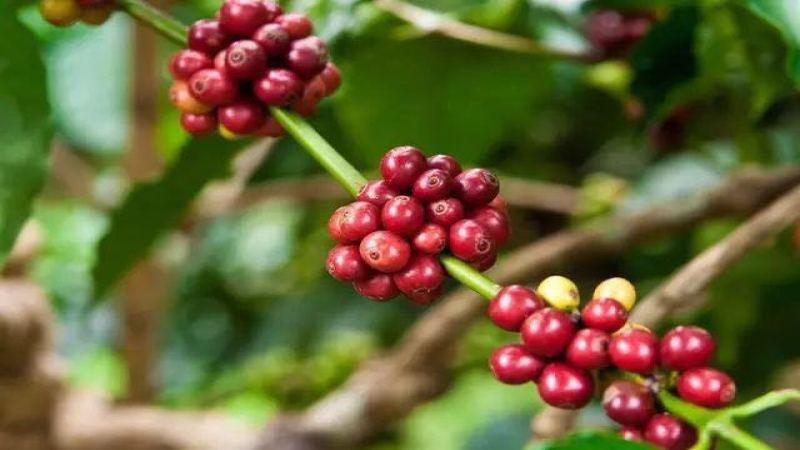
What Makes Xinglong Coffee Beans Different?
Xinglong coffee comes from Hainan, a Chinese growing region outside Yunnan. The island sits in the coffee belt, with average temperatures above 20°C, more than 1,600 mm of annual rainfall and fertile volcanic-ash soil. Robusta coffee beans dominate, giving a cup that is aromatic without bitterness and rich without harshness.
Hainan also keeps a sugar-roasting tradition from Southeast Asia, where beans are roasted in a large iron wok over firewood with sugar. That method adds sweetness and body. Together with Fushan coffee, Xinglong coffee shows how variety, climate and local roasting technique shape a regional style rarely seen in export markets.
When people think of Chinese coffee, most first think of Yunnan, but in fact Hainan is also one of the country's important coffee-producing regions. Hainan lies in the golden coffee belt and is dominated by the Robusta variety, giving rise to two well-known representatives: Xinglong Coffee and Fushan Coffee. The warm climate, abundant rainfall, and fertile volcanic-ash soil here create Hainan coffee's unique style—aromatic without being bitter, rich without being harsh. What's even more special is that Hainan still preserves the sugar-roasted coffee tradition introduced from Southeast Asia, using a large iron wok, firewood
When it comes to coffee-producing regions in China, Yunnan may be the most familiar name to the public, but in fact, China's coffee-growing map is not limited to Yunnan. Yunnan is well known because its output accounts for a relatively large share of the national total, and it is also the main coffee-growing region in the country. However, coffee cultivation in China is also distributed in parts of Taiwan, Hainan, and other areas. Among them, Hainan coffee is also of no inferior quality; it is just relatively less discussed by the outside world, and not many people have tried it.
Yunnan's coffee-growing areas have long been known as a golden belt, and the coffee produced there often carries flavors of nuts, tea, brown sugar, and plum-like acidity, with a slight pine note in the mouthfeel and an overall relatively full body. Hainan's geographical conditions, however, have their own characteristics: the average annual temperature here is relatively high, usually remaining above 20°C, and rainfall is also quite abundant, with an average annual precipitation of more than 1,600 millimeters, placing it right in the core of the coffee belt. Hainan Island's soil is also very fertile, and the volcanic ash soil left by volcanic activity has good drainage, providing an excellent foundation for coffee growth.
Because of this, Hainan coffee presents a mellow and rich character—fragrant without being bitter, strong without being harsh. This is its biggest flavor label. In addition to its unique aroma, Hainan's roasting technique also makes the coffee's taste richer and more fragrant. The local roasting technique inherits and develops the methods of Southeast Asia and is known for being "excellent in color and taste, strong without being bitter, fragrant without being harsh." The coffee's original aroma and flavor are fully preserved, and its mellow, rich scent can fill the whole room. After drinking, the finish is long and lingering, making it a top-grade product excellent in color, aroma, and taste.
Main Producing Areas of Hainan Coffee
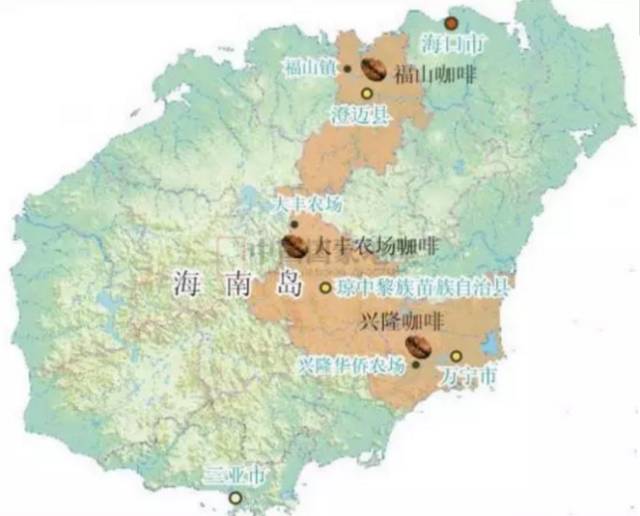
Hainan mainly grows medium-bean coffee, that is, the Robusta variety. The advantageous producing areas cover six cities and counties: Chengmai, Wanning, Wenchang, Qiongzhong, Baisha, and Sanya. Hainan is one of the earliest coffee-growing regions in China, and coffee from two places there is especially famous: one is Xinglong coffee in Wanning, and the other is Fushan coffee in Chengmai. In addition, Hainan also has high-quality coffee brands such as Chunguang, Nanguo, Houchen, and Lishen.
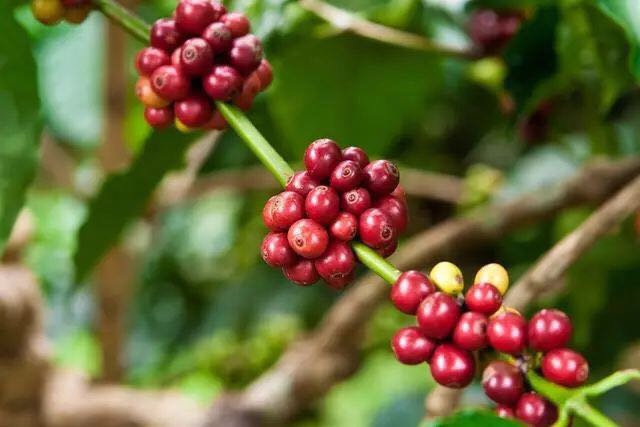
The cultivation history of both Xinglong coffee and Fushan coffee began after the founding of the People's Republic of China. In 1953, shortly after the Hainan Xinglong Overseas Chinese Farm was established, returned overseas Chinese introduced coffee seedlings from abroad for planting. By the 1970s, the planted area of Xinglong coffee had reached more than 1,000 mu. Fushan coffee started in a fairly similar environment; in the 1950s, the coffee-planted area in Chengmai County was only about 100 mu. In the early 1970s, Xu Xiuyi, founder of "Fushan," established the Fushan coffee plantation and processing factory in Fushan Town, Chengmai County, in northern Hainan Island, opening up wasteland and vigorously promoting coffee cultivation. By 2013, Fushan coffee's planted area was about 60,000 mu, and annual output of dried coffee beans reached 3,000 tons.
Xinglong coffee beans are produced in the Xinglong area of Wanning, Hainan, and are a geographical indication product mutually recognized by China and the EU. This product selects premium Robusta coffee bean varieties from Xinglong, Hainan, and uses a unique honey processing method, bringing wonderful aroma and taste to the coffee beans. It is sweet, mellow, and full-bodied while also clear and smooth, with a mouth-watering finish and a long-lasting sweet aftertaste. This unique flavor comes from a geographical environment shaped by years of accumulation and transformation, and is also influenced by climate and the seasonality of the variety. Its distinctive processing technique also divides the product into multiple finished branches such as black honey and red honey.
Hainan Coffee Bean Variety—Robusta
Arabica coffee is mostly used for specialty coffee and is relatively picky about its growing environment, for example requiring high altitude and shade trees; while Robusta is less demanding about the growing environment and has stronger adaptability and disease resistance. Generally, the higher the altitude, the better the coffee's flavor expression, so Arabica is naturally superior to Robusta in flavor. Robusta is mostly used as commercial beans, such as in instant coffee or as a blending component in espresso.
The environment for growing coffee in Hainan is generally at low altitude, which is very suitable for the growth of Robusta coffee trees. Therefore, basically the entire Hainan Island mainly grows the Robusta variety.
Hainan Coffee Bean Roasting Methods
The coffee we drink every day is usually machine-roasted and then brewed, but Hainan coffee's roasting method is quite unique, with its own distinctive ancient stir-frying method—sugar-roasted coffee. Hainan coffee uses the traditional stir-frying method of overseas Chinese; the returned overseas Chinese brought back the Southeast Asian method of deeply roasting coffee beans, which also gave Hainan coffee its special taste. Hainan coffee does not use a roaster like modern roasting factories, but instead uses a large iron wok. Hainan's roasting technique originates from Southeast Asian methods, and local coffee is best suited to this stir-frying method. During the stir-frying process, one must not only control the heat but also add white sugar, salt, and butter at the right time, so that the coffee roasted this way is especially fragrant and rich.
Fushan coffee's roasting method is to set up a large wok, light a wood fire, hold a large iron shovel, pour in the coffee beans, and keep stirring. This may seem simple, but how strong the heat is and how long to roast all depend on experience, and these factors directly affect the coffee's taste. Fushan coffee's roasting characteristics are also reflected in the final step: put sun-dried Robusta coffee beans into a large iron wok, heat them over charcoal below, and the roaster keeps stirring with a large shovel. When the first crack is about to occur, one must seize the moment to add a large amount of white sugar and continue stirring. When the white sugar and coffee beans merge and gradually caramelize, and the beans become glossy and black, they can be taken out and cooled.
Usually, adding sugar to coffee is to reduce bitterness and increase sweetness, but adding sugar when roasting beans in Hainan is not intended to increase the coffee's sweetness, but to use the dissolved sugar to form a coating on the outside of the coffee beans and wrap up the coffee beans' aroma. After this step, the coffee beans taken out of the wok change in color from brown to black. At this point, the roasting of Xinglong coffee beans is complete. Many manufacturers now use machine roasting, but the people of Fushan believe that only coffee roasted over a wood fire has human warmth. Of course, coffee made by these traditional methods is different from the original regional flavors advocated by specialty coffee; it is more of a local specialty coffee.
Some people may not be used to the taste of this kind of coffee, so locally, coffee is more often drunk with condensed milk or sugar added, and this is also the local specialty coffee. However, Front Street believes that if there is a chance, it is still worth experiencing Hainan coffee and feeling different coffee flavors. Of course, Front Street has more than fifty kinds of coffee from different producing areas, such as: more than ten single-origin coffee beans from Ethiopia, the coffee gene bank; the favorite Panama Geisha coffee; floral-flavored Colombia coffee; whiskey-flavored Sherry coffee, and so on.
No matter what kind of coffee it is, Front Street recommends brewing with fresh coffee beans, so the coffee beans shipped by Front Street Coffee are all within 5 days of the roasting date. Front Street's roasting principle is "freshly roasted good coffee," so that every customer who places an order receives the freshest coffee when they get it. Coffee's resting period is about 4-7 days, so when customers receive it, it is exactly at its best flavor.
For friends who need ground coffee, Front Street offers a warm reminder: if the coffee beans have been ground in advance, there is no need to rest them, because during transportation the pressure generated by carbon dioxide inside the package can also make the coffee flavor rounder, so as soon as you receive the ground coffee, you can brew a cup and drink it right away. But ground coffee needs to be brewed promptly, because after ground coffee contacts the air it oxidizes relatively quickly; in other words, the coffee's flavor will dissipate relatively quickly, and the coffee will not taste as good. Therefore, Front Street recommends buying whole beans and grinding fresh before brewing, so that you can better taste the coffee's flavor.
For professional coffee knowledge exchange and more coffee bean information, please follow Coffee Workshop (WeChat public account: cafe_style)
For more specialty coffee beans, please add the private WeChat of Front Street Coffee (FrontStreet Coffee), WeChat ID: qjcoffeex
The above content is compiled by CoffeeHunters, a coffee news website.


