







How Does Wet-Hulling Shape Golden Mandheling Coffee?
Golden Mandheling coffee gets its herbal, medicinal aroma, deep sweetness and full body from Indonesian terroir plus wet-hulling, a method used because the tropical climate keeps humidity high year round. Farmers pulp the fruit, ferment the parchment overnight, then hull and dry it in stages so the beans dry fast enough to avoid mold.
The process sits between washed and natural. PWN grading separates true Golden Mandheling from ordinary Mandheling, so Sumatra coffee golden shell lots carry the cleaner, more uniform cup buyers look for. Knowing the four steps helps shoppers check origin, grade and processing before paying a premium.
The herbal, medicinal aroma, intense sweet aftertaste, and solid, full-bodied mouthfeel of Golden Mandheling have captivated countless coffee connoisseurs. Front Street Coffee believes that the formation of this unique flavor stems both from the inherent conditions of variety and terroir, and from Indonesia's distinctive wet-hulling process. This article will fully break down the four key steps of the wet-hulling process, explain why it must race against time in a high-humidity environment, and clarify the essential differences between ordinary Mandheling and PWN Golden Mandheling, helping you accurately identify true Golden Mandheling when making a purchase.
For professional coffee knowledge exchange and more coffee bean information, please follow the Coffee Workshop (WeChat public account: cafe_style)
For more specialty coffee beans, please add the private WeChat of Front Street Coffee (FrontStreet Coffee), WeChat ID: qjcoffeex
A herbal, medicinal aroma, intense sweet aftertaste, and a solid, full-bodied mouthfeel—these are the signature flavors unique to Golden Mandheling coffee beans, and precisely why it has won the favor of a large number of coffee connoisseurs. Front Street Coffee (FrontStreet Coffee) has always maintained that the reason Golden Mandheling can present such a uniquely rich and full-bodied taste is due, on the one hand, to the inherent conditions of variety and terroir, and on the other hand, to an inseparable connection with Indonesia's locally distinctive wet-hulling process.
The Origins of the Wet-Hulling Process
Indonesia lies in a tropical rainforest climate zone, where it is hot, humid, and rainy all year round, with air humidity remaining high for extended periods. These humid conditions are extremely unfavorable for drying coffee beans, and any lapse can easily lead to mold and spoilage. For this reason, local coffee farmers had to find ways to compress the time required for drying while ensuring the degree of dryness was sufficient to meet storage requirements. Thus they developed a processing method between washed and natural—wet hulling.
The Complete Wet-Hulling Process
Step one: first remove the outer pulp of the coffee fruit, keeping the parchment and the attached mucilage, then pour it into concrete tanks or plastic barrels to rest and ferment overnight. This process helps break down the mucilage, making it easier to remove in subsequent steps;
Step two: wash the coffee fruit. The mucilage is removed during washing, leaving coffee beans with only the parchment. Spread them in the sun to dry for two to three days, and the moisture content drops to 20% to 24%, while the beans' hardness increases to the point where they can be separated from the parchment;
Step three: when the moisture content is in the 20% to 24% range, the coffee beans themselves are still relatively soft, with considerable moisture remaining inside, while the parchment is already semi-dry. However, Sumatra's humid climate no longer allows continued drying.
At this point, a machine must be used to separate the parchment from the coffee beans. Peeling the parchment in this semi-dry state often makes it difficult to remove completely, always leaving some residue; and each additional degree of peeling increases the risk of damaging the beans, thus producing Sumatra's distinctive "goat-foot" beans. This is also why the quality of many Mandheling green beans on the market is somewhat inconsistent.
Step four: continue drying these coffee beans with varying degrees of residual parchment, bringing the moisture content down further to 12% to 13%. During the day the beans are exposed to sunlight, and at night they are stored in burlap sacks, continuing to ferment under the influence of moisture. Once drying is thoroughly complete, this batch of coffee beans can be delivered to buyers.
The above is the complete processing procedure of the wet-hulling method. Compared with other processing methods, wet hulling is essentially a race against time, and its ultimate goal is to shorten the drying cycle as much as possible in a high-humidity air environment.
The Difference Between Golden Mandheling and Ordinary Mandheling
Mandheling coffee beans broadly refer to Arabica varieties grown on the Indonesian island of Sumatra, mostly Ateng or Timtim. Golden Mandheling, however, is an exclusive product of the well-known Indonesian green bean company PWN (Pwani), and PWN has also registered the name "Golden Mandheling" as a trademark.
The Mandheling coffee purchased by PWN is selected from the Gayo Mountains in the Aceh region of north-central Sumatra, and the variety is Ateng. This variety is a hybrid of Arabica and Robusta, thus combining Arabica's excellent flavor expression with Robusta's strong disease resistance.
After purchasing Mandheling green beans from the Gayo region, PWN strictly carries out three rounds of manual sorting to remove defective beans, ensuring that the coffee beans are consistent in color, shape, and size, with every bean being screen size 18 or above, and no more than 3 defective beans in a 300-gram sample.
For this reason, PWN's Golden Mandheling is the only coffee bean to receive the G1 grade, the highest grade for Indonesian green beans. Therefore, Front Street's PWN Golden Mandheling tastes cleaner and more transparent on the palate, with more pronounced body and sweetness.
As PWN's Golden Mandheling has become widely popular, many "Golden Mandheling" products that are not "Front Street PWN Golden Mandheling" have also appeared on the market. Therefore, when purchasing, be sure to look for PWN's certificate of authenticity, and if necessary, ask the seller to provide it for inspection.
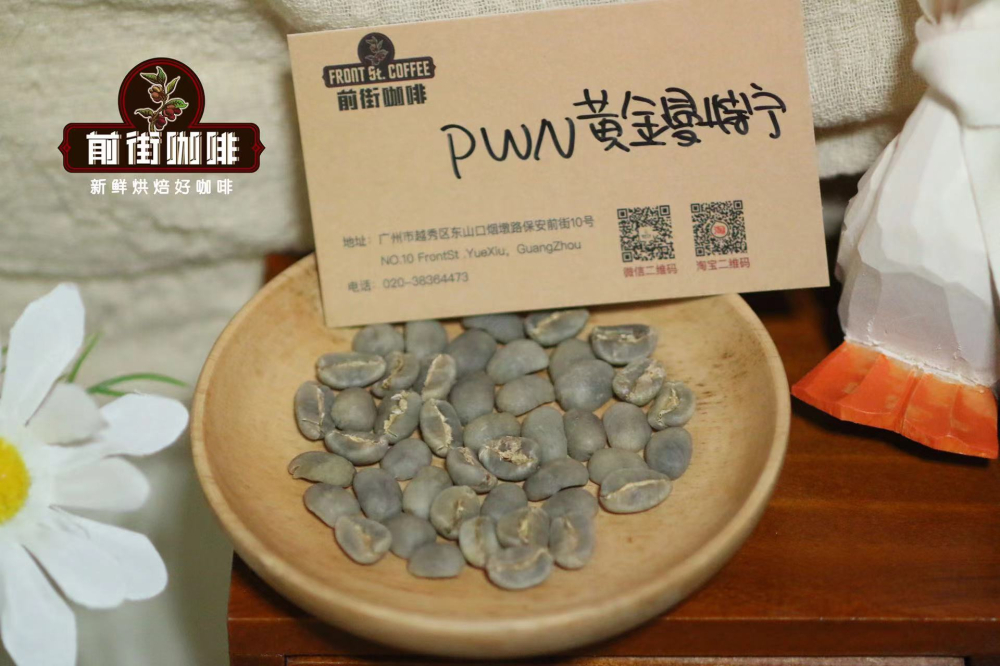
The Golden Mandheling coffee beans currently sold by Front Street Coffee (FrontStreet Coffee) all come from PWN~At Front Street Coffee's (FrontStreet Coffee) physical stores, you can see the certificate issued by PWN as well as burlap sacks containing green beans and printed with the PWN logo.
The above content is compiled by CoffeeHunters, a coffee news website.


