







What Makes Yellow Bourbon Coffee From Queen Estate Distinct?
Brazil grows about one-third of the world's coffee yet its beans are usually inexpensive, because large volumes come from flat, mechanized areas and go to commodity blends. Yellow Bourbon coffee from Queen's Farm in Mogiana, Sao Paulo State, sits outside that pattern: a specific variety, pulped natural processing, and a cup that leans sweet with noticeable body rather than sharp acidity.
Pulped natural processing leaves some mucilage on the bean during drying, which supports sweetness and body. A coffee farm in Mogiana sits at moderate altitude with a marked dry season, conditions that suit Yellow Bourbon's ripening. On the pour-over side, expect a medium grind, water near 90C, and a 1:15 ratio to keep the cup sweet without muting its body.
Brazil is the world's largest coffee-producing country, accounting for about one-third of global output, but why are Brazilian coffee beans generally inexpensive? From the perspective of Front Street Coffee, this article first outlines Brazil's coffee-growing conditions and cultivation characteristics, then highlights the Queen's Farm coffee beans from Mogiana in São Paulo State, introducing their Yellow Bourbon variety, pulped natural processing method, and flavor profile, along with Front Street Coffee's pour-over brewing parameters and pricing reference, to help coffee enthusiasts gain a comprehensive understanding of this Brazilian specialty coffee that combines sweetness and body.
For more specialty coffee knowledge, please follow: Front Street Coffee
Brazil is the largest country in South America, and its coffee production has long ranked first in the world, accounting for roughly one-third of global output. However, coffee beans produced in Brazil are usually not expensive. So how much does a cup of Brazilian coffee actually cost? Next, Front Street Coffee will address these questions one by one.
Why is Brazil's coffee production so high?
According to Front Street Coffee, Brazil is located in the Latin American region of the Western Hemisphere, in the eastern part of South America on the western shore of the Atlantic Ocean. On land, it borders every other South American country except Ecuador and Chile; moreover, the vast majority of its territory lies between the equator and the Tropic of Capricorn, making it the country with the largest tropical area in the world. One-third of Brazil has a tropical rainforest climate, and two-thirds has a tropical savanna climate. These excellent tropical natural conditions are highly suitable for the growth and production of coffee and other tropical cash crops.
Brazil also makes full use of its tropical geographic environment and places great emphasis on coffee production and sales, keeping its coffee output, export volume, and per capita consumption at the top of the world for many years, earning it the title of "Coffee Kingdom."
So why is Brazilian coffee not expensive?
As mentioned above, Brazil is the world's largest coffee-producing country, but that does not mean its entire territory is suitable for growing coffee. According to Front Street Coffee, Brazil's main producing areas are concentrated in the central and southern provinces. The areas suitable for coffee cultivation are relatively flat, with most coffee farms located below 1,200 meters in elevation and without shade trees; during harvest, ripe and unripe cherries are picked together, so it does not qualify as specialty coffee.
It can thus be seen that Brazilian coffee is generally grown in flat areas. To adapt to local conditions, Brazilian estate operators developed improved Arabica coffee trees decades ago that do not require high altitudes or shade, and can be planted on plains or grasslands directly exposed to the sun, which is completely different from the traditional shade-growing method at higher altitudes.
According to Front Street Coffee, the elevation of Brazilian coffee farms is mostly only a few hundred meters, and coffee is even planted on flat land without issue. This sun-exposed cultivation method makes coffee cherries grow faster, but flavor development is not complete enough, and the density of the beans—that is, so-called hardness—is not as good as that of highland beans. The fruity acidity is noticeably lower and the flavor is monotonous, so it is rarely used for high-quality single-origin coffee beans, but rather for espresso blends, and the price is naturally not high.
So how much is a cup of Brazilian coffee?
To drink a delicious Brazilian coffee, choosing pour-over coffee beans is clearly the better way to taste the finest flavors of coffee beans from Brazilian producing regions. This brings us to the Brazilian Queen's Farm coffee beans, which hold a certain position in the specialty coffee market.
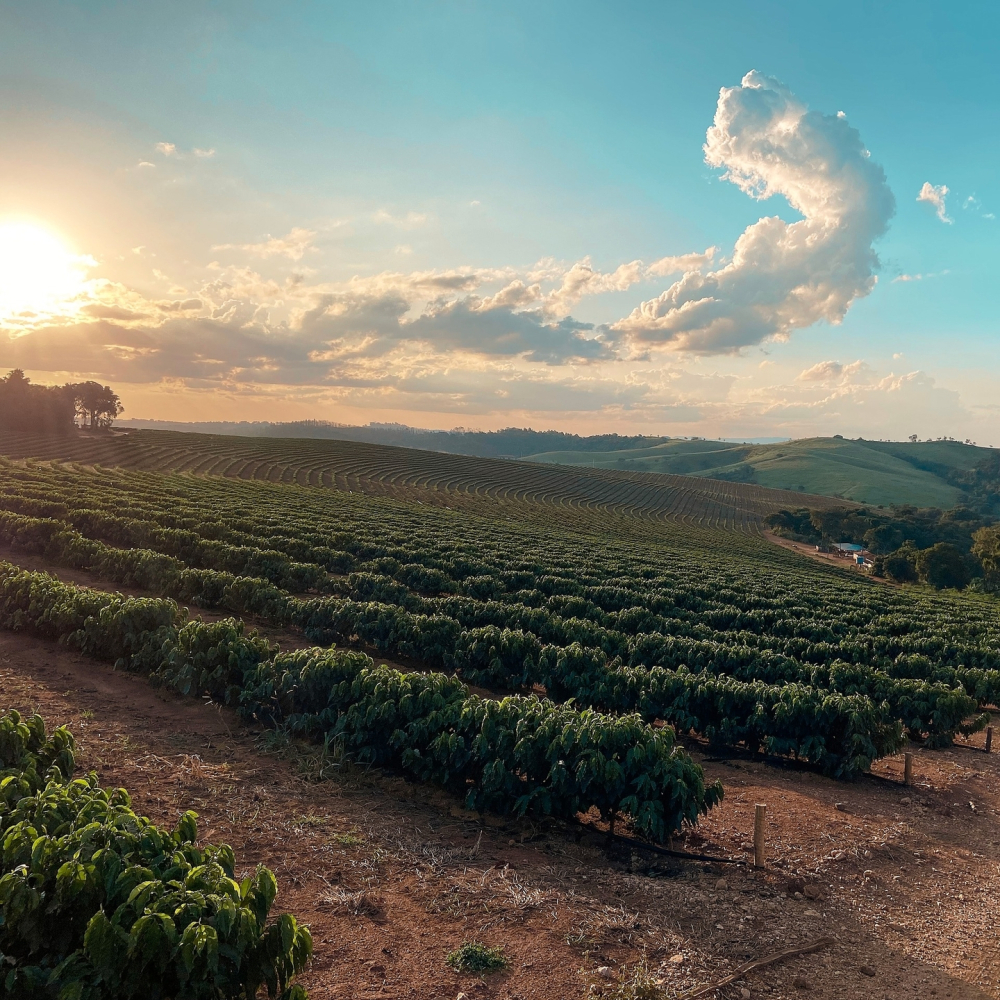
Queen's Farm is located in Mogiana, within São Paulo State, Brazil's most famous coffee-producing region, an area very close to southern Minas. The coffee is grown among shrubs, grasses, and other vegetation. In this region there are many farming families, some of which use traditional large-farm operating methods, while others adopt small-scale modern operations. Modern technology combined with mountain coffee-growing culture creates the highest-quality green coffee beans.
Queen's Farm is located in the north of the Mogiana region in São Paulo State, Brazil. The farm is highly renowned in Brazil and is owned by the Carvalho Dias family. Carvalho Dias owns four major farms, and since the first Brazil COE competition in 1999, they have won awards year after year, taking more than 12 awards over seven years. In 2004, they even captured first place, ninth place, and eleventh place. Therefore, Front Street Coffee has also introduced these coffee beans for coffee lovers to taste, and next Front Street Coffee will share information about these beans with everyone.
Front Street Coffee Brazil Queen's Farm Coffee Beans
Country: Brazil
Region: São Paulo State (Queen's Farm)
Altitude: 1,400-1,950m
Variety: Yellow Bourbon
Processing method: Pulped natural / natural
Flavor: Nuts, cream, peanut, fermented fruit, sucrose
As mentioned above, the coffee bean variety of Brazil Queen's Farm is Yellow Bourbon . Yellow Bourbon is a variant of Bourbon grown in Brazil. Due to the influence of a recessive gene, its fruit turns yellow. Yellow Bourbon coffee beans are naturally sweet, clean, well balanced, and have tropical fruit aromas. According to Front Street Coffee, of Queen's Farm's 280 mu of land, 200 mu are entirely planted with Yellow Bourbon.
At the same time, this Queen's Farm coffee uses Brazil's unique pulped natural processing method. Because Brazil's local climate conditions are relatively dry, it created this distinctive pulped natural method to process green coffee beans. Pulped natural processing can control the degree of fermentation of the mucilage-covered beans after pulping and demucilaging. The pulped natural method does not have the "tank fermentation, clean water rinsing" process of washed processing; without this fermentation step, the flavor of the coffee beans is completely different.
So how much does it cost? Using Front Street Coffee's pricing as a reference, a cup of pour-over coffee is 30 yuan, while a half-pound (227g) bag of Brazil Queen's Farm coffee beans is 85 yuan.
So how can the flavor of these coffee beans be brought out through pour-over brewing? Below, Front Street Coffee will share the pour-over parameters for this Brazil Queen's Farm coffee.
Brazil Queen's Farm Pour-Over Brewing Parameters
Dripper: KONO
Dose: 15g
Water temperature: 90℃
Grind size: medium grind, 75% passing a No. 20 standard sieve
Water-to-coffee ratio: 1:15
Brewing method: staged extraction.
Use 30g of water for a 30-second bloom, then pour in a small stream in circles up to 125g for the first stage; when the water level is about to expose the coffee bed, continue pouring to 225g and stop; when the water level is about to expose the coffee bed again, remove the dripper. (Start timing from the beginning of the bloom.) The V60 dripper extraction time is 2'00", while the Kono dripper takes slightly longer at 2'10".
Brazil Queen's Farm Coffee Bean Flavor : Balanced mouthfeel, with an almond-cocoa main note highlighting the sweetness of sucrose; it is a coffee with good body and abundant sweetness.
For more specialty coffee beans, please add the private WeChat of Front Street Coffee, WeChat ID: kaixinguoguo0925
The above content is compiled by CoffeeHunters, a coffee news website.


