







Do dark roast espresso blend beans work in a pour-over?
Espresso blend beans labeled dark roast can be brewed as pour-over, but the cup shifts toward smoke, cocoa and heavy body instead of bright fruit. Roast level decides much of this: terms like French Roast, Italian Roast and City Roast describe depth, not origin, and Italian Roast sits at the darkest end with strong bitterness.
French Roast in the United States is often roasted very dark, giving burnt bitterness and a smoky coffee aroma that suits café au lait or Viennese coffee, while City Roast keeps a balance of bitterness and acidity. Knowing the Agtron values and drop times behind each stage helps predict how a blend performs as pour-over.
Many coffee enthusiasts encounter a question when selecting beans: are coffee beans labeled as espresso blend and dark roast actually suitable for pour-over? To answer this, we need to start with the classification of coffee roast levels. What exactly do terms like French Roast, Italian Roast, and City Roast represent? What flavor profiles correspond to different roast levels? From the perspective of Front Street Coffee, this article systematically sorts out the Agtron color values and drop times for each roasting stage, and shares the development approach, roasting curve, and espresso extraction plan for Front Street Sunflower Warm Sun Blend, helping you understand the performance differences of dark-roasted beans in both pour-over and espresso scenarios.
For more specialty coffee knowledge, please follow: Front Street Coffee (Frontsteet Coffee)
The roast level often plays a decisive role in the final flavor direction of a coffee bean. When purchasing coffee, the packaging label usually indicates the roast depth. Terms like light roast and dark roast are fairly intuitive, but once you encounter terminology like Cinnamon Roast or City Roast, many people are at a loss. In this issue, Front Street will guide you through the knowledge related to coffee roast levels.
The naming system for coffee roast levels is quite rich, with French Roast, Italian Roast, City Roast, and others being common terms. It should be noted that French Roast and Italian Roast refer to roast depth and have nothing to do with where the coffee beans are grown.
Generally understood, French Roast falls into the lighter end of espresso roasting, while Italian Roast enters a darker range. However, in the United States, beans called French Roast are often astonishingly dark, with a burnt bitterness on entry, a heavy smoky aroma, and occasionally giving the illusion of chewing charcoal. This intense bitterness combined with a unique roast aroma is actually quite suitable for making café au lait or Viennese coffee.
City Roast originated in New York. The bean surface is a glossy tea-brown, with a balance between bitterness and acidity, and a rich, mellow aroma. It is the roast level for daily consumption in most coffee shops and homes. Italian Roast is the deepest level, with coffee beans nearly charcoal black, offering intense bitterness and a full body, suitable for making espresso and cappuccino.
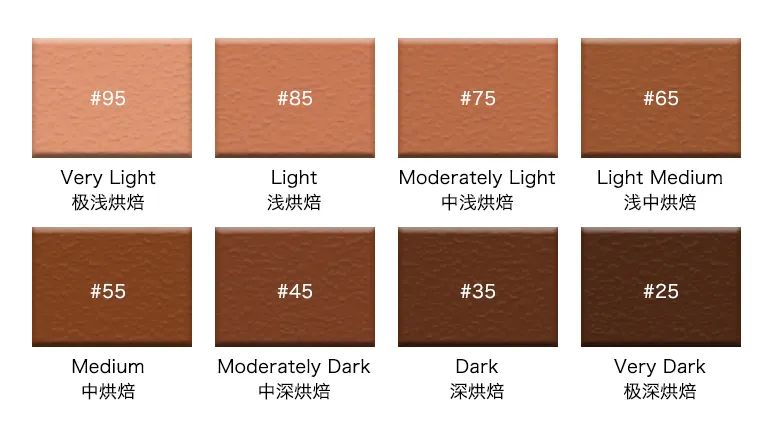
Agtron color value #95: Light Roast Drop time: The dense first crack is about to end
Agtron color value #85: Cinnamon Roast Drop time: Around the end of first crack
Agtron color value #75: Medium Roast Drop time: After the end of first crack
Agtron color value #65: High Roast Drop time: The quiet period between first and second crack
Agtron color value #55: City Roast Drop time: The start of second crack
Agtron color value #45: Full City Roast Drop time: Before the dense second crack
Agtron color value #35: French Roast Drop time: During the dense second crack
Agtron color value #25: Italian Roast Drop time: Oils begin to seep onto the bean surface
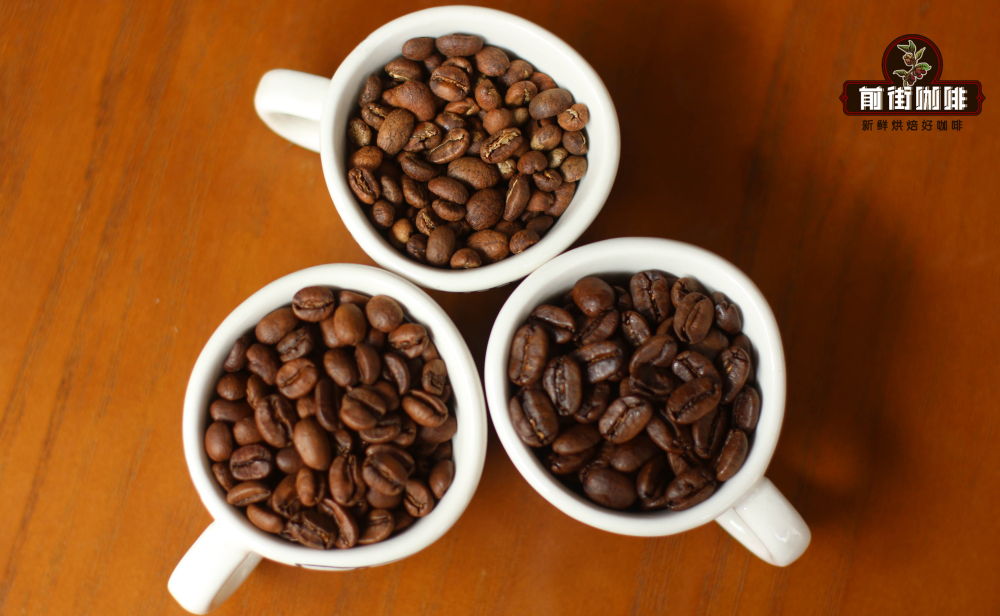
The above three roast levels can all be classified under the category of "dark roast." Dark-roasted beans can release abundant sweet mellow flavors and aromas because, with prolonged roasting time, the caramelization reaction is more complete, more oils are produced, and sweetness becomes more prominent. This richness sometimes has more depth and layers than light brown Cinnamon Roast, and sweetness can be used to neutralize acidity, fully releasing the flavor components of high-quality beans from premium origins. If you are new to coffee, when selecting beans, you might consider your flavor preferences, origin information, and brewing method. The safest approach is to directly consult the shop and ask for their recommendation, making it easier to get a cup of coffee that suits your taste.
Front Street Blend Coffee Approach Sharing
At Front Street Coffee (FrontStreet Coffee), you can find 4 Front Street espresso blend coffee beans: Front Street Sunflower Warm Sun Blend, Front Street Specialty Espresso Blend, Front Street Commercial Espresso Blend, and Front Street Basic Espresso Blend. Among them, Front Street Sunflower Warm Sun Blend is currently Front Street's best-performing blend. Below, we'll discuss how Front Street blended the Front Street Sunflower Warm Sun Blend coffee beans that combine rich chocolate, wine aroma, and vanilla flavors.
In the season of warm winter sun, Front Street planned to make a blend that can be used for both pour-over and espresso. In terms of taste, they hoped for a pleasant aroma that hits you immediately upon entry with high recognizability, a full body with soft fruit acidity, and a medium-to-high level of sweetness in the aftertaste.
After repeated consideration, the approach gradually became clear: beans with prominent aroma and a full body are needed. Could special processing methods be a good direction? Anaerobic processing? Wine barrel fermentation? The Ethiopian region has thousands of varieties, with great potential for flavor exploration. Washed beans have bright fruit acidity and a clean taste, while natural beans have richer tropical fruit notes with a complex and full body. When it was hard to decide, they remembered that they had previously made SOE with wine barrel fermented beans and natural Front Street Yirgacheffe beans, and both extractions performed well, with fruit acidity in the aroma, balanced without being monotonous, and sufficient sweetness.
Front Street Coffee (FrontStreet Coffee) Roasting Curve Analysis
For use as a blend, it needs body, sufficient sweetness, and overall balance. Considering that mixed blend beans may experience uneven heating during roasting, a stepwise heat reduction method was used during roasting to allow the beans to develop as synchronously as possible.
When the drum temperature rose to 210°C, the beans were charged, the damper was adjusted to 4, the heat was 200, the turning point was at 1'30" at 92°C; when the drum temperature reached 140°C, the damper was opened to 6; at this point the bean surface turned yellow, the grassy smell completely dissipated, entering the dehydration stage; when the drum temperature reached 180°C, the heat was reduced to 10, and the damper was opened to the maximum of 10;
At 9'30", wrinkles and dark spots appeared on the bean surface, and the toast aroma clearly turned into coffee aroma, which can be regarded as the prelude to first crack. At this time, listen carefully for the sound of the first crack point; at 10'38" the first crack began, and after first crack developed for 3'40'', the beans were dropped at 197.5°C.
After cupping, pour-over, and espresso extraction tests, this bean has soft fruit acidity on entry, a lasting sweet aftertaste, sufficient sweetness, rich chocolate aroma, with vanilla, cream, and a distinct wine note. The taste is clean and smooth, with a medium body, very much in line with the positioning Front Street wanted for the Warm Sun Blend beans.
Front Street Coffee (FrontStreet Coffee) Espresso Extraction Plan
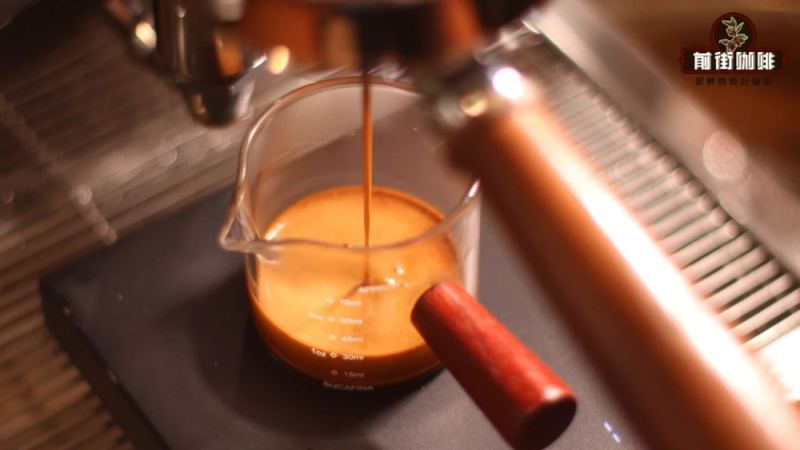
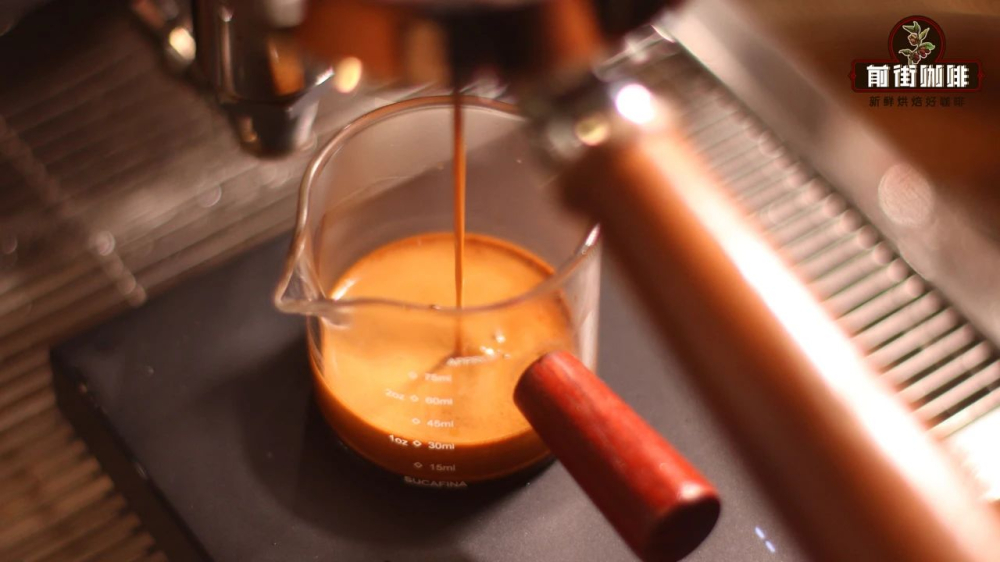
Grind setting on Pegasus 600N grinder #1.8, dose 20g, extract 40g of coffee liquid, brew ratio 1:2, extraction time 28s.
Flavor: Smooth taste, medium body, noticeable fruit acidity on entry, accompanied by a faint berry aroma, with wine aroma and rich chocolate flavor, and a prominent sweet aftertaste.
Americano: The ratio of espresso liquid to water is 1:5, with sherry aroma and vanilla cream flavor, the tipsy feeling of sherry, and notes of cocoa and caramel.
Latte: The ratio of espresso liquid to milk is 1:6, presenting rich chocolate milk and caramel flavors, very high sweetness, and smooth.
The above content is compiled by CoffeeHunters, a coffee news website.


