







How Did Coffee Producing Regions Shape Brazilian Varieties?
Brazil grows more coffee than any other country, and its variety lineage runs from Typica, introduced in the 18th century, through Bourbon, Caturra, Catuai and Mundo Novo. Coffee arrived from French Guiana in the 1720s via captain Francisco de Melo Palheta, then spread from the north toward São Paulo and Paraná. Growers also developed pulped natural processing to work around climate and water limits.
The main coffee producing regions shifted over time. Frost in higher-latitude Paraná caused heavy losses, so from 1970 to 1980 farmers expanded into warmer areas. Brazil's tropical climate, covering roughly a third rainforest and two thirds savanna, suits arabica beans, and examples such as Red Bourbon and Yellow Bourbon show how variety and terroir interact in the cup.
As the world's largest coffee producer, Brazil's coffee cultivation history and variety evolution have profoundly shaped the global coffee landscape. From the introduction of Typica in the 18th century to the successive emergence of Bourbon, Caturra, Catuai, Mundo Novo, and other varieties, Brazil has not only nurtured many classic coffee varieties but also invented the pulped natural processing method to address climate and water resource challenges. This article will systematically outline Brazil's coffee variety lineage and major producing regions, with a focus on Front Street Coffee's Red Bourbon and Queen's Farm Yellow Bourbon, along with detailed roasting analysis and pour-over brewing recommendations.
When it comes to Brazilian coffee, what comes to mind? The "Rio beans" once labeled as inferior, the reigning champion of global coffee production, or the founding country of the Cup of Excellence? These labels together form the historical backdrop of Brazilian coffee. So what impression does today's Brazilian coffee leave? Front Street Coffee will take you through a series of articles to rediscover Brazilian coffee.
The Cultivation History of Brazilian Coffee
Brazil is located in the Latin American region of the Western Hemisphere, in the eastern part of South America along the Atlantic coast, sharing land borders with every South American country except Ecuador and Chile. Most of its territory lies between the equator and the Tropic of Capricorn, making it the country with the largest tropical expanse in the world. One-third of the country has a tropical rainforest climate, while two-thirds has a tropical savanna climate. These exceptional tropical natural conditions provide an ideal environment for the growth and production of coffee and other tropical cash crops.
Coffee was introduced to Brazil from French Guiana in the 1720s. At the time, a Portuguese captain named Francisco de Melo Palheta won the favor of the governor's wife in Cayenne, the capital of French Guiana, and thereby successfully brought coffee seeds into Brazil. After that, coffee quickly took root in Brazil, gradually expanding from the north to São Paulo in the southeast and Paraná in the south. However, Paraná's latitude is relatively high, and frost occurs in winter, causing considerable losses for coffee farmers.
Between 1970 and 1980, Brazilian farmers began expanding toward the warmer Minas province and Bahia region in northern São Paulo. These areas have warm winters with no risk of frost, and today Minas has become one of Brazil's core specialty coffee producing regions.
Before 1990, the Brazilian government exercised strict control over the coffee industry, employing both strong intervention and price support policies. The state long guaranteed minimum prices for farmers, which led to coffee overproduction.
After 1990, as free markets gradually opened up, the former Brazilian Coffee Institute (IBC) was replaced by the National Economic Association, a non-investment administrative body of the state. This association adopted a non-interventionist policy, allowing producers and exporters to trade directly. Exporter operations are supervised by government legislation, and legitimate exporters must register with the relevant authorities. Continuing from three centuries ago to the present day, coffee has become Brazil's most important economic pillar, and Brazil remains firmly in first place in global coffee production.
What Coffee Varieties Does Brazil Have?
As the backbone of coffee in the Americas, Brazil served as the conduit through which many coffee varieties spread to Latin American countries. Among the well-known ones are Typica, Bourbon, Caturra, Catuai, and Mundo Novo.
Typica: Typica can be considered the oldest coffee variety in the world, with unquestionable flavor quality, but its shortcomings are low yield and weak disease resistance. Brazil began cultivating Typica as early as the 18th century and was one of the earliest coffee-growing regions in the Americas. However, due to unsatisfactory yields, it was gradually replaced by the slightly higher-yielding Bourbon after the 19th century. Today, very little Typica remains in Brazil, and it is difficult to achieve scale production.
Bourbon: Bourbon was the second coffee variety to enter Brazil, primarily to replace the lower-yielding Typica, but its overall yield is only about 30% higher than Typica.
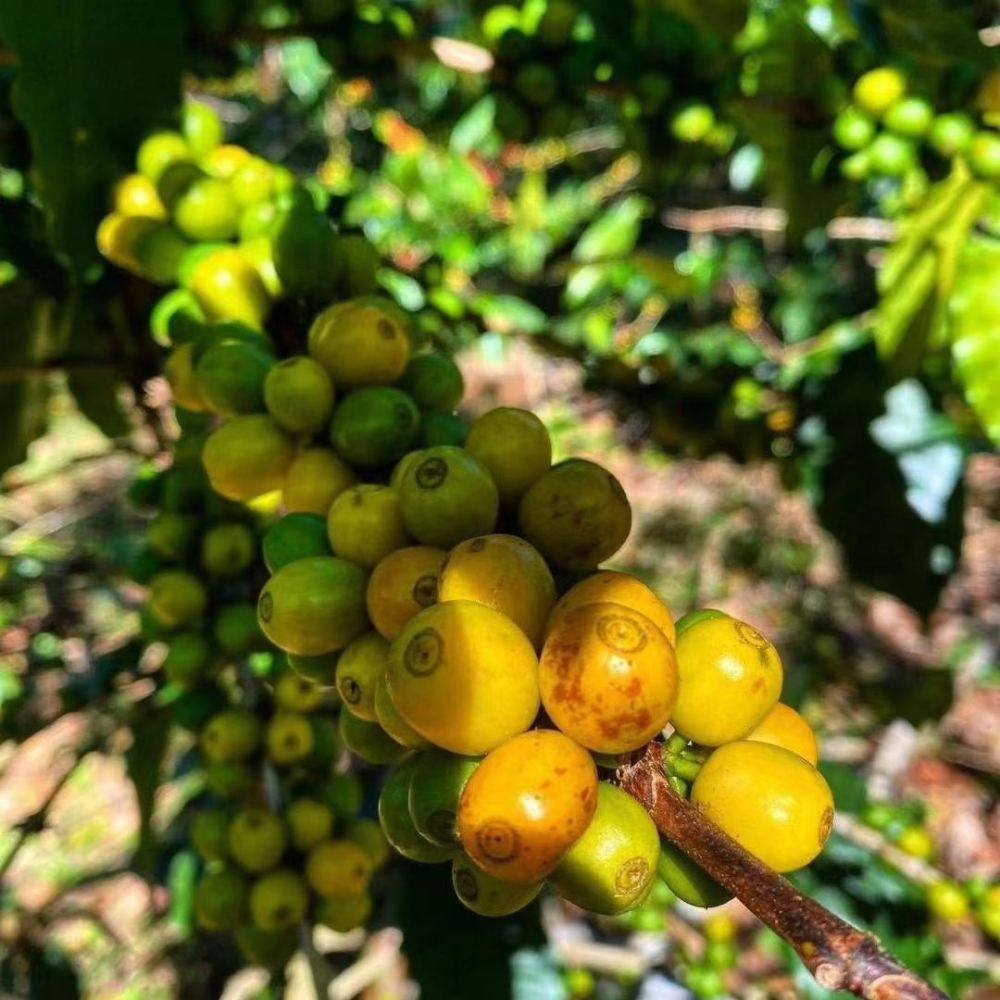
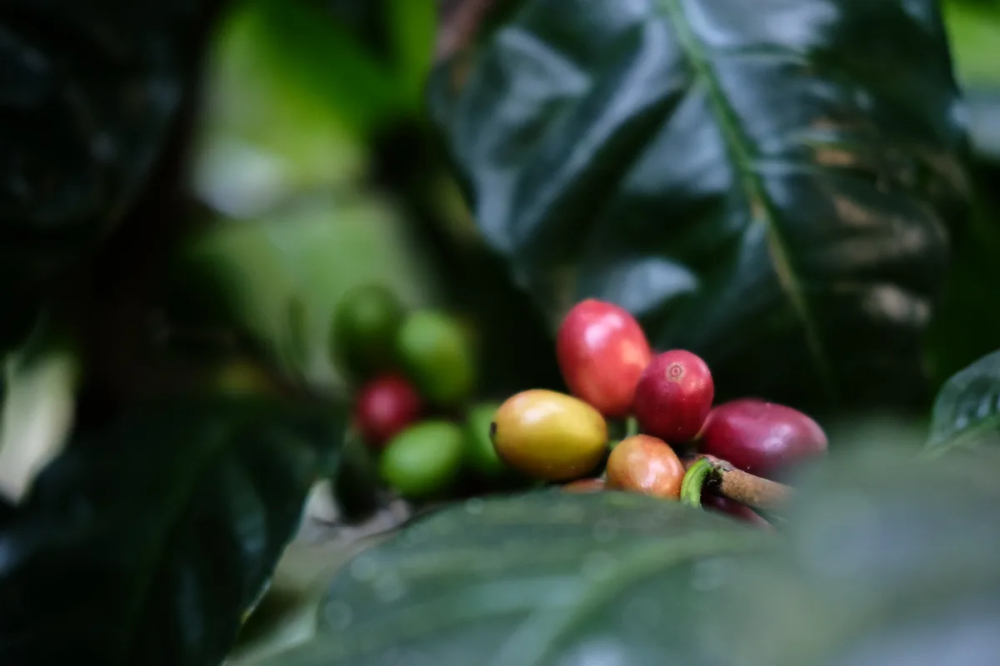
Normal Bourbon coffee cherries turn red when ripe, while Yellow Bourbon cherries are not red but yellow when ripe. Yellow Bourbon was first discovered in Brazil in 1930 and is currently mainly grown in Brazil. It is generally believed to have resulted from a mutation after crossing red-fruited Bourbon with a yellow-fruited Typica variant called "Amerelo de Botocatu" (discovered in São Paulo state in 1871). Due to its low yield and susceptibility to wind and rain, Yellow Bourbon has not been widely cultivated. However, when grown at high altitudes, it can display excellent flavor expression, and it has gradually gained attention in recent years.
Caturra: Caturra is a natural mutation of the Bourbon variety, discovered between 1915 and 1918 on a plantation in Minas Gerais, Brazil. A group of genes in the Bourbon on the plantation mutated, causing the plant to grow more compact (similar to dwarfism). This coffee variety, appearing in a new biological form, was called Caturra by locals in the Guarani language, meaning "small," and is sometimes also called "Nanico."
The Agronomical Institute of Campinas (IAC) in São Paulo State, Brazil began selection in 1937. The breeding process for Caturra is known as mass selection, which involves selecting a group of individuals based on superior traits, pooling the seeds of these plants to form a new generation, and then repeating the process. Interestingly, this variety was never officially released for promotion in Brazil, yet it has become quite common in Central America.
Mundo Novo: Mundo Novo is the product of a natural cross between Bourbon and Sumatra Typica, first discovered in 1943 in Tietê, São Paulo, Brazil. Mundo Novo was initially planted in the city of Novo Mundo, now known as Urupês.
The first selection work on Brazilian Mundo Novo coffee beans was completed between 1943 and 1952. The variety began being distributed to coffee farmers for planting in 1952. In the 1960s, Mundo Novo was widely planted in Brazil and hailed as the new hope for the Brazilian coffee industry. In 1977, the Agronomical Institute of Campinas (IAC) released a new selection. In Brazil and other South American countries, the Mundo Novo variety has high commercial value. Mundo Novo also spread to other countries, but for various reasons it was not widely cultivated locally. Mundo Novo coffee trees are tall, with green or brown leaf tips. Brazilian coffee beans generally have a rounder shape and larger size.
Catuai: Catuai—just from the name, one can see its close connection to Caturra. It is a variety artificially bred by the Agronomical Institute of Campinas (IAC) in São Paulo State, Brazil, by crossing Mundo Novo with Yellow Caturra, originally called "H-2077." Mundo Novo is the result of a natural cross between Bourbon and Typica, first discovered in 1943 in Tietê, São Paulo, Brazil.
Catuai inherited Mundo Novo's advantages of high yield, strong disease resistance, and good cupping quality, while also inheriting Caturra's characteristics of a compact plant, fine acidity, and suitability for sun exposure. Therefore, Catuai has strong resistance to disasters, especially wind and rain. Because the plant is smaller, it can be planted at double density, and its compact size makes pest and disease management relatively easier. Catuai grows vigorously and is short in height, but is susceptible to leaf rust.
It is precisely because this coffee variety performs so outstandingly that it was named Catuai, which means "very good" in the Guarani language. However, the variety originally called "H-2077" did not stand out in cupping; it was only excellent in terms of disease resistance, pest resistance, yield, and adaptability to growing environments.
Maragogype: Maragogype, scientific name Maragogype. Because it was first discovered in 1870 in the Maragogipe producing region of Bahia, Brazil, this unusually large coffee bean variety was named after that origin. Through morphological comparison and genetic testing, it has been confirmed that Maragogype is a natural mutation of Typica, with coffee beans three times the size of ordinary Arabica beans.
In addition to its large beans, Maragogype's trunk and branches are also thicker than ordinary coffee varieties, so it requires more space, nutrients, and resources for cultivation. Combined with the difficulty of management and harvesting and the high time cost (the fruit takes a long time to mature, bearing fruit only after five years), few farmers are willing to grow it. Currently, it is found in small quantities in Brazil, Nicaragua, Mexico, Guatemala, and other Latin American countries. In Brazil, due to high cultivation costs, only a small amount exists and it is difficult to achieve scale.
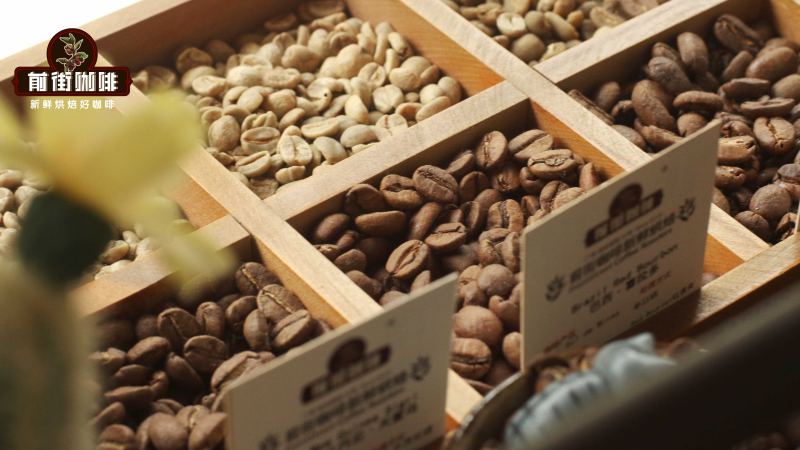
Front Street Coffee Brazil Red Bourbon Country: Brazil Region: South Minas Altitude: 1,000 meters Variety: Red Bourbon Processing Method: Pulped Natural
This Brazilian coffee bean from Front Street comes from Minas Gerais. The representative coffee-producing regions of Minas Gerais include Cerrado and South Minas, both of which are high-altitude areas. Cerrado is located in western Minas Gerais and is a flat plateau with an altitude of 750 to 1,200 meters. South Minas is a hilly area with an altitude of 700 to 1,200 meters. Since 1999, among the estates that have won in Brazil's Cup of Excellence auction events, South Minas has had the highest number.
The Pulped Natural Coffee Processing Method Invented by Brazil
Before 1990, Brazil used almost entirely rough natural processing, which made Brazilian beans prone to picking up flavors of decaying wood or earth. Because coffee cherries need to undergo two to three weeks of sun exposure, once rain or moisture returns, musty flavors easily develop. To change this situation of complete dependence on weather, in 1990 Brazil developed the pulped natural method based on the country's relatively dry climate, in order to shorten processing time.
Pulped natural processing, which can also be called semi-washed processing, is essentially a combination of natural and washed processing. Brazil faces water shortages and unstable rainy seasons; using full washed processing cannot guarantee sufficient water supply, while full natural processing cannot guarantee long periods of dry weather. So, taking advantage of natural conditions, the pulped natural processing method was created. This processing method greatly reduced water consumption and sun-drying time, reversing Brazil's two-hundred-year situation of rough coffee quality.
Front Street Coffee Roasting Analysis
Brazilian coffee generally grows at altitudes between 1,000 and 1,300 meters, so its density is relatively low, moisture content is moderate, the bean texture is relatively soft, and the thickness from bean surface to bean core is relatively thin. It is not suitable for roasting at too high a temperature, otherwise scorched and bitter flavors easily develop. We use a medium flame when charging the beans, maintaining the flame as we enter the dehydration phase. After first crack begins, we make slight adjustments as the temperature rises to promote a more complete caramelization reaction. This pulped natural bean rises slowly in temperature after first crack, and can be dropped when approaching second crack.
Preheat the roaster to 200°C and charge the beans. Set the airflow to 3. After 30 seconds, turn on the flame and adjust the heat to 160, keeping the airflow unchanged. The turning point is at 1 minute 30 seconds. Maintain the flame. At 5 minutes, the beans turn yellow, the grassy smell disappears, and the dehydration phase begins. Lower the heat to 130 and open the airflow to 4. At 168°C, lower the heat again to 100. At 8 minutes, dehydration is complete. The bean surface develops wrinkles and dark streaks, and the toasty bread aroma turns into coffee fragrance—this is the prelude to first crack. At this point, listen carefully for the sound of first crack. At 8 minutes 50 seconds, first crack begins, and open the airflow fully to 5. Post-first-crack development time is 3 minutes 10 seconds. At 190°C, lower the heat to 50; at 194°C, lower it again to 30; drop the beans at about 200°C.
Front Street Coffee Brewing Recommendations Dose: 15g Water Temperature: 86–88°C Grind Size: Medium grind, 70% passing through a No. 20 standard sieve Water-to-Coffee Ratio: 1:15
Front Street uses staged extraction: the blooming water amount is twice the coffee dose, that is, 30 grams of water for a 30-second bloom. Pour in a slow circular stream to 125 grams, then pause. When the water level drops and is about to expose the coffee bed, continue pouring to 225 grams and stop. The total extraction time is 2 minutes.
Brewing Flavor: High sweetness, clean, smooth, low acidity, with flavors of peanut, almond, nuts, and chocolate.
Front Street Coffee Brazil Queen's Farm Region: Brazil, Mogiana Region Estate: Queen's Farm Altitude: 1,400–1,950m Variety: Yellow Bourbon Processing Method: Natural Processing
The Mogiana region is very close to southern Minas. Coffee is grown among shrubs, grasses, and other vegetation. There are many farming families in this region; some operate traditional large farms, while others run small-scale modern operations. The combination of modern technology and mountain coffee-growing culture produces the highest-quality green coffee beans. Through cupping, Front Street found that coffee beans from this region carry a clear sweetness like cane sugar.
Estate Fine Natural Processing
Unlike Brazil's large-scale harvesting and processing, Queen's Farm uses fine natural processing, which solves the quality decline caused by Brazil's large-scale centralized processing. In the picking stage, semi-mechanical harvesting is used, improving harvest quality while ensuring efficiency. After harvesting, a second flotation is carried out, and qualified coffee cherries are selected for raised-bed sun drying. During this period, the degree of dryness is manually monitored and defective fruits are removed. When dried to 12% moisture content, the beans are hulled and polished, then stored in parchment.
Front Street Coffee Roasting Analysis
This is also Brazilian coffee, but this bean's average growing altitude is higher, so the coffee bean texture is relatively harder.
Brazilian Yellow Bourbon roasting recommendations: Yangjia 800N, charge weight 550g. Preheat the roaster to 200°C and charge the beans. Adjust the heat to 150, set the airflow to 3. The turning point is at 1 minute 30 seconds. Maintain the flame. At 5 minutes 10 seconds, the beans turn yellow, the grassy smell disappears, and the dehydration phase begins. Lower the heat to 125 and open the airflow to 3.5. At 8 minutes 20 seconds, dehydration is complete. The bean surface develops wrinkles and dark streaks, and the toasty bread aroma turns into coffee fragrance—this is the prelude to first crack. At 178°C, lower the heat to 80. At this point, listen carefully for the sound of first crack. At 9 minutes 14 seconds, first crack begins, and open the airflow fully to 5. Post-first-crack development time is 3 minutes, and drop the beans at 201°C.
Front Street Coffee Brewing Recommendations Dripper: KONO#01 Dripper Dose: 15g Water Temperature: 88°C Grind Size: Medium grind, 70% passing through a No. 20 standard sieve Water-to-Coffee Ratio: 1:15
Use Front Street's three-stage brewing method. First, preheat the dripper and server. Add 15 grams of coffee grounds and gently tap to level the coffee bed surface. Begin the first pour, spiraling from the center outward, pouring 30 grams of water for a 30-second bloom. The ideal state is when the coffee grounds are evenly saturated and puff up into an expanded "coffee hamburger."
After 30 seconds, begin the second pour. In this stage, the water stream height is 3 to 5 centimeters. Pour 95 grams of water in concentric circles from the center outward; the total water poured at this point is 125 grams. Observe that the coffee liquid surface should be entirely golden coffee foam. When the coffee bed is about to be exposed, begin the final pour. In this stage, pour 100 grams of water, slowly drawing circles in concentric spirals while keeping the flow consistent. After all the coffee liquid in the dripper has flowed into the server, remove the dripper and end the extraction. Total time is 2 minutes 5 seconds.
Flavor: Balanced mouthfeel. Against a base of almond and cocoa, the sweetness of cane sugar stands out. It is a coffee with good body and abundant sweetness.
The above content is compiled by CoffeeHunters, a coffee news website.


