







How Do You Tell Real Blue Mountain Coffee Beans Apart?
Authentic Blue Mountain coffee is grown in Jamaica's Blue Mountains at roughly 1,000 to 1,700 meters, and its annual output is small. The cup is balanced and smooth, with citrus acidity, a nutty middle and a dark chocolate finish, and no single flavor dominates. Genuine beans carry wooden barrel packaging, the tree frog logo and a government certificate.
Labels found on shelves describe something different: Blue Mountain Blend requires at least 60 percent Blue Mountain beans, while Blue Mountain Flavor may contain none at all. Japan set out those three tiers, and the distinction explains the wide price gap. This classic coffee suits a KONO dripper, 88°C water and a 1:15 ratio poured in three stages.
Blue Mountain Coffee is hailed as the crème de la crème of coffee, grown in Jamaica's Blue Mountains, with scarce annual output and a high price. Yet the commonly seen "Blue Mountain Flavor" and "Blue Mountain Blend" on the market differ enormously from authentic Blue Mountain coffee beans. This article starts from the actual Blue Mountain beans received by Front Street Coffee, and clearly explains Blue Mountain coffee's grading standards, methods for distinguishing the genuine from the fake (wooden barrel packaging, the tree frog logo, government certificates), and documents in detail Front Street's three-pour hand-brew parameters using a KONO dripper, 88°C, and a 1:15 coffee-to-water ratio, as well as the citrus acidity, nutty mid-palate and dark chocolate finish presented by this Clifton Mount Blue Mountain, helping coffee lovers understand Blue Mountain coffee's core characteristics of balance, smoothness, and no standout flavor.
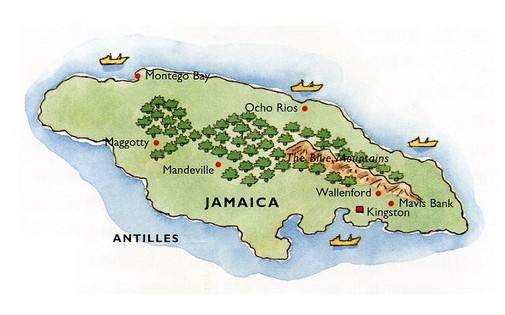
In the international coffee world, authentic Blue Mountain Coffee has always enjoyed considerable prestige. It is produced in Jamaica's Blue Mountains, where total annual output is quite limited, and there are clear requirements for growing altitude, usually above 1,000 to 1,700 meters. Because production is small, prices are high, and it is not easy to find on the market, many coffee products imitating the Blue Mountain flavor have been created.
Blue Mountain Flavor coffee is a rather peculiar coffee; it is not equivalent to genuine Blue Mountain coffee beans. Japan once classified Blue Mountain-related products into three quality and product grades: the highest grade is called "Blue Mountain Coffee," which must use 100% Blue Mountain coffee beans with no non-Blue Mountain beans blended in; the next grade is called "Blue Mountain Blend," requiring Blue Mountain beans to make up at least 60%; the lowest grade is called "Blue Mountain Flavor," which may even contain no Blue Mountain coffee beans at all.
From this it can be seen that Blue Mountain Flavor coffee beans are not authentic Blue Mountain from Jamaica. True Blue Mountain coffee grows in the Blue Mountain range, which got its name because sunlight reflecting off the sea casts a blue glow on the mountains.
Front Street Coffee has also obtained this authentic Blue Mountain coffee bean. So how do you tell whether Blue Mountain coffee beans are genuine? Front Street Coffee shares a little tip: genuine Blue Mountain coffee does not use cotton or linen packaging bags, but is packed in wooden barrels, and the barrels bear the logo of the tree frog. In addition, buyers also receive relevant certificates issued by the Jamaican government. Therefore, when buying Blue Mountain coffee, you might ask the merchant to show these materials.
Coffee from Jamaica's Blue Mountain region is divided into three grades: Blue Mountain Coffee, Jamaica High Mountain Supreme Coffee Beans, and Jamaica Prime Coffee Beans. Blue Mountain Coffee and High Mountain Coffee are each further subdivided into two levels. Ranked by quality from high to low, they are Blue Mountain No. 1, Blue Mountain No. 2, High Mountain No. 1, High Mountain No. 2, and Jamaica Coffee. If classified as NO.1, NO.2, NO.3, and PB, PB refers to peaberry. According to CIB standards, the basic requirements for NO.1 Blue Mountain green beans are: beans of 17 screen size or above, a defect rate below 3%, a moisture content of about 13%, and so on. Only coffee beans produced according to these standards can have guaranteed flavor.
Many people have heard descriptions of Blue Mountain coffee's flavor. You will often see merchants write this on Blue Mountain coffee packaging: pure Jamaican Blue Mountain coffee perfectly blends coffee's unique acidity, bitterness, sweetness, and body into a strong, alluring elegance; it is insistently grown by hand, of high quality and scarce output, something other coffees can hardly match.
Front Street Coffee believes such descriptions are not inappropriate, because everyone's perception of the same coffee bean is inherently different. So if you want to understand a coffee bean's flavor, relying only on others' descriptions is not enough; you must taste it yourself to verify whether what others say is right. Those who love Blue Mountain coffee call it a "coffee beauty" that combines the merits of all good coffees. Jim, general manager of the American Pete's company, famous for coffee and tea, once said in describing Blue Mountain coffee: "Blue Mountain coffee is aromatic, smooth, and full-bodied in flavor; it feels to me as precious as a gemstone." Precisely because Blue Mountain coffee's taste is moderate and perfect, it is usually drunk as black coffee. Blue Mountain coffee's caffeine content is very low, less than half that of other coffees, which fits well with modern health concepts.
Jamaican Blue Mountain coffee is the finest representative among the classic coffee beans of the Caribbean region, truly the crème de la crème of coffee. Unfortunately, recently some operators have resorted to speculative practices, mixing coffee beans grown at lower altitudes with high-altitude beans, lowering the original standard, which has made Jamaican Blue Mountain coffee less and less remarkable; many coffee lovers are cautious when buying, and quite a few are unwilling to spend a large sum on it.
In addition, some people mistakenly buy coffee beans such as "Blue Mountain Flavor Coffee" or "Blue Mountain Blend Formula." The former contains not a single genuine Blue Mountain coffee bean, while the latter contains only a very small proportion of Blue Mountain coffee beans. Such quality naturally cannot be mentioned in the same breath as orthodox Blue Mountain coffee, greatly disappointing those who are unaware.
You may then wonder why Blue Mountain coffee is so expensive and what exactly makes it taste good. Let Front Street Coffee tell you. Front Street Coffee's Blue Mountain coffee comes from Clifton Mount Estate. Blue Mountain coffee green beans are greenish in color, uniform in appearance, medium to small in size, with slightly upturned ends; after roasting they expand greatly in volume and look very plump. In addition, because genuine Blue Mountain coffee beans grow at high altitude, their cell structure is relatively loose, so when hand-grinding it feels very crisp, pleasant, and continuous, without any sense of resistance.
The ground coffee beans have a very rich, dense aroma; so-called blended Blue Mountain coffee does not have this aroma. Next comes the taste! The parameters Front Street used to brew this Blue Mountain coffee are: KONO dripper, 88°C water temperature, 15 grams of coffee, 1:15 coffee-to-water ratio.
The hand-brewing method uses Front Street's simplest three-pour technique: in the first pour, first use 30g of water to fully wet the coffee bed into a "hamburger" shape, and let it bloom for 30s; then proceed to the second pour, injecting water until it reaches 125g at 54s on the timer, then stop and wait for the water level to drop to 2/3 of the coffee bed before starting the third pour; in the third pour, inject water until it reaches 225g at 1'40" on the timer, with a total extraction time of 2'10". After extraction is complete, gently swirl, and wait for the coffee liquid to be fully uniform before tasting.
The brewed Blue Mountain coffee beans present a slight citrus acidity, overall balance, a smooth mouthfeel, a nutty tone in the mid-palate, and a dark chocolate note in the finish. Genuine Blue Mountain coffee has a balanced, rich taste, without any one flavor standing out or being lacking; Front Street Coffee believes this is also something no other coffee bean can match, and it is the most crucial point for identification.
For professional coffee knowledge exchange and more coffee bean information, please follow Coffee Workshop (WeChat public account: cafe_style)
For more specialty coffee beans, please add the private WeChat of Front Street Coffee: kaixinguoguo0925
The above content is compiled by CoffeeHunters, a coffee news website.


