







How is the coffee-to-water ratio for pour-over calculated?
The coffee-to-water ratio for pour-over is calculated by weight, and most hot brews use 1:15. Iced pour-over follows a coffee-to-water-to-ice ratio of 1:10:5, which returns to roughly 1:15 once the ice melts. For beans that handle extraction well, such as Panama Geisha coffee, the ratio can widen to 1:16, using 20 grams of coffee and 320 grams of water in a three-pour method.
That wider ratio makes floral aroma and sweet-tart fruit notes clearer. A practical example is Hacienda La Esmeralda washed Green Label Geisha, one of several Panama geisha coffee beans offered, brewed with a three-pour process. The logic is simple: more water lowers concentration and slows the extraction of heavier compounds, so delicate flavors come forward instead of nutty or caramel notes.
How exactly should the coffee-to-water ratio for pour-over coffee be calculated? Front Street Coffee’s daily hot pour-over routine uses 1:15, while iced pour-over follows a coffee:water:ice ratio of 1:10:5, and once the ice melts it also returns to 1:15. But when encountering beans that withstand extraction well, such as Panama Geisha, Front Street deliberately widens the ratio to 1:16, using 20 grams of coffee and 320 grams of water for a three-pour process, making the floral aroma and sweet-and-tart fruity character clearer, with a finish that offers Tieguanyin-like sweetness. This article starts from the principles of extraction, combines the origin background of Hacienda La Esmeralda washed Green Label Geisha with a brewing example, and helps you understand the logic behind the coffee-to-water ratio.
Tasting wine emphasizes adapting to each wine, and coffee beans are actually the same. If you want to fully bring out the personality of a certain bean, you need to match it with a suitable roast profile and brewing parameters. Friends who often read Front Street Coffee content are probably familiar with the combination of “15 grams of coffee with 225 grams of water.” However, Front Street also often mentions “15 grams of coffee with 150 grams of water.” Which set of data is actually reliable? Which one tastes better when brewed?
To answer this question, you first need to understand the underlying logic of pour-over extraction. After coffee beans are ground into particles like fine granulated sugar, the surface area exposed to hot water increases greatly. As soon as hot water touches the coffee grounds, the flavor substances in the particles begin to exchange, and the longer the time, the more substances are exchanged, so the coffee concentration rises accordingly.
In fact, Front Street uses both sets of data above. When producing hot pour-over, Front Street uses a 1:15 coffee-to-water ratio; when making iced pour-over, it uses a coffee:water:ice ratio of 1:10:5, and after the ice cubes completely melt, the cup still has a concentration of 1:15. Front Street’s bean list has nearly a hundred coffee beans, and the vast majority are suited to this 1:15 ratio. However, Panama Geisha coffee beans are the exception.
Geisha coffee , with its rich floral aroma and sweet-and-tart performance, breaks the nutty notes and caramel sweetness customary in Central American coffee, making it a treasure of the coffee world. The reason its flavor is so outstanding is inseparable from the local unique growing environment.
When talking about Geisha coffee, Hacienda La Esmeralda is unavoidable. In the early twenty-first century, in order to improve coffee quality, Hacienda La Esmeralda compared and recorded multiple varieties one by one, and thereby discovered the uniquely flavored Geisha. It then won first place in the 2004 Best of Panama (BOP).
Although the Geisha variety originated in Ethiopia, the estate owner of Gesha Village, in order to trace its roots, even found the original producing area of Geisha and built Gesha Village near the Geisha forest. Friends who are just getting into specialty coffee can easily confuse the Geisha of Ethiopia’s Gesha Village with Panama Geisha, and even want to taste the flavor of Panama Geisha in Ethiopian Geisha.
However, scientific testing shows that Panama Geisha and the Geisha of Ethiopia’s Gesha Village differ significantly at the genetic level, and naturally there are also obvious differences in flavor.
To prevent the Geisha variety from monopolizing the spotlight, the BOP competition specifically divided entries into a Geisha group and a non-Geisha group. Panama’s Hacienda La Esmeralda is both the discoverer of the Geisha variety and the promoter of its flavor. Panama Geisha is mostly planted around Barú Volcano, where the volcanic soil is fertile, the mountains are shrouded in clouds and mist year-round, and the climate is mild but with a large temperature difference between day and night; the coffee produced there is mostly sweet and tart. In the early days, coffee beans from the Barú Volcano area were also exported under the name Barú coffee, and Hacienda La Esmeralda is located in one corner of Barú Volcano.
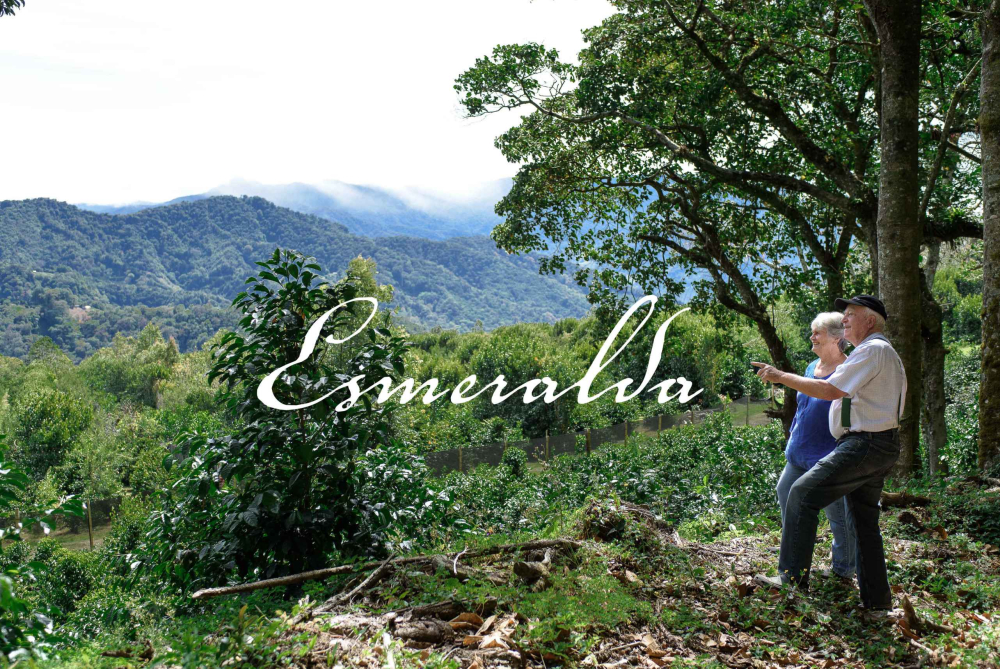
Panama Hacienda La Esmeralda’s washed Green Label Geisha is grown at an altitude above 1,600 meters and uses a multi-plot blended-bean model, so it cannot be traced back to a specific plot. Although the Green Label grade is not as high as Red Label, the quality is still excellent; sometimes it shows a flavor highly similar to Red Label, and the next time it may be completely different.
Front Street Coffee Panama Hacienda La Esmeralda Green Label Geisha coffee beans
Region: Boquete, Panama
Estate: Hacienda La Esmeralda
Altitude: 1,600 meters—1,800 meters
Variety: Geisha
Processing method: Washed processing method
Front Street Coffee’s washed Green Label Geisha from Hacienda La Esmeralda amazed Front Street’s baristas with its unique Tieguanyin-like sweetness. It was also because of this sweetness that a customer once returned to the Front Street store within an hour, just to buy a bag of Green Label Geisha and preserve that Tieguanyin-like finish.
When Front Street brews Panama Geisha, the parameters are also adjusted. During brewing, the sour, sweet, and bitter substances that everyone pays attention to are extracted in three stages over time.
The flavor characteristics of Panama Geisha coffee are known for rich white floral aromas and a sweet-and-tart fruity character. Some friends, in order to take only the early-stage sweet-and-tart substances and avoid the later bitterness as much as possible, remove the dripper before the water in it has finished dripping. Front Street believes that with 15 grams of coffee plus 225 grams of hot water, if the dripper is removed before the water finishes dripping, the final coffee-to-water ratio obtained cannot be counted as 1:15.
Some friends have also heard of the saying “high concentration, low extraction,” and should know that this method usually uses a smaller coffee-to-water ratio, close to 1:10, but the resulting coffee has only a full sweet-and-tart fruity character, with concentrated flavor yet a hollow later stage.
In fact, later-stage extraction is equally critical; it dilutes concentration and enhances body. Although when the flavor is too concentrated you can add bypass water to open up the layers, the final mouthfeel is ultimately not solid enough. Therefore Front Street suggests that after determining the coffee-to-water ratio, wait until the water has completely dripped before removing the dripper, so that you can obtain a complete flavor.
Because Panama Geisha coffee beans withstand extraction well, Front Street generally uses a 1:16 coffee-to-water ratio when brewing.
Dripper: Hario V60
Water temperature: 91°C
Coffee dose: 20 grams
Coffee-to-water ratio: 1:16
Grind level: 80% pass-through rate on Chinese standard No. 20 sieve
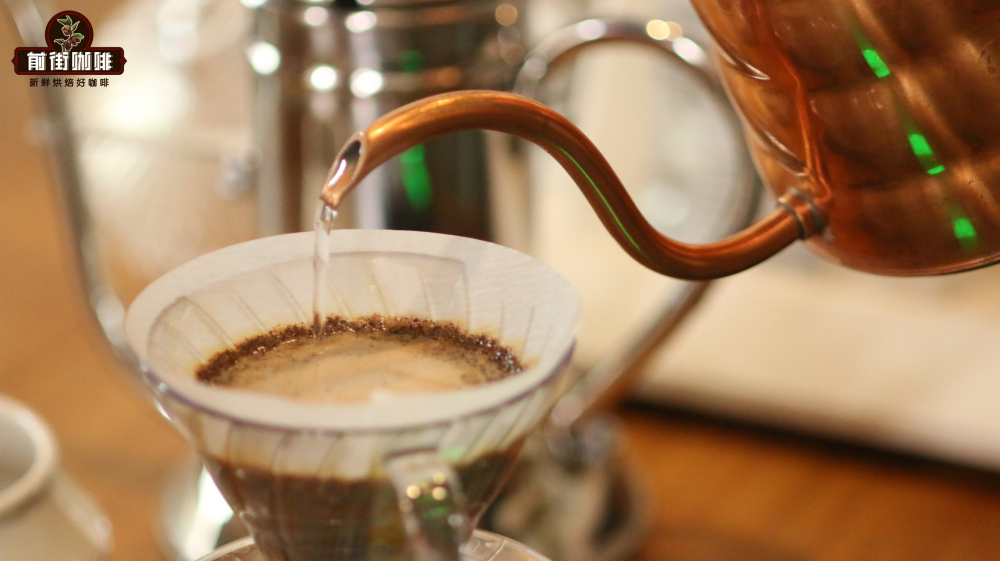
First pour 40 grams of water and bloom for 30 seconds, then pour from the center point in a fine stream while slowly circling to 200 grams, and when the water level in the dripper drops to the point where the coffee bed is about to be exposed, continue circling and pouring to 320 grams; total extraction time is about 2 minutes 30 seconds.
Normally Front Street Coffee has always recommended a 1:15 coffee-to-water ratio. But when brewing Panama Geisha, Front Street usually uses 1:16. The reason is that Panama Geisha withstands extraction well; if brewed at 1:15, flavor substances such as acidity will be too concentrated; by widening the ratio slightly to 1:16, the flavor becomes clearly distinguishable, the floral aroma is more obvious, and the sweetness in the finish is also more prominent.
The washed Green Label Geisha brewed by Front Street Coffee with the above parameters smells of obvious white floral notes, enters the mouth with citrus acidity, has a very refreshing mouthfeel, and finishes with a Tieguanyin-like sweetness; after taking another sip of water, that unique sweetness can still be felt.
So if a bag of beans is only 100 grams and one cup uses 15 grams, how should the remaining 10 grams be brewed? You can also use the same water temperature, grind level, and coffee-to-water ratio. If using 10 grams of coffee grounds, at a 1:15 coffee-to-water ratio, pour in 150 grams of hot water; at a 1:16 coffee-to-water ratio, pour in 160 grams of hot water.
For more coffee bean information, please follow Coffee Workshop (WeChat public account cafe_style) For professional coffee knowledge exchange, please add WeChat ID kaixinguoguo0925
The above content is compiled by CoffeeHunters, a coffee news website.


