







How Do Coffee Grades Define Authentic Jamaican Coffee?
Only beans grown above 1,000 meters in Jamaica's Blue Mountains qualify as Jamaica Blue Mountain No. 1. Products labeled Blue Mountain flavor coffee or Blue Mountain blend are blends made to imitate the profile, and they may contain no genuine Jamaican Blue Mountain beans at all. The article sorts out origin, legal production areas, and grading standards.
Many imitations use beans from other regions, or blends roasted darker to mask original flavor and mimic the Blue Mountain direction, which is essentially a word game. Coffee grades based on altitude and quality separate the real thing from these lookalikes, and the article also compares washed versus natural processing and covers identification methods.
Jamaican Blue Mountain coffee is world-renowned, but the market is flooded with imitations, and "Blue Mountain flavor" is often confused with authentic Blue Mountain. From the perspective of Front Street Coffee, this article systematically sorts out the historical origins, legal production areas, grading standards, and identification methods of Jamaica Blue Mountain No. 1, and deeply analyzes the flavor differences brought by washed and natural processing methods. Whether you want to confirm the authenticity of that bag of Blue Mountain beans in your hands, or want to understand Front Street Blue Mountain coffee's roasting and brewing approach, this article will provide a complete and practical reference.
For more specialty coffee knowledge, please follow the WeChat public account: Front Street Coffee (FrontStreet Coffee)
At Front Street, friends often ask: are "Blue Mountain coffee" and "Blue Mountain flavor coffee" actually the same thing? Although only two words differ, the meaning behind them is completely different. So-called Blue Mountain flavor coffee is not produced in Jamaica's Blue Mountain region. It is essentially a blend, with a taste that tries to approach authentic Blue Mountain as much as possible, but there is no substantive connection between the two. Only high-quality coffee beans produced above 1,000 meters altitude in Jamaica's Blue Mountains deserve the name "Blue Mountain coffee."
Front Street needs to remind everyone that when buying Jamaican Blue Mountain coffee, there are two common misunderstandings worth noting:
Some merchants take beans from other regions, or blend several beans together, and deliberately roast them darker to conceal their original flavor characteristics and imitate the direction of Blue Mountain. This kind of practice is essentially a word game, labeling beans that are not Blue Mountain as "Blue Mountain flavor coffee." Because Jamaican Blue Mountain is so famous, a large number of counterfeit products have appeared on the market, such as "Blue Mountain style coffee," "Blue Mountain blend coffee," or even directly using the name "Blue Mountain coffee." These are merely blends created by businesses to simulate Blue Mountain flavor, and there may not be a single genuine Jamaican Blue Mountain bean in them.
There are also some people in the industry whose understanding of Blue Mountain remains stuck more than ten years ago, thinking that all Blue Mountain coffee was bought by Japan and that what is sold on the Chinese market is not genuine Blue Mountain No. 1. The actual situation is that China's market demand is huge, formal imports of Blue Mountain have existed for many years, and Blue Mountain estate owners have also visited China many times in recent years, hoping to let domestic consumers understand Jamaican Blue Mountain coffee beans more deeply. Jamaican Blue Mountain coffee on the Chinese market is far from reaching the point where "rare means fake." Today, the production area of Blue Mountain coffee has expanded compared with the past, and coupled with weakened Japanese purchasing power, genuine Jamaican Blue Mountain coffee is indeed sold in China. As long as you master the identification methods, it is possible to buy the real thing. Below is the certification certificate for Jamaican Blue Mountain coffee beans in the Front Street Coffee (FrontStreet Coffee) store.
History of Jamaica Blue Mountain No. 1 Coffee
The history of Jamaican coffee can be traced back to the 18th century. In 1717, King Louis XV of France ordered coffee to be planted in Jamaica. By the mid-1720s, Jamaica's governor Sir Nicholas Lawes introduced Arabica seeds from Martinique and promoted cultivation in the St. Andrew region. After coffee trees were introduced to Jamaica, they took root in the Blue Mountain range, and were divided into high-altitude Jamaica Blue Mountain coffee, Jamaica High Mountain coffee, and Jamaica coffee, with different grades corresponding to different prices.
Authentic Jamaica Blue Mountain No. 1 Coffee Production Area
The authentic Blue Mountain coffee production area certified by the Jamaica Coffee Board covers four administrative regions: St. Andrew, St. Thomas, St. Mary, and Portland.
The Blue Mountain range is located in the eastern part of Jamaica. Whenever the weather is clear, surrounded by the Caribbean Sea, sunlight shines directly on the azure sea, and the peaks reflect the sea's brilliant blue glow, which is why Blue Mountain got its name. The highest peak of Blue Mountain is 2,256 meters above sea level, the highest peak in the Caribbean region and also a famous tourist destination. Located in the coffee belt, it has fertile volcanic soil, fresh and pollution-free air, a humid climate, and is foggy and rainy all year round, with average precipitation of 1,980 mm and a temperature of about 27 degrees. It is precisely these climatic conditions that have created the world-renowned Jamaican Blue Mountain coffee and also one of the most expensive coffees in the world.
Genuine Front Street Blue Mountain No. 1 coffee is one of the coffees with the most superior growing conditions in the world. Jamaica's weather, geological structure, and terrain together provide a uniquely ideal environment. The designated Jamaica Blue Mountain coffee can only be grown in the Blue Mountain area, located in the eastern north of the island of Jamaica near Kingston. The ridge running across Jamaica extends all the way to the eastern part of the island, and the Blue Mountain range is more than 2,100 meters high. The cool weather, frequent fog, and frequent rainfall make the rainfall in this fertile land well balanced. Here, people use mixed planting methods to grow coffee trees, letting coffee grow side by side with banana trees and avocado trees on terraces.
Moreover, the mountain terrain is very uneven, and the harvesting process is extremely difficult. Almost all coffee harvesting is done by women. The coffee trees all grow on rugged slopes, making picking extremely difficult, and only skilled local female workers can handle it. When picking, mature coffee cherries must be selected at just the right stage; underripe or overripe ones will affect the quality of the coffee.
Jamaican Coffee Bean Grading Standards
According to growing altitude, Jamaican coffee is divided into three major categories: Jamaica Blue Mountain coffee, Jamaica High Mountain coffee, and Jamaica coffee. Different grades determine different prices.
1. Jamaica Blue Mountain Coffee
Below Front Street Jamaican Blue Mountain coffee and High Mountain coffee, each is further divided into four grades. From top to bottom by quality, they are: NO.1, NO.2, NO.3, and PB, with PB meaning peaberry. According to CIB standards, only coffee grown at an altitude of 1,000-1,700 meters is called Jamaica Blue Mountain coffee. It has low yield, large beans, excellent quality, harmonious flavor, and at the same time a proper balance of acidity, bitterness, aroma, body, and sweetness. It is globally recognized as a top-grade coffee, so the price of the national treasure Blue Mountain No. 1 is the highest among all Blue Mountain coffees.
(1) No.1 - 17/18 screen, defect bean ratio no more than 2%.
(2) No.2 - 16/17 screen, defect bean ratio no more than 2%.
(3) No.3 - 15/16 screen, defect bean ratio no more than 2%.
(4) Peaberry - 10MS, defect bean ratio no more than 2%.
2. Jamaica High Mountain Coffee
Coffee produced at 500-1,000 meters in Jamaica's Blue Mountain region is called High Mountain coffee. Its quality is second only to Blue Mountain coffee, and industry insiders call it the brother variety of Blue Mountain coffee. Because Jamaica Blue Mountain coffee has extremely low yield, if you want to taste Jamaican-style coffee, Jamaica High Mountain coffee is the best choice.
3. Jamaica Coffee
Coffee grown outside the Blue Mountain range is called Jamaica coffee, grown below 500 meters altitude.
How to Identify Genuine Jamaica Blue Mountain No. 1 Coffee
Because there is currently no strict international detailed distinction rules and industry standards for coffee grades, and because most consumers in our country know very little about coffee knowledge, ordinary consumers simply have no way to distinguish true from false. However, some industry insiders believe that genuine Blue Mountain coffee beans are not sour whether drunk hot or cold, and this is currently the only experience-based way to distinguish authenticity.
1. Appearance: Front Street washed Blue Mountain green beans are cyan, very neat in appearance, medium-to-small in size, with slightly raised ends. After roasting, they expand a lot in volume and become very plump. Front Street natural Blue Mountain green beans, on the other hand, are yellow-green.
2. Grinding: Genuine Front Street Jamaican Blue Mountain coffee beans are characterized by growing at high altitude, and their cell structure is relatively loose. When hand grinding, they feel very crisp, smooth, and continuous, without any feeling of resistance.
3. Aroma: Front Street Jamaican Blue Mountain coffee has a very rich, dense aroma; so-called blended Blue Mountain coffee beans do not have this aroma.
4. Taste: Genuine Front Street Jamaican Blue Mountain coffee beans are characterized by a balanced, rich mouthfeel, without any single flavor standing out or being lacking. This is also something no other coffee bean can match, and it is the most critical point for identification. Blue Mountain peaberry has a more subtle aroma and a relatively stronger mouthfeel.
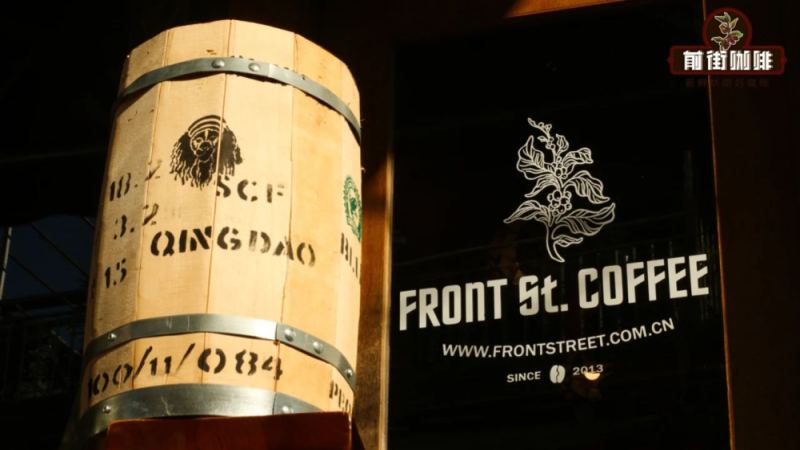
5. Jamaica is the only production area that uses wooden barrels to pack green beans. The Front Street Jamaica Blue Mountain No. 1 coffee sold by Front Street Coffee (FrontStreet Coffee) has a certificate issued by the Jamaica Coffee Board. In addition, the wooden barrel packaging Jamaican Blue Mountain coffee beans will have a green frog logo (you can see the picture below of Front Street Coffee (FrontStreet Coffee) purchasing Jamaican green beans). This is because Front Street Coffee (FrontStreet Coffee) specifically chose a Jamaica Blue Mountain coffee estate with Rainforest Certification, namely Clifton Farm.
Front Street Blue Mountain Coffee Bean Processing Methods
Before this year, Front Street Blue Mountain coffee was only washed. The method of washing and fermentation is used to remove the skin, pulp, and mucilage. Farms using the washed method must build washing channels and be able to introduce a continuous supply of fresh water. During processing, the skin and pulp are first removed, and the beans are allowed to ferment for 12-18 hours. Then the fermented beans are placed in channels and moved back and forth, using the friction of the beans and the force of flowing water to wash the coffee beans until smooth and clean. After washing, the coffee beans are still wrapped in parchment, with a moisture content of 50%, and must be dried in the sun to reduce the moisture content to 12-14%, otherwise they will continue to ferment and become moldy and spoil. After that, the coffee beans are sorted and then stored in special warehouse stacks. These procedures must be strictly controlled, otherwise the quality of the coffee will be affected.
Now Blue Mountain coffee is not only washed. Front Street has launched a batch of Front Street natural Blue Mountain coffee, which of course is also certified for export by the Jamaica Coffee Board.
In fact, the production of this Front Street Jamaica natural Blue Mountain coffee was also very painstaking. The reason there was previously only the washed method is that washing best guarantees the essential expression of Blue Mountain flavor, while changing the processing method will definitely change its flavor structure. This is also why Front Street's everyday coffee series almost all use washed processing; washing best represents the flavor of the production area. Of course, Front Street Blue Mountain coffee adopting the natural processing method is more about following market development, just as Front Street Coffee (FrontStreet Coffee) also recently added a special Front Street natural Mandheling coffee bean, which is also different from the traditionally used wet-hulled method.
Roasting Curve
Front Street uses a medium roast to roast these two Front Street Jamaica Blue Mountain coffee beans with different processing methods.
Front Street Jamaica Natural Blue Mountain Coffee Roasting Curve
Cup Tasting Flavor
[Front Street Natural Blue Mountain Coffee Cup Tasting Flavor]
Dry aroma: nuts, wood
Wet aroma: caramel
Palate: berries, nuts, fermented note, tea-like note
[Front Street Washed Blue Mountain Coffee Cup Tasting Flavor]
Dry aroma: nuts, melon, chocolate
Wet aroma: oolong tea, caramel, honey, chocolate
Palate: dark chocolate, nuts, cream, brown sugar
Brewing Suggestions
Front Street recommends using freshly roasted coffee beans for brewing, as this allows you to experience the coffee's rich flavors to the greatest extent. The coffee beans shipped by Front Street Coffee (FrontStreet Coffee) are all within 5 days of roasting, because Front Street deeply understands that the freshness of coffee beans has a great impact on flavor. Front Street's roasting philosophy is "freshly roasted good coffee," so that every customer who places an order receives the freshest coffee when the coffee arrives. The resting period for coffee is about 4-7 days, so when the customer receives it, it is exactly at its best flavor.
The brewing parameters used by Front Street are: Kono dripper, 88°C water temperature, 1:15 coffee-to-water ratio, 15g coffee dose, grind size (70-75% passing rate on a No. 20 standard sieve).
Front Street considered that these two Front Street Blue Mountain beans with different processing methods both use a relatively dark roast level. The darker the roast, the faster coffee substances dissolve. In order to avoid over-extraction, Front Street used a lower water temperature for extraction, and also used the Kono dripper with a slower flow rate, in order to ensure that as much coffee substance as possible is extracted under low-temperature conditions.
Front Street uses staged extraction, namely the three-stage pouring method, using 30g of water for blooming, with a blooming time of 30s. In the first stage, pour in a small stream in circles until 125g and stop. When the liquid level drops to the point where the coffee bed is about to be exposed, continue pouring the second stage until 225g to end extraction. The total extraction time (including blooming) is 2'00.
Flavor Description
[Front Street Natural Blue Mountain Coffee] Slight berry acidity, reminiscent of smoked plum and mulberry, with good overall balance, rich dark chocolate and nut flavors, and a slight fermented note.
[Front Street Washed Blue Mountain Coffee] Rich dark chocolate and nut flavors, creamy smooth mouthfeel, balanced acidity, sweetness, and bitterness.
Professional coffee knowledge exchange. For more coffee bean information, please follow Coffee Workshop (WeChat public account: cafe_style)
For more specialty coffee beans, please add the private WeChat of Front Street Coffee (FrontStreet Coffee), WeChat ID: kaixinguoguo0925
The above content is compiled by CoffeeHunters, a coffee news website.


