








How Does Panama Geisha Compare With Blue Mountain No. 1?
Blue Mountain Geisha comes from Jamaica's Clifton Mount estate, which planted Geisha in the Blue Mountain region in 2020, a break from the Typica-only tradition there. The lot was washed, exported in wooden barrels, and cupped against classic Blue Mountain No. 1. Blue Mountain No. 1 stays clean, balanced, and full-bodied, while the Geisha side brings a more floral, aromatic profile.
Clifton Mount has grown coffee since around 1750, at roughly 4,300 feet, where cloud shade and mineral-rich soil slow the fruit's ripening. The estate began testing natural-process Blue Mountain beans in 2019 and expanded in 2020. It is the only farm in the region holding Rainforest Alliance certification, and the barrels carry that mark.
In 2020, Jamaica's Clifton Mount estate did something that broke with tradition—planting Geisha in the Blue Mountain region. This scarce lot of Blue Mountain Geisha was washed processed and exported in wooden barrels, and Front Street Coffee obtained it immediately and completed roasting and cupping. This article covers the estate's history, the motivation behind Blue Mountain innovation, the origins of the Geisha variety, processing methods, roasting curves, and brewing parameters, providing a complete overview of this bean's flavor performance. It also answers how it differs from the classic Blue Mountain No. 1 in taste, offering coffee enthusiasts a detailed tasting reference.
2020 was a rather groundbreaking year for Jamaica's Blue Mountain Clifton Mount estate. For a long time, the Blue Mountain region planted only Typica and used washed processing, which created Blue Mountain coffee's signature clean, balanced, and full-bodied character. In 2019, Clifton Mount began experimenting with a small amount of naturally processed Blue Mountain beans, and market feedback was positive, so in 2020 it expanded production of natural Blue Mountain coffee beans, and FrontStreet Coffee also bought a batch.
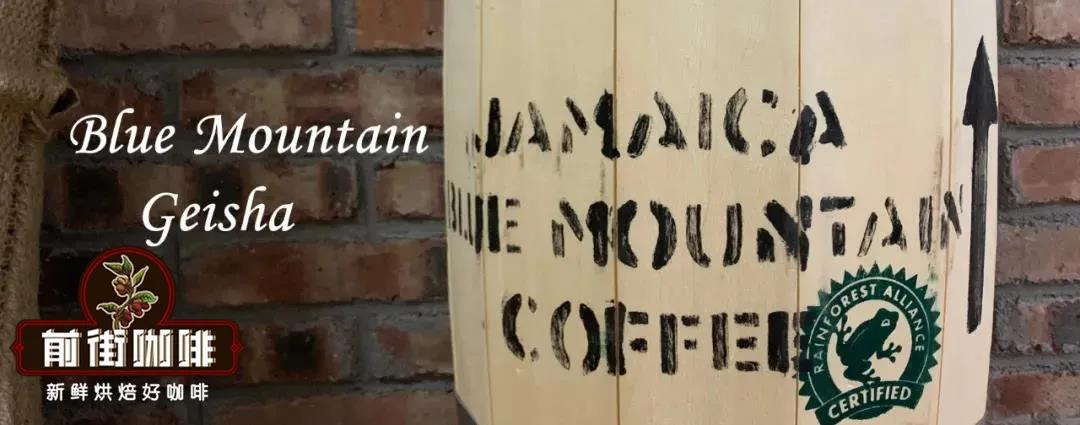
The most eye-catching move by Clifton Mount in 2020 was undoubtedly the trial planting of Geisha coffee. This batch arrived in China in late November, and FrontStreet Coffee obtained a barrel of Blue Mountain Geisha right away. Like traditional Blue Mountain No. 1, it was still exported in wooden barrels, and this batch was extremely limited. The barrel bears the Rainforest Alliance certification mark—currently, only Clifton Mount in Jamaica's Blue Mountain region has this certification.
First, a brief introduction to Clifton Mount estate
All Blue Mountain coffee currently sold by FrontStreet Coffee comes from Clifton Mount estate. The estate's coffee-growing history can be traced back to the mid-18th century, with coffee production beginning around 1750. The average altitude of the growing and processing area is about 4,300 feet (1,310.64 meters). Sufficient elevation, gentle cloud shade in the mountain forests in the afternoon, abundant sunlight, and mineral-rich soil together provide an ideal growing environment for coffee trees and also lengthen the ripening cycle of the coffee fruit.
Clifton Mount is also the only farm in the Blue Mountain region to hold Rainforest certification. Rainforest certification refers to the traditional cultivation method of growing under native forest shade, an ecologically beneficial farming system. Part of the alliance's proceeds are also invested in wildlife conservation in tropical rainforest animal reserves and improving laborers' living conditions.
Why has Blue Mountain, after a decade of unwavering focus, begun to broaden its thinking and innovate in recent years?
There were previously reports that Jamaica is trial planting Bourbon. After learning of this, the folks at Front Street speculated about the reasons behind Jamaica's move. In the past, people's understanding of coffee often stopped at the full-bodied style of Mandheling, or the extremely balanced and rich Blue Mountain; traditional Blue Mountain coffee was then regarded as the king of birds.
However, in recent years the specialty coffee market has developed rapidly, and light roasting has become dominant. First came the fruity Yirgacheffe, and then the world-famous Panama Geisha, which sparked a global pursuit of bright coffee acidity. Blue Mountain coffee, this "elder" that had sat securely for many years, was thus shaken. Perhaps fearing being forgotten by the times, it began gradually trying innovation—this year's newly added natural Blue Mountain and Blue Mountain Geisha are clear evidence.
The Geisha coffee variety
Geisha coffee beans are slender and elongated, with a fresh and pleasant flavor. From these two points, Geisha indeed does not seem like a Central or South American variety, but rather closer to Ethiopian coffee. So when was Geisha introduced to Panama? In 1931, it was discovered in Ethiopia's Geisha forest.
After that, Geisha was sent to the Kenya Coffee Research Institute, spread to Uganda and Tanzania in 1936, was introduced to Costa Rica in 1953, and reached Panama around 1960. Although Geisha has strong disease resistance, its yield is low, so at the time people used it as breeding stock for variety improvement and then stopped paying attention to it, until it was rediscovered in Hacienda La Esmeralda's windbreak in 2004, and then competitions brought Geisha coffee beans into the public eye. Clifton Mount's 2020 Blue Mountain Geisha was very likely introduced and planted from the Panama region four years earlier.
Geisha coffee beans need to be grown at high altitudes to develop rich, captivating floral aromas. For example, the average altitude for Geisha at Hacienda La Esmeralda is above 1,500 meters, while the Blue Mountain region is only 1,310 meters. Through cupping Blue Mountain Geisha, Front Street found that its floral aroma is not prominent; only when drinking carefully can one detect a faint jasmine note.
Blue Mountain Geisha coffee bean processing method
This batch of Blue Mountain Geisha obtained by FrontStreet Coffee still uses the washed processing Jamaica is known for. During processing, the skin and pulp are first removed, and the beans are fermented for 12 to 18 hours. Then the fermented beans are moved into a water tank and pushed back and forth; through friction between the beans and the force of running water, the coffee beans are washed until smooth and clean.
After washing, the coffee beans are still wrapped in parchment, with a moisture content of about 50%, and must be dried so that the moisture content drops to 12% to 14%; otherwise, fermentation will continue, leading to mold and spoilage. The coffee beans are then sorted and stored in dedicated warehouses.
FrontStreet Coffee Blue Mountain Geisha roasting
Faced with this batch of Blue Mountain Geisha, FrontStreet Coffee's roaster encountered a difficult question: should the Blue Mountain character be highlighted, or the Geisha character? If made to taste like Blue Mountain, then what is the point of the Geisha variety? If the Geisha character is highlighted, does it still match the Blue Mountain name? In order to showcase the characteristics of Geisha coffee, FrontStreet Coffee's roaster ultimately chose a medium-light roast to highlight the floral and fruity aromas.
Charged at 180°C, heat 130, airflow 3; turning point at 1'32", heat unchanged at 97°C; at 3 minutes airflow adjusted to 4, at 4 minutes heat increased to 140. At 153.5°C the bean surface turns yellow, the grassy smell completely disappears, and the bean enters the dehydration stage. At 8'36" rough wrinkles and dark patches appear on the bean surface, and the toast aroma clearly turns into coffee aroma, which can be regarded as the prelude to first crack; at this point, listen carefully for the sound of first crack. First crack begins at 9'31", develops for 1'28" after first crack, and the beans are dropped at 192°C.
FrontStreet Coffee Blue Mountain Geisha cupping report
FrontStreet Coffee conducts cupping within 8 to 24 hours after roasting sample coffee beans. FrontStreet Coffee baristas generally use a 200ml ceramic cupping bowl with a water temperature of 94°C. The grind size is controlled so that a No. 20 standard sieve (0.85 mm) has a pass-through rate of 70% to 75%. The ratio is 11 grams of coffee powder to 200 milliliters of hot water, or 1:18.18. The resulting concentration is right within the golden cup range of 1.15% to 1.35%, with a steeping time of 4 minutes.
Dry aroma: caramel
Wet aroma: floral
Flavor: citrus, berries, pomelo, caramel, honey
FrontStreet Coffee Blue Mountain Geisha brewing notes
Dose: 15g
Grind size: medium-fine (No. 20 standard sieve pass-through rate 78%)
Coffee-to-water ratio: 1:15
Water temperature: 91°C
Dripper: V60#01
FrontStreet Coffee staged brewing: 1. First pour 30 grams of water and bloom for 30 seconds. 2. After blooming, pour the second stage, circling outward from the center for 100 grams. This stage can be poured slowly; Geisha coffee is very resistant to extraction and needs a certain pouring time to fully release its aroma. After pouring, wait until the water level drops to half. 3. When the coffee bed is about to be exposed, pour the third stage of 95 grams, for a total of 225 grams. Once the coffee has finished filtering, remove the dripper. Total brew time is 1 minute 50 seconds.
Brewed flavor: citrus acidity on entry, pomelo sweetness and tartness, jasmine floral notes in the middle, and a honey and caramel sweet-tart finish.
For professional coffee knowledge exchange and more coffee bean information, please follow Coffee Workshop (WeChat public account: cafe_style)
For more specialty coffee beans, please add the private WeChat of FrontStreet Coffee: qjcoffeex
The above content is compiled by CoffeeHunters, a coffee news website.


