







Why is geisha coffee from panama so expensive?
Panama Geisha ranks among the most expensive coffees sold, often costing more per cup than Blue Mountain. The variety came from Ethiopian wild forests and stayed obscure for nearly a century before a 2004 BOP competition win brought it attention. Prices reflect scarcity, small yields, and intense demand from buyers.
Geisha needs high altitude, cloud cover or shade, and fertile soil to express rose aroma and delicate fruit acidity. Boquete's volcanic soils in Panama suit it. Within Hacienda La Esmeralda, Red Label and Green Label separate lots by grade, so Panama geisha coffee beans vary widely in price depending on label and lot.
Panama Geisha is hailed as one of the most expensive coffees in the world, its price even making Blue Mountain coffee seem affordable. What exactly makes this coffee so precious? From the wild forests of Ethiopia to the volcanic fertile soil of Boquete, Panama, Geisha underwent nearly a century of migration and obscurity, until it won the BOP competition in 2004 and amazed the world. This article will provide an in-depth analysis of the reasons behind Geisha coffee's price, the grade classification of Hacienda La Esmeralda's Red Label and Green Label, and the cost-effective Geisha options recommended by Front Street Coffee. Whether you are a beginner coffee enthusiast or a seasoned connoisseur, you can find the right cup of Geisha for yourself.
For more specialty coffee knowledge, please follow our WeChat public account: FrontStreet Coffee
Blue Mountain coffee has always been regarded as a premium coffee, with a rich aroma and mellow taste, but its price is relatively high. However, nowadays a coffee has overshadowed Blue Mountain, also ranking among the world's most expensive coffees — that is Panama Geisha, which even gives people a sense of being out of reach. As the saying goes, you get what you pay for. What exactly makes Panama Geisha coffee so expensive?
I believe many friends, like Front Street, were stunned the first time they tasted Red Label Geisha by its sweet rose fragrance, as well as the full juice texture and richly layered flavors of berries, apricots, and citrus — an unforgettable experience to this day. Front Street would like to clarify here that when baristas talk about Geisha coffee, they usually mean Geisha produced in Panama, and among those, Hacienda La Esmeralda is the most renowned.
Panama Geisha coffee beans
Everyone knows that coffee is essentially a crop, and its flavor is naturally inseparable from its growing environment and climate conditions. The Geisha variety is extremely demanding about its growing environment — only in areas with higher altitude, cloud cover or abundant shade trees, and fertile soil can it produce rich, enchanting floral aromas and delicate, elegant fruit acidity. Panama is located in Central America, connecting North and South America, bordering Costa Rica and Colombia, and its coffee industry can be said to have developed with a silver spoon in its mouth.
The reason Panama Geisha coffee beans are world-famous has a great deal to do with their growing environment and climate. Coffee cultivation in Panama is almost entirely concentrated in the Chiriquí volcanic region, and the most scenic area is the Boquete production zone. It possesses uniquely favorable volcanic fertile soil, abundant water sources, regular rainfall, dense vegetation, and cloud cover that nourishes the coffee trees, thereby producing high-quality coffee beans with intense flavor. Numerous different microclimates also help produce coffee beans with diverse flavors, and Hacienda La Esmeralda is located within this production zone.
Geisha is actually a coffee variety native to Ethiopia, discovered in 1931 in the Geisha forest, which is located within Ethiopia, and subsequently sent to a leading coffee research institute in Kenya;
In 1936, Geisha coffee was introduced to Uganda and Tanzania; in 1953, Costa Rica also began introducing the variety; finally in the 1970s, Mr. Francisco Serracín of Hacienda Don Pachi in Panama obtained seeds from CATIE in Costa Rica and began cultivating Geisha coffee. Due to its extremely low yield, it needed to participate in bidding. At the time, it was just an unknown coffee tree — low yield, tall tree, difficult to harvest — that was people's general impression of it. Nearly half a century later, Hacienda La Esmeralda in Panama separated it from other varieties in 2003, and in 2004 it won the BOP competition championship in one fell swoop, and the Geisha variety officially entered the public eye.
Since winning the championship in the Panama cup test, Geisha coffee's reputation spread like wildfire. This is the most basic principle of supply and demand — when production is scarce while many people want to try it, Geisha coffee's bidding prices soared, from $350.25 per pound in 2013, to $803 per pound in 2018, and now to $1,029 per pound. It keeps breaking its own price record every year. Although more coffee farmers have begun planting Geisha, the upward momentum of prices seems unstoppable.
After Geisha became famous, in many coffee-related competitions, Hacienda La Esmeralda's Geisha coffee beans were contestants' favorites. In addition to the Geisha grown by Hacienda La Esmeralda, many other Panama estates later also grew Geisha coffee beans with extremely exquisite flavors and participated in competitions and auctions. Many estates hold auctions to bid at high prices for premium Geisha coffee. At the 2019 Best of Panama (BOP) competition, Panama Geisha coffee maintained its throne as the most expensive coffee with a high price of $1,029 per pound! This adds even more weight to the price!
Of course, not all Panama Geisha coffee beans are so expensive; it mainly depends on the fame of the producing estate and whose Geisha flavor is more exquisite and outstanding. Some Panama Geisha coffees that do not clearly indicate a specific estate can also have excellent flavors. For example, the Boquete Geisha sold by FrontStreet Coffee has the unique and charming orange-blossom honey charm of Panama Geisha coffee. For friends who are new to specialty coffee but dare not easily purchase high-priced Geisha, this Boquete Geisha coffee is very suitable for beginners to try, and the price of 98 yuan/100g is also more affordable!
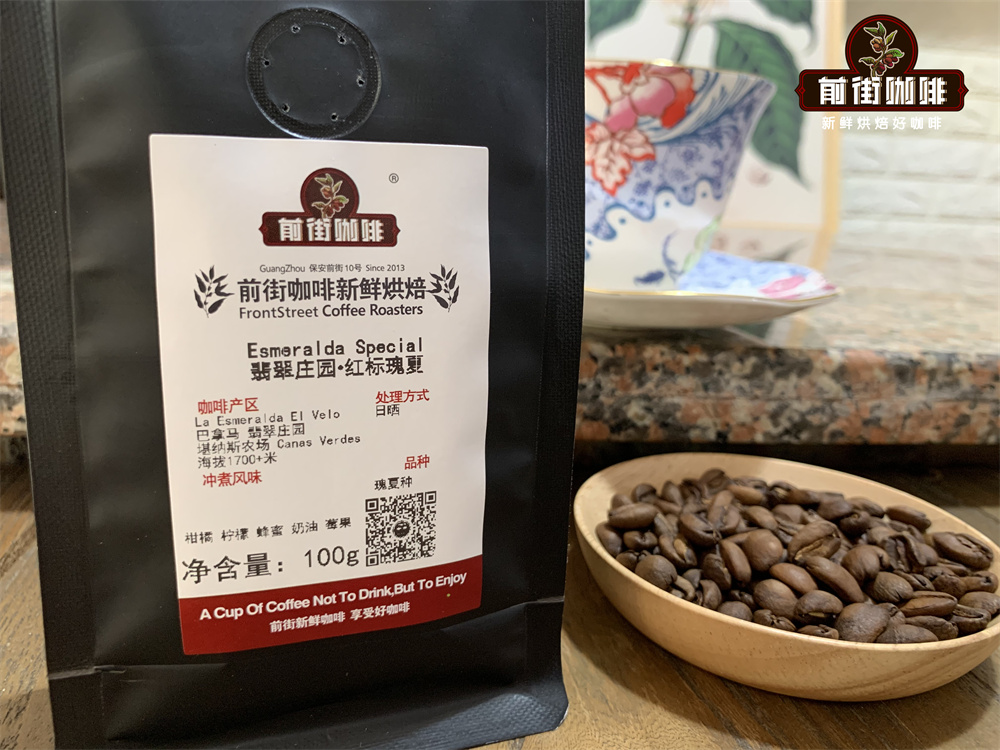
The Esmeralda Red Label Geisha and Green Label Geisha roasted by FrontStreet Coffee are fully guaranteed in terms of brand and quality, and more importantly, they offer extremely high cost-effectiveness. Esmeralda Red Label is 100 grams per bag, priced at only 350 yuan; Esmeralda Green Label is only 158 yuan per bag. Calculating at 15 grams of coffee beans per cup, one bag of Red Label can make 6 cups of coffee, at only about 60 yuan per cup — compared to the prices of over a hundred yuan per cup at cafés, this can truly be called a conscientious recommendation.
After Geisha coffee became famous, other estates in Panama and producing countries around the world also began researching and cultivating Geisha coffee. Besides the Geisha coffee from Panama's Hacienda La Esmeralda, FrontStreet Coffee also offers Costa Rica Geisha coffee, Ethiopia Geisha coffee, and Colombia Geisha coffee, all worth trying, and their prices are much cheaper than Hacienda La Esmeralda's Geisha coffee, yet you can still taste and understand the basic flavor characteristics of Geisha coffee from them.
Hacienda La Esmeralda Geisha Red Label
In the early days, Hacienda La Esmeralda's Geisha was also divided into Red Label, Green Label, and Blue Label based on planting altitude. However, in the 2021 harvest season, Hacienda La Esmeralda announced that there would no longer be a Blue Label series, and Blue Label no longer appears on Hacienda La Esmeralda's official website, leaving only Red Label and Green Label.
【Red Label Geisha】 Among the Geisha coffee varieties currently offered by Hacienda La Esmeralda, this is the highest grade. Those who know about Hacienda La Esmeralda's Geisha coffee beans should know that Red Label was originally translated as Esmeralda Special, and because the brand's Geisha coffee icon is red, it is straightforwardly called "Red Label."
To be selected as Red Label Geisha coffee beans, the planting altitude must be above 1,600 to 1,800 meters, and the cup test score must be above 90 points. Red Label grade Geisha coffee beans mainly come from the Jaramillo farm and the Cañas Verdes farm. This grade of Geisha coffee beans has an extremely intense Geisha coffee flavor and can be traced to a specific plot, which provides detailed information for friends who want to learn about Red Label Geisha.
Of course, FrontStreet Coffee's bean shelf cannot miss this classic Geisha flavor. The Red Label Geisha coffee beans that Front Street offers come from the Mario plot of the Jaramillo farm, the same plot where the Geisha coffee flavor was discovered back then, and also the same farm that won the BOP competition championship in 2004.
This Front Street Esmeralda Red Label Geisha uses the natural process, making the typical Geisha flavor more intense, with richer and more complex layers, and the sweet-tart sensation and aroma elevated by another degree. The reason Front Street chose the natural-process Red Label Geisha is also because Red Label, as Hacienda La Esmeralda's most iconic Geisha coffee, has its iconic Geisha coffee flavor brought out to the fullest by the natural process.
FrontStreet Coffee Geisha Brewing Recommendations
FrontStreet Coffee's baristas, considering that Geisha coffee beans are all light-roasted, and light-roasted coffee beans have a lower extraction rate of coffee substances than dark-roasted ones, therefore, in order to ensure full extraction of the Geisha flavor, they use a higher water temperature for brewing and also choose a finer grind size.
The brewing parameters recommended by FrontStreet Coffee are: Hario V60 dripper, 90°C water temperature, 15g coffee dose, 1:15 coffee-to-water ratio, medium-fine grind (80% passing through a Chinese standard No. 20 sieve).
FrontStreet Coffee Brewing Method
FrontStreet Coffee uses staged extraction, also called three-stage brewing: use 30g of water for blooming for 30 seconds, then pour in a small stream in a circular motion until reaching 125g for the stage break, and when the water level drops and is about to expose the coffee bed, continue pouring until reaching 225g and stop. After the water in the dripper has dripped through, remove the dripper. Timing starts from the beginning of pouring, and the extraction time is 2'00". Next, pick up the entire cup of coffee and shake it evenly, then pour it into a cup for tasting.
Flavor Description
Red Label Geisha coffee flavor : Bright rose and citrus aromas, genmai, berries, apricots, complex fruits, honey, with a thick juice body, rich flavor layers, and pronounced sweetness.
Regarding coffee brewing, Front Street always recommends that freshly roasted coffee beans can better express coffee's rich flavors. Therefore, the coffee beans sold by Front Street are all within 5 days of roasting. Front Street's roasting philosophy is "Freshly roasted good coffee," so that every customer who places an order receives the freshest coffee. Coffee's resting period is about 4-7 days, so when customers receive it, it is at its optimal flavor.
Of course, some customers need Front Street to help grind the beans, which is also fine, but Front Street must remind you: once coffee beans are ground in advance, they need to be brewed promptly; if already ground into coffee powder, there is no need for further resting, because during transportation, the pressure from carbon dioxide inside the packaging can also round out the coffee flavor, so once you receive the coffee powder, you can immediately brew a cup and drink it. However, coffee powder oxidizes relatively quickly after contact with air, meaning the coffee flavor will dissipate faster and the coffee won't taste as good. Therefore, Front Street recommends buying whole beans and grinding fresh for each brew, so you can better taste the coffee's rich flavors.
Of course, FrontStreet Coffee has more than 50 single-origin coffee beans, some expensive and some cheap. The best recommendation is Front Street's 7 daily beans. Though called daily beans, they refer to the most representative flavor coffee beans from 7 producing countries, with extremely high cost-effectiveness. For friends who are just getting into coffee, they are the best introductory beans and the best choice for discovering which flavor you like! Of course, if possible, you should try every one — after all, different producing countries... though you can't go to each producing country one by one, you can still taste them here at Front Street!
The above content is compiled by CoffeeHunters, a coffee news website.


