







What is the Americano origin and how does it compare to long black?
Americano is espresso diluted with water, which places it in the black coffee category since it holds no other ingredients. The practice traces to World War II, when American troops stationed in Italy found espresso too intense and added water to soften the concentration. Italian-run shops in the United States later served the same watered espresso.
The difference from a long black comes down to build order and water volume, which changes how much crema survives and how the cup reads on the palate. Coffee drinking spread in the United States after the 1773 Boston Tea Party boycott, and by the 1880s about one third of the world's coffee beans went to the country. Aged ice is used for iced americanos coffee.
Walk into any coffee shop, and the first item usually listed on the menu is Americano. It is both a daily pick-me-up for many and favored by health-conscious crowds. In this article, Front Street will guide you through the definition, historical origins, and differences between Americano and Long Black, as well as explain in detail the ratio of espresso to water. We will also share Front Street's experience of using aged ice when making iced Americanos, and how to determine the right coffee-to-water ratio, giving you a comprehensive understanding of this seemingly simple yet nuanced beverage.
When you step into a coffee shop to place an order, the drink that first catches your eye is often Americano. Nowadays, more and more people in China are drinking coffee, and Americano has not only become a helpful daily pick-me-up but is also loved by those pursuing a healthy lifestyle. This time, Front Street will explore Americano with you.
Is Americano a type of black coffee?
From the name, it's not hard to guess that espresso likely originated in Italy, while Americano should be related to the United States. The popularity of Americano can be traced back to the 18th century. At that time, the American public was extremely dissatisfied with the British government's heavy taxation on tea imports, leading to the "Boston Tea Party" in 1773 and a call to switch to drinking coffee. Afterwards, the number of coffee shops in the United States continued to grow, driving the rapid expansion of the coffee industry in America. By the 1880s, about one-third of the world's coffee beans were shipped to the United States. During World War II, American troops needed to consume large quantities of coffee daily to relieve the monotony of life and keep soldiers alert.
However, Italians have always preferred the intense taste of espresso, while American soldiers found it hard to accept such strong bitterness, so they added water to dilute the coffee to a concentration they could tolerate. Later, when Italians operated coffee shops in the United States, they also introduced "watered coffee" based on espresso, which was widely praised. Since then, this "watered coffee" has been called "Americano." Because it contains no other ingredients and is made only of water and espresso, it falls under the category of black coffee.
What is the difference between Americano and Long Black?
Besides Americano, another drink called Long Black has begun to appear on the menus of some coffee shops. In the 1980s, a large number of Italians emigrated to Australia, bringing espresso machines to New Zealand, Australia, Melbourne, and other places. Australians prefer coffee with a richer flavor, and clearly, the lighter Americano did not suit their taste. So Italians adjusted the espresso base and preparation ratios to satisfy Australians' pursuit of "bold flavors." In Australia, people usually use "Black Coffee" to refer to black coffee and "White Coffee" to refer to coffee with milk. Long Black is made by adding a small amount of water to reduce the overly high concentration, thereby highlighting the aromatic characteristics of black coffee.
After consulting relevant materials, Front Street found that the most notable difference between Americano and Long Black is the amount of water added. Americano is made by first extracting espresso and then pouring in water to dilute it, with an espresso-to-water ratio between 1:5 and 1:8. Long Black has a stronger coffee flavor than Americano, with a smaller cup size; the barista extracts two shots of espresso (40g) into a cup containing 100-120ml of water, leaving a thick layer of crema on the surface. Therefore, Long Black is most intense and full-bodied on the first sip, with the flavor becoming clearer and cleaner afterwards.
The mixing ratio for Americano
Currently, there is no clear standard for the coffee-to-water ratio, meaning that Americano from each coffee shop may be different, as they decide based on the flavor characteristics of the coffee beans used and the cup size. For example, the Americano served at Front Street's shop uses Front Street's own roasted Front Street Sunflower Warm Sun espresso blend coffee beans, which under ideal extraction should present flavors of wine, vanilla, cream, chocolate, and berries. To highlight these aromas, Front Street conducted repeated comparisons and finally determined a 1:4.5 ratio, which means adding 180g of hot water to 40g of espresso.
When making iced Americano, it's necessary to consider the effect of chilling the coffee and the melting speed of the ice, so Front Street uses solid large ice cubes. Typically, the ice is taken out in advance and stored refrigerated as "aged ice," which can slow down the melting and help the iced coffee maintain its taste longer.
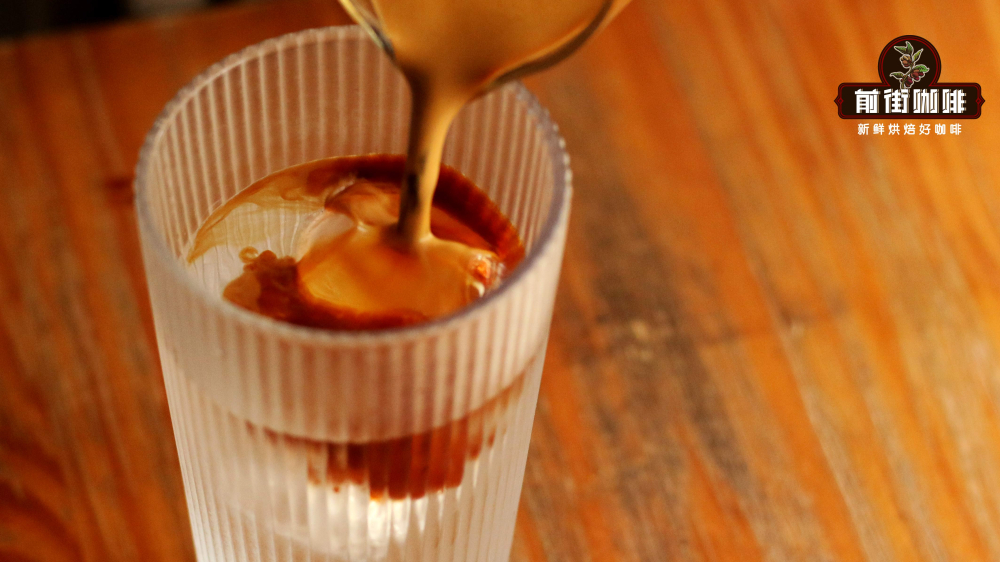
Each ice cube at Front Street weighs about 25g, and the ratio for a cup of Front Street iced Americano is 40g of espresso, which means adding 4g of ice cubes and 120g of water, i.e., 1:2.5:3. The resulting iced Americano is neither too strong to be unpleasant at first nor too diluted by melting ice.
The above content is compiled by CoffeeHunters, a coffee news website.


