







How Does Coffee Development Differ in Rwanda and Tanzania?
Rwanda and Tanzania sit behind Ethiopia and Kenya in recognition, yet both produce distinct washed coffees. Rwanda rebuilt its industry after colonialism and civil unrest and won the top prize at the 2008 COE competition with Bourbon varieties. Tanzania relies on Mount Kilimanjaro's altitude, where Typica and Bourbon give bright acidity. Front Street compares Rwanda Gaseke and Tanzania Kilimanjaro side by side.
In Rwanda, coffee was introduced by German missionaries and later shaped by Belgian colonial rule, with low purchase prices and high export taxes keeping quality down. After independence, the OCIR organization was formed and production climbed until the 1990s. Tanzania's story rests on elevation rather than recovery, and the comparison covers origin background, processing, variety, grading, cupping flavors, and brewing parameters.
African coffee doesn't just have Ethiopia and Kenya standing out alone—Rwanda and Tanzania are equally outstanding producing regions. Rwanda, having endured colonialism and civil unrest, rose to prominence through washed processing and the Bourbon variety, clinching the top prize at the 2008 COE competition; Tanzania, relying on the altitude advantage of Mount Kilimanjaro, presents bright acidity through Typica and Bourbon varieties. Front Street Coffee has selected representative beans from both countries—Rwanda Gaseke and Tanzania Kilimanjaro—and breaks down and compares them one by one, from origin background, processing methods, variety and grading to cupping flavors and brewing parameters, to introduce you to the unique charm of these two hidden gems of African coffee.
When it comes to African coffee, most people's first thought is inevitably Ethiopia and Kenya—these two countries can be called the pillars of the African coffee world, firmly seated in the top two spots. However, those producing countries that haven't been widely memorized by the public don't lack good coffee; they simply aren't famous enough. Rwanda and Tanzania are quality choices in Africa that shouldn't be missed, and this time Front Street has deliberately selected two beans for a side-by-side comparison, to discuss why they were chosen to face off against each other.
【Rwanda】
Rwanda Coffee Development
Rwanda is located in central Africa and is a standard landlocked country, with almost all of its neighboring countries being major coffee producers. In the early twentieth century, Rwanda successively became a colony of Germany and Belgium, and coffee was first introduced by German missionaries. Although production rose significantly during the colonial period, labor was exploited, coffee farmers were paid low purchase prices, and export taxes were high, resulting in less-than-ideal bean quality—this was also a common phenomenon in commercial coffee at the time. Front Street Coffee notes that Brazil, which also experienced colonial rule, likewise long bore a reputation for poor coffee quality because it prioritized quantity over quality.
It wasn't until Rwanda gained independence and established its first official coffee organization, OCIR, that coffee production gradually received attention. From the 1960s to the 1980s, Rwanda's coffee production continued to grow, reaching a historic peak in 1986, and it was only in the early 1990s, with domestic political turmoil (the Rwandan genocide), that the industry stalled. Front Street Coffee has also recently purchased multiple batches of Rwandan beans from different producing regions, for two reasons: first, Rwanda's coffee industry is developing rapidly and quality is guaranteed; second, the country has gradually developed a unique regional flavor that is distinct from Ethiopia and Kenya.
Rwanda Coffee History
Looking through historical records, Front Street found that Rwanda was a German colony in the early twentieth century, with coffee first introduced by German missionaries around 1904, and production increased significantly around 1930. Rwanda was once Africa's ninth-largest exporter of Arabica coffee, with nearly 450,000 smallholder farmers, each small estate averaging less than 1 hectare (about 165 coffee trees per household), and a total planted area of about 28,000 hectares. Coffee-producing areas are mainly distributed in the western half of the country and the central region near the capital Kigali.
Rwanda Coffee Processing Methods
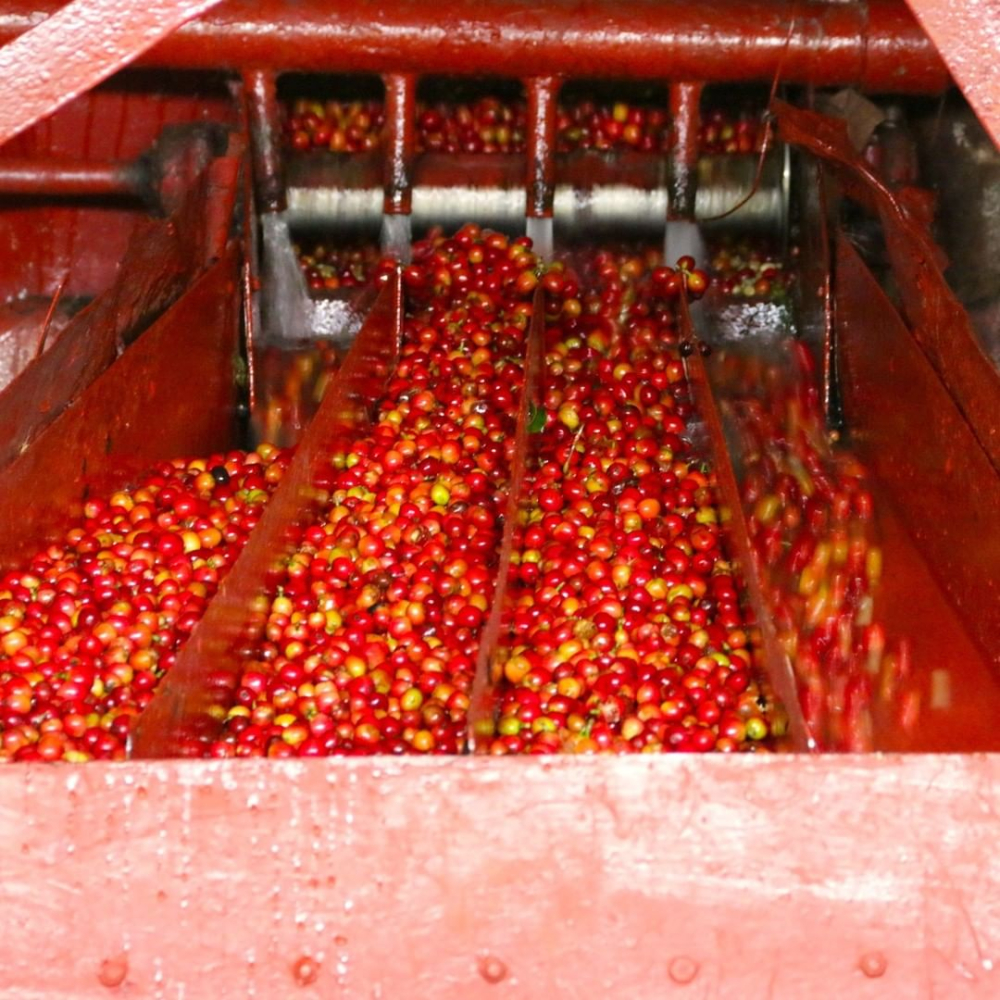
In 2000, Rwanda, having just experienced internal chaos, began rebuilding with the support of two major coffee development programs, PEARL and SPREAD, funded by the United States Agency for International Development (USAID). After the programs were implemented, Rwanda successively built 46 coffee washing stations, and the strong export of coffee beans drove significant economic growth. Therefore, Rwandan coffee beans are currently mainly washed-processed: ripe cherries are hand-selected, the skin and pulp are removed, washing and fermentation are carried out for 12 to 18 hours, the mucilage is cleaned off, and finally the beans are dried until the moisture content is below 14%.
Front Street Coffee believes that Rwanda establishing washed processing as the main method at the initial stage of development was a choice that clearly highlights flavor. Washing best reveals the essential flavor of coffee, and when recommending a producing region, Front Street also always prioritizes recommending washed beans so that the flavor characteristics of that region can be clearly understood. In the 2008 annual top coffee competition held by the Specialty Coffee Association of America (SCAA), Rwanda's Aromec top washed Bourbon beans defeated Jamaica Blue Mountain No.1 and Sumatra Mandheling G1 Special Grade in the same competition, winning the COE championship award, and since then it has risen to fame in the coffee world, with prices climbing accordingly.
【Tanzania】
Tanzania Coffee
Africa's highest peak, Mount Kilimanjaro, stands in northeastern Tanzania. According to information Front Street reviewed, Tanzania was a trust territory after World War I and was once under British colonial rule, gaining independence in 1964. As early as 1893, the Bourbon line was introduced for cultivation, and green beans are mainly washed-processed. High-altitude, high-quality Tanzanian coffee, like Kenyan coffee, has lively, bright acidity. Tanzania is located in east-central Africa and usually uses washed processing, with bright acidity and quite good flavor. As far as East Africa is concerned, Kenya is certainly the main force, but Tanzania is actively catching up and produces many good coffees comparable in quality to Kenya's. What makes Tanzanian coffee unique is that it is a combination of three different estates in the north, one of which is located in the Mount Kilimanjaro range—Africa's highest peak and the largest free-standing mountain mass on Earth. The coffee grows at altitudes between 1,150 and 1,500 meters.
Washed processing—Front Street Coffee's southern Tanzanian coffee beans use washed processing. The steps are: after harvesting, select high-quality ripe cherries, complete depulping, naturally ferment for 12 to 24 hours, wash clean, soak in water for 24 hours, wash again, and finally sun-dry.
Variety—In 1898, Bourbon coffee was introduced to Tanzania's Kilimanjaro region by Catholic missionaries, and later Kent was also introduced in 1920. Tanzania currently mainly cultivates Kent and Bourbon. Front Street Coffee's southern beans are Bourbon. Bourbon coffee cherries are short and round, with very dense pulp and seeds. Front Street's cupping found that Bourbon coffee usually has high sweetness and bright acidity, with yields 20% to 30% higher than Typica, but it is still regarded as a low-yield variety and is likewise susceptible to leaf rust.
Tanzanian Coffee Bean Grading System
Tanzania's grading system is the same as Kenya's, classified by screen size into AA, AB, PB, and so on.
Front Street Coffee Roasting Recommendations
Machine: Yangjia 800N, 550g green beans charged
【Rwanda】
Rwandan coffee beans have fresh acidity. To highlight this flavor, Front Street Coffee recommends a medium-light roast. The darker the roast, the more fruit acidity is lost.
When Front Street Coffee cupped this Rwandan washed bean, the aroma showed obvious citrus, cherry tomato, and fresh grass notes, with the overall flavor presenting bright acidity, citrus, berries, and nuts, and a honeyed sweetness in the finish.
Front Street Coffee: Rwanda · Gaseke
Region: Nyamasheke region, Rwanda
Washing Station: Gaseke Washing Station
Altitude: 1500m
Variety: Bourbon, Caturra, Catuai
Processing Method: Washed
【Tanzania】
Front Street Coffee's Tanzanian coffee is washed Typica. Typica is recognized as a coffee variety of excellent quality. Tanzania uses a grading system similar to Kenya's, based on bean size. Front Street's beans are AA grade, meaning 90% are 18 screen or above, so their appearance is large, plump, and uniform.
Front Street's cupping of this bean showed flavors of citrus, berries, honey, and tea.
Front Street Coffee: Tanzania · Kilimanjaro
Region: Kilimanjaro, Tanzania
Altitude: 1300m~2000m
Variety: Typica
Processing Method: Washed
【Front Street Coffee Brewing Parameters】
Dripper: Hario V60
Water Temperature: 90℃
Dose: 15 grams
Coffee-to-Water Ratio: 1:15
Grind Size: EK43s setting 10 (80% passing through China standard No. 20 sieve)
Brewing Recommendation: Front Street Coffee uses staged extraction. First bloom with 30 grams of water for 30 seconds, then pour in a slow circular stream to 125 grams for the first stage; when the water level is about to expose the coffee bed, continue pouring to 225 grams and stop; when the water level is about to expose the coffee bed again, remove the dripper. Extraction time (starting from the beginning of blooming) is 2'00".
Flavor Description
【Rwanda】Floral and berry aromas, with obvious citrus, berries, and plum on the palate, nuts in the middle, and a caramel sweetness in the finish.
【Tanzania】Floral, berries, citrus, nuts.
For more coffee bean information, please follow Coffee Workshop (WeChat public account cafe_style)
For professional coffee knowledge exchange, please add WeChat ID kaixinguoguo0925
The above content is compiled by CoffeeHunters, a coffee news website.


