







Why Does Yunnan Coffee Depend So Heavily on Catimor?
Yunnan coffee has drawn wide attention as brands such as Luckin and Manner promoted the region and bean prices rose with demand. The regional flavor, however, has stayed hard to pin down, and the main reason is the dominant variety itself: Catimor, which sets limits on the cup. Since 2013, Typica and Bourbon have been trial-planted in Lincang to seek a way forward from the variety level.
National-trend demand and deeper technical support in the producing regions lifted both yield and quality, while new processing methods gave Yunnan beans a more distinctive profile. Typica, one of the original arabica varieties, is central to that search. The article compares Catimor and Typica, weighs special processing methods, and covers flavor performance and brewing suggestions for a natural Typica and a Baoshan Catimor everyday bean.
In recent years, Yunnan coffee has rapidly entered the public eye with the boost of brands like Luckin and Manner, and prices have risen accordingly. However, the flavor of the producing region has always remained vague and unclear. Front Street Coffee believes the root cause lies in the flavor limitations of the dominant variety, Catimor, itself. Since 2013, Front Street has been trial-planting Typica and Bourbon in Lincang, attempting to find a way out for Yunnan specialty coffee from the source of varieties. This article will sort through the past and present of Yunnan Catimor and Typica, analyze the pros and cons of special processing methods, and introduce the flavor performance and brewing suggestions of Front Street Yunnan Natural Typica and Baoshan Catimor Everyday Beans.
In recent years, Yunnan coffee has truly risen abruptly, leaping from obscurity to become a hot topic in the specialty coffee field. Leading brands such as Luckin, Manner, Blue Bottle Coffee, and Seesaw have all turned their attention to Yunnan, racing to launch related products, and every new release invariably sparks heated discussion in the coffee community. Along with this wave of enthusiasm, the market price of Yunnan coffee beans has also climbed steadily.
Why has Yunnan coffee been able to win such concentrated attention in a short time? On one hand, the national trend culture is flourishing, and consumers' identification with domestic products has significantly strengthened; on the other hand, many coffee companies have gone deep into the producing regions to provide technical support, enabling coffee farmers to master more scientific cultivation methods, with both yield and quality improving together. At the same time, advances in processing techniques have also allowed Yunnan beans to present a distinctive flavor, successfully attracting the taste buds of the younger generation.
Although Yunnan coffee is receiving increasing attention, its regional flavor has never formed a clear identity. From the very beginning of the concept of specialty coffee, it has emphasized the identifiable regional flavor nurtured by specific climate and geographical conditions. For example, when coffee enters the mouth with bright acidity, people naturally think of Yirgacheffe. However, the signature flavor of the Yunnan producing region remains undecided to this day.
Front Street Coffee believes that the main reason for this situation is that the Catimor variety, which is planted on a large scale in Yunnan, itself lacks sufficient flavor cleanliness and distinct layering. In addition, a large number of Yunnan beans with special processing methods have emerged on the market, causing consumers' impression of Yunnan coffee to mostly remain at the level of a dazzling array of fermented flavors, while their memory of the variety itself has instead become blurred. If Yunnan coffee is to leave a lasting imprint in consumers' minds, the selection and optimization of varieties is clearly crucial.
For this reason, Front Street Coffee has been laying out operations in Lincang, Yunnan since 2013, mainly planting the Typica variety, along with a small amount of Bourbon. The preference for Typica is due to two reasons: first, it is one of the oldest coffee varieties, possessing pure Arabica genetics, with an elegant and clean flavor, and has long been regarded as a benchmark variety for specialty coffee; second, the earliest coffee trees introduced to Yunnan were precisely Typica, brought in by French missionaries.
Historically, Yunnan once planted Typica on a large scale to repay loans to the Soviet Union, but after the loans were repaid, the domestic coffee consumption market had not yet taken shape, and many farmers cut down coffee trees to plant crops with higher economic returns. It was not until the 1990s that Nestlé, attracted by Yunnan's natural conditions, distributed Catimor seedlings with stronger resistance to coffee leaf rust to farmers, allowing coffee cultivation to revive and supply raw materials to Nestlé for a long time. However, Catimor contains Robusta ancestry, and its flavor performance is less than satisfactory, with a poor experience when drunk directly, causing the public's perception of Yunnan coffee to remain at the instant coffee level for a long time.
Catimor is not pure Arabica, but rather a hybrid descendant of Timor (belonging to Robusta) and Caturra (a Bourbon variant), with Robusta ancestry accounting for about one quarter. This genetic composition determines its flavor shortcomings: the aroma is not rich enough, the bitterness is prominent, and it easily presents astringency and a stimulating musty taste. But its yield is several times that of Typica, so Yunnan planted Catimor in large quantities for many years without giving sufficient attention to quality, mainly supplying it as raw material for Nestlé.
Therefore, Yunnan coffee using conventional processing methods is difficult to satisfy in terms of flavor and mouthfeel when drunk directly, and naturally difficult to gain market favor. It was not until recent years, as special processing methods gradually matured, that people applied them to Yunnan Catimor, masking defects through external intervention, and only then did consumers begin to slowly accept Yunnan coffee.
So why not simply switch entirely to planting Typica? Because a coffee tree needs at least four years from planting to having commercial production capacity, and the time and labor costs invested during this period are extremely high, so the only option is to rely on processing methods to modify the flavor. However, this approach may be leading Yunnan coffee onto a path that deviates from its essence.
Catimor and Typica are not inherently contradictory: the former is a raw material, the latter is specialty coffee. The significance of specialty coffee lies in improving quality, while the value of raw material coffee lies in ensuring yield. It is an unavoidable reality that Yunnan mainly cultivates Catimor. But if the two are conflated, it may appear on the surface that a way out has been found for Yunnan coffee, while in reality the variety and altitude of the coffee beans have not changed, and relying only on emphasizing post-processing methods to claim quality improvement is inevitably somewhat far-fetched.
Guiding farmers to rely on processing methods to slap a "good coffee" label on their beans after harvesting, on the grounds of solving the sales problem for two million mu of planted area, is too simplistic and crude. Those who advocate this kind of evaluation may not truly understand Yunnan coffee. From the perspective of growers, encouraging and supporting starting from variety and altitude, and following the basic rules of specialty coffee, may be another attempt at healthy and sustainable development for the Yunnan producing region. It is very difficult for an entire producing region to achieve full specialty status, but a breakthrough must be made. Only when washed processing can be consistently delicious and present a main flavor profile every year can Yunnan specialty coffee truly get started.
Based on this philosophy, Front Street Coffee established its own estate from the very beginning to plant Typica. Although as of 2022, Front Street's total Yunnan Typica volume was only just over 600 kilograms, enough only to supply Front Street Coffee's Taobao store and physical shop, only by personally experiencing the entire cultivation process can shortcomings be discovered and continuous improvement be made. Thanks to the change in variety, Front Street 2013 Yunnan Typica coffee beans, despite using traditional natural processing, have a very full and alluring flavor, presenting a complex aroma of plum, berries, brown sugar, black tea, and nuts.
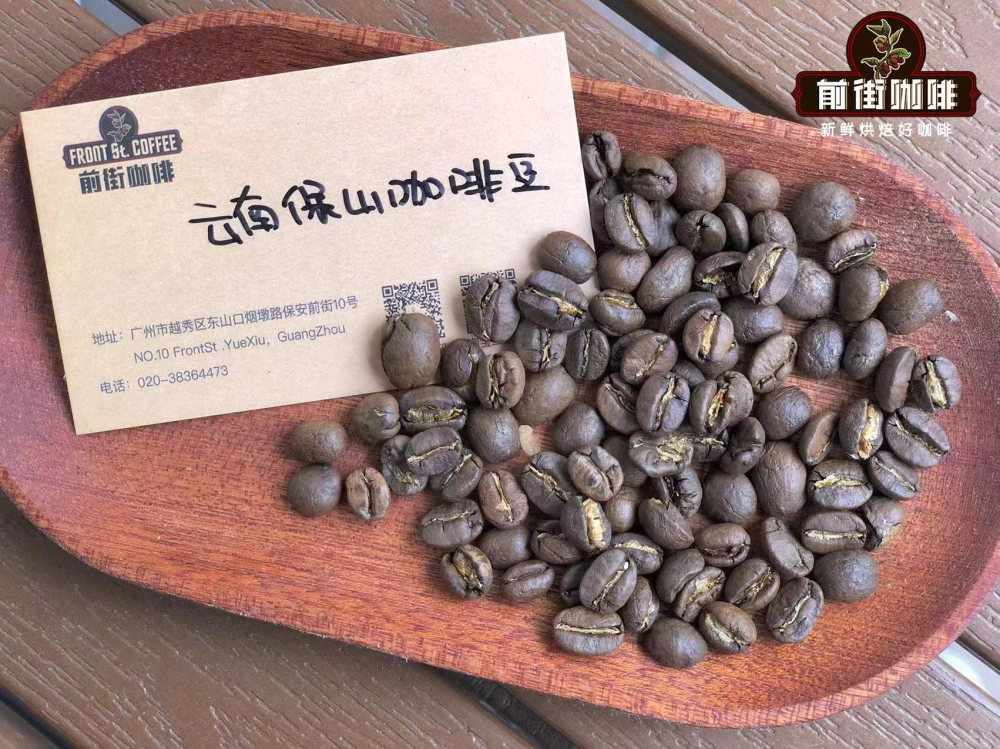
In addition to Front Street Yunnan Natural Typica, Front Street Coffee also has a Catimor coffee bean from the Baoshan producing region. As a member of the signature Everyday Beans series, this Yunnan small-batch coffee bean allows consumers to experience the flavor of the Yunnan producing region at extremely high value for money. This series also covers representative coffee beans from six major producing regions: Ethiopia, Colombia, Costa Rica, Guatemala, Brazil, and Indonesia. For coffee lovers who are just starting out and do not know how to choose, it may be better to begin with the Everyday Beans series and gradually clarify their own taste preferences.
All coffee beans sold by Front Street Coffee are shipped within five days after the roasting date. Only fresh roasting can release coffee's most beautiful flavor. To preserve the sweet-and-sour sensation and tea-like quality of Yunnan coffee, Front Street gives it a medium roast. When brewing, it is recommended to use a V60 dripper, with a coffee-to-water ratio of 1:15, medium grinding (about the size of coarse granulated sugar, with a 75% passing rate through a Chinese No. 20 standard sieve), and a water temperature of 88-89 degrees Celsius.
Specific brewing method: first pour 30 grams of water and let it bloom for 30 seconds; for the second stage, pour in a small stream in a circular motion up to 125 grams, and after the water level in the coffee bed drops by half, pour again, continuing to pour in a small stream in a circular motion up to 225 grams. Wait until all dripping and filtration is complete. The total extraction time is about 2 minutes and 10 seconds.
For professional coffee knowledge exchange and more coffee bean information, please follow Coffee Workshop (WeChat public account: cafe_style)
For more specialty coffee beans, please add the private WeChat of Front Street Coffee, WeChat ID: qjcoffeex
The above content is compiled by CoffeeHunters, a coffee news website.


