







How Does Blending Coffee Beans Shape Espresso Flavor?
Espresso is made by forcing nearly boiling water under high pressure through finely ground coffee, which makes it more concentrated than other brews and gives it a layer of crema. To reach an ideal cup, blending coffee beans from different origins is often necessary, balancing body and flavor. The blend is built from a base bean, adjusted with Robusta where needed, and rounded out with key coffees.
Beneath the crema sit emulsified oil droplets and suspended particles carrying sugars, acids, proteins and caffeine. Because humidity, storage time and grinder wear keep changing, grind size needs daily adjustment to hold the taste steady. Green beans can be mixed before roasting or after, and a Colombian and Brazilian specialty blend shows how a sweet, balanced espresso suits daily output.
Espresso, with its rich taste and abundant crema, serves as the foundation for many coffee beverages. To craft an ideal Espresso, blending coffee beans from different origins is often necessary to balance both physical and flavor characteristics. This article explores, from the physical and flavor dimensions of Espresso, how blending coffee achieves flavor goals through base bean selection, the use of Robusta, the addition of key coffees, and balance adjustments, and introduces the applicable scenarios for the two processes of blending before roasting and roasting before blending. Finally, using Front Street Coffee's specialty Espresso blend of Colombian and Brazilian beans as an example, it demonstrates a sweet and balanced blend suitable for daily output.
Espresso is a beverage made by forcing nearly boiling water under high pressure through finely ground coffee. Compared to other brewing methods, Espresso is more concentrated, with a richer content of suspended particles and soluble solids, and a creamy foam called crema forms on the surface. Due to the pressure involved in its preparation, Espresso has a very strong taste, with a notably high concentration of chemical substances. It is often used as a base for other drinks, such as lattes, cappuccinos, macchiatos, mochas, and Americanos.
Beneath the foam layer of Espresso are emulsified tiny oil droplets and particles, in which sugars, acids, protein-like substances, and caffeine are dissolved. Espresso holds a high status among coffee enthusiasts, not only for its rich taste and pure Italian heritage but also for its solution state with suspended bubbles and solids. As humidity and storage time constantly change, the wear on grinder blades also changes over time; to ensure a basically consistent espresso taste, we must adjust the grind size daily. So, how exactly can one make a good espresso?
Blended coffee, also known as mixed coffee, combines multiple single-origin coffee beans to fully leverage the strengths of each bean. Blends consist of coffee beans from different origins, aiming to achieve a more balanced flavor. For example, if one bean is smooth but lacks aroma, another aromatic bean can be added to complement each other's strengths, enhancing or complementing the taste to create a richer, more layered new flavor. Sometimes green beans are mixed before roasting, called pre-roast blending; other times, they are roasted separately and then mixed, called post-roast blending.
ESPRESSO RECIPE
An ideal Espresso has very low acidity, high body, and a rich, velvety, thick reddish-brown crema that encapsulates the coffee's aroma and flavor. Crema is a key indicator of a complete Espresso, and it must essentially carry the coffee's intense flavors. During the extraction of Espresso, the steam generated is enveloped by fine oil foam; when consumed, these foams explosively release volatile aromatic molecules that shoot from the mouth to the olfactory receptors in the nasal cavity. These foams also adhere to the taste buds, providing a long-lasting aftertaste that can last up to an hour.
Some prefer to make SOE (Single-Origin Espresso) with a single coffee, which might be the simplest approach, but I believe the result requires compromises. Since no single coffee can provide all physical and flavor characteristics in the right balance, a high-quality Espresso must combine two or more coffees.
Simply put, I think Espresso's characteristics can be described from two broad and distinct directions. Physical traits include color, body, and crema; flavor traits include aroma, taste, and aftertaste. Physical traits are composed of one set of coffees, and flavor traits come from another set. Although these two traits cannot truly be completely separated, I must make choices so that coffees providing thickness to Espresso's color, body, and crema have less impact on aroma and taste, and vice versa. Where feasible, the variables of the two trait groups can be adjusted independently.
Natural-process coffees often have more crema than washed coffees. If you can find a low-acidity, high-body natural coffee, it will be an excellent base for Espresso. Asian coffees, especially beans from India and Indonesia, as well as Brazilian coffees, offer low-acidity options. After selecting the base beans, we need to assess whether the recipe is suitable for adding high-quality Robusta. High-quality Robusta is hard to obtain and expensive, often more costly than many Arabicas, but Espresso can use clean, mild specialty Robusta.
Unlike ordinary grades, higher-priced Robusta can create a smoother, milder, softer mouthfeel without a rubbery aftertaste. Additionally, it can increase the caffeine content in Espresso, an extra benefit that many seek. The Robusta content in Espresso blends varies depending on the beans' aging, grade, and roast level, but more importantly, on the other coffee recipe. Considering that Espresso-based drinks sold in North America are mostly milk beverages, high-quality Robusta is an effective way to enhance coffee acceptance; by blending with milk, Robusta helps Arabica elevate its flavor.
Perhaps the most notable impact of high-quality Robusta is that it increases the thickness and persistence of crema without affecting the moderate traits most important to high-quality Espresso. It also adds a unique taste to the flavor profile, typical of European-style Espresso, which I believe Arabica struggles to express alone. To add flavor components to the recipe, you can choose one or two coffees whose aroma and taste you truly enjoy; I call them "key coffees." These coffees can be medium or lower in body, even slightly acidic. Start with one coffee, then add a second coffee flavor if necessary.
The next step is that you must balance the recipe. All features must blend together without any one overpowering the others. It must be smooth, mild, thick, without unpleasant bitterness or noticeable acidity. The crema should be thick, smooth, velvety, and not easily dissipating. Pay special attention to the aftertaste; the aroma must be very pleasant so that when the oil foam bursts, the steam fills the entire nasal receptors, creating a delightful experience.
Blending before roasting or roasting before blending
Whether to pre-blend green beans or roast individually and then blend must depend on the characteristics of the coffees in the recipe. Both methods are acceptable. Post-roast blending provides different roast levels for each bean so that each component performs optimally. It also offers opportunities for non-roasting shops to create their own exclusive recipes. The most obvious drawback of this method is that if the roastery is very concerned about freshness, it requires multiple roasts, causing losses. Pre-roast blending is feasible when the roasting characteristics of the coffees in the recipe are compatible. However, when beans differ in screen size, density, moisture content, thermal conductivity, and roast development curve, pre-blend roasting becomes very difficult and in most cases impossible.
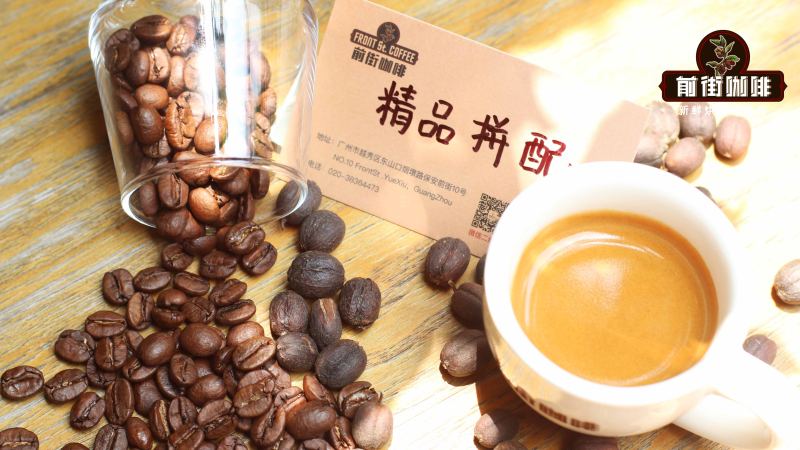
Front Street Specialty Espresso Blend Coffee Beans
Coffee beans: Colombia : Brazil
Flavor of Front Street Specialty Blend: Sweet taste. Using a medium-dark roast, when making espresso, the taste has a soft slight acidity, clean sweetness, nutty aftertaste, and an overall feel that is not too stimulating, mild, with medium crema, suitable for daily beverage production in coffee shops.
The above content is compiled by CoffeeHunters, a coffee news website.


