








Which blended coffee beans suit a flat white?
A flat white is a milk coffee from Australia or New Zealand, made with a shot of espresso and a thin layer of steamed milk foam level with the cup rim. The thin foam, rather than a thick cappuccino-style cap, is what separates it from a latte and gives the drink a more balanced mouthfeel.
The style grew from customers wanting less foam than cappuccino offered, and it reached mainstream menus after the 1980s and Starbucks' 2015 release. Blended coffee beans built for espresso work well: Front Street Coffee serves its Sunny blend as a double ristretto in a 200ml cup, and four espresso blends are suggested for home brewing.
Flat White (平白咖啡) is often called 澳白, 澳瑞白, or 馥芮白 in China, and is one of the most popular milk coffees in cafés in recent years. Where exactly did it come from? Why do different shops produce such different versions? This article starts from the origins of 澳白, sorts out the differences between the Australian and New Zealand approaches in cup size, base, and milk foam thickness, explains why thin milk foam became the key indicator distinguishing 澳白 from latte and cappuccino, and introduces Front Street Coffee’s approach of presenting 暖阳拼配 with a double Ristretto in a 200ml cup. At the end, it also lists four espresso blend beans suitable for recreating Flat White at home, helping you find that cup of 澳白 with rich aroma and balanced taste.

Flat White is literally translated into Chinese as 平白咖啡, and is also commonly called 澳白, 澳瑞白, 馥芮白, and so on. It is a milk coffee category that has become extremely popular in cafés in recent years. This time, Front Street Coffee will talk about this trendy drink.
How 澳白 evolved step by step
When it comes to the origin of 澳白, both Australia and New Zealand insist that it came from their own country. Although the birthplace of Flat White is still not settled, one thing is clear: its emergence came from consumers’ higher demands for coffee quality.
From the instant coffee era to the espresso era, people have always been looking for a coffee different from cappuccino. Back then, cappuccino often had at least three centimeters of milk foam piled on top, shaped like a hamburger, so some people hoped the foam could be flatter (Flat), which led to the development of a latte with a more balanced mouthfeel. When the milk foam on the surface of milk coffee was made flatter and flatter, until only a thin layer remained, level with the rim of the cup, today’s Flat White took shape.
It did not attract much attention at first, until Australians in the 1980s put Flat White on café regular menus, and it soon became a standard offering in cafés in the United States and elsewhere. The reason Flat White became popular in China is not unrelated to Starbucks introducing it in 2015 under the name "馥芮白" as a featured drink, which also shows that this milk coffee has entered the mainstream.
The many ways 澳白 is presented
The reason 澳白 made by different cafés differs is that different countries and different baristas have different understandings of it. It is worth returning to the original intention of its creation: baristas hoped that when drinking 澳白, the drinker could feel the fusion of the milk foam and the milk coffee beneath it in every sip, and only when the milk foam is sufficiently dense, relatively thin, and at a temperature suitable for drinking can one taste both the milk foam and the rich coffee liquid in every sip, and finish it quickly before the milk foam separates. From this, the basic characteristics of 澳白 can be summarized: dense thin milk foam, moderate temperature, coffee flavor that is not masked, and a consistent mouthfeel throughout.
When New Zealand baristas make a flat white, they use a smaller cup than for a latte (about 150ml), and the base is uniformly a double espresso. After the amount of milk is reduced, the proportion of coffee in the whole cup rises, so the coffee flavor is naturally richer.
As extraction techniques have continued to improve, in order to more fully express the aroma of the coffee beans used in a flat white, Melbourne cafés also replace the base with a double Ristretto, pouring milk foam of a thickness comparable to that of a latte into a 150ml cup. Ristretto refers to extracting a smaller liquid yield from the same dose of coffee, and can be understood as a reduced version of espresso. The flavor is more concentrated in the early and middle stages of extraction, and the mouthfeel is richer, so the requirements for coffee bean quality are also higher.
In Australia, however, baristas believe that as long as the milk foam is thinner than that of a latte, it is fine. When making a flat white, they use a cup of the same capacity as for a latte, and the emphasis is placed on the difference in milk foam thickness.
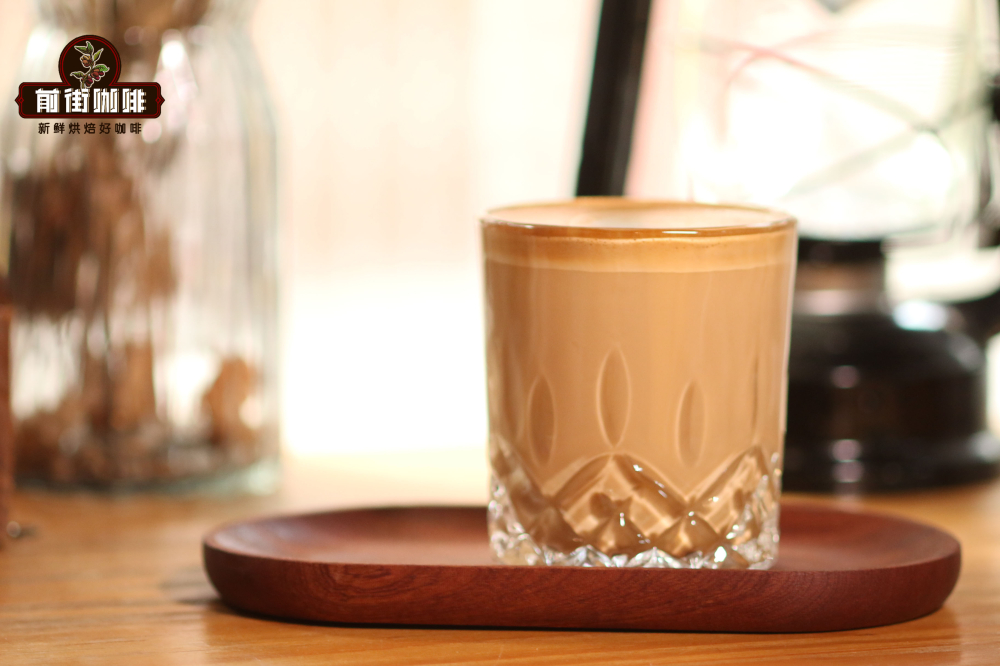
The thickness of the milk foam is one of the main references by which we distinguish a flat white from other milk coffees. Thin milk foam is meant to let people better taste the coffee liquid and highlight a smooth, sleek "velvet" texture. Some baristas, in order to keep the flat white they serve from being disturbed by the taste of crema, even filter off the milk foam layer and leave only the coffee liquid. Therefore, in the early days there was no fixed numerical standard for exactly how thin the milk foam should be.
As this drink became more and more popular, in order to distinguish it from regular hot lattes and cappuccinos, people roughly set the thin milk foam thickness of a flat white at 0.3cm to 0.5cm. The thinner the milk foam, the easier it is for the milk liquid to sink during fusion, and the surface lacks enough milk foam support, so the white milk foam will "run wild," and the difficulty of making latte art increases accordingly. This is also why some baristas choose not to do latte art. Of course, highly skilled baristas are another matter; as long as they can control it, even very thin milk foam can be used to make exquisite patterns.
Therefore, every café presents a flat white with its own style according to its own preferences and skills, combined with the characteristics of the coffee beans used and its understanding of the flat white. The 暖阳拼配 espresso beans used by Front Street Coffee have a relatively soft mouthfeel. In order to show the rich aroma of the coffee, it chooses to serve it with a double Ristretto as the base in a 200ml cup.
Recommended coffee beans for making Flat White at Front Street Coffee
Front Street Coffee has noticed that many friends who like milk coffee want to recreate a delicious Flat White at home, and the flavor of Flat White mainly depends on the espresso beans used. So to make a delicious Flat White, an aromatic Espresso is indispensable.
Front Street Coffee’s classic espresso blend is recommended. This recipe is composed of beans from three origins: Brazil, Indonesia, and Vietnam. It uses a dark roast, which can maximize the rich aroma of the coffee and also make it easier for everyone to extract rich, dense crema. It is suitable whether for an Americano diluted with water or a latte paired with milk, and can be purchased and ordered at the Front Street Coffee Taobao store or the Front Street Coffee Tmall flagship store.
In addition to the strongly styled classic espresso blend, Front Street Coffee's espresso bean list also includes three highly cost-effective blended coffee beans. Their mellow mouthfeel and rich aroma are equally suitable for making a flat white. These are all blended products that Front Street Coffee has compared and tested many times, covering the high-quality flavors of different coffee-producing regions and also helping to ensure stable extraction.

1. Classic mellow type — Front Street Coffee commercial blend coffee beans
Washed Robusta coffee beans + washed Colombian coffee beans + semi-washed Brazilian coffee
The espresso has thick golden crema and nutty aroma. After blending with milk, the Flat White has a roasted coffee bitterness on entry, but it is accompanied more by a creamy, full-bodied mouthfeel. After swallowing, the bitterness also dissipates, leaving fragrance on the lips and teeth.
2. Slightly acidic and mellow type — espresso moka pot coffee beans recommended by many baristas - Front Street Coffee black cocoa blend coffee beans
Washed Yunnan small-bean coffee beans + semi-washed Brazilian coffee beans
Yunnan small-bean coffee has a soft acidity, and paired with the mellow aroma of Brazilian Cerrado coffee, the espresso presents notes of caramel, nuts, and a soft plum acidity.
3. Balanced and aromatic type — Front Street Coffee specialty blend coffee beans
Washed Colombian coffee beans + semi-washed Brazilian coffee beans
Adding Colombian coffee to the nutty tonality of classic Brazilian coffee gives the espresso a dark chocolate flavor, with caramel sweetness and a full roasted aroma.
Professional coffee knowledge exchange For more coffee bean information, please follow 咖啡工房 (WeChat public account: cafe_style)
For more specialty coffee beans, please add the private WeChat of Front Street Coffee (FrontStreet Coffee), WeChat ID: qjcoffeex
The above content is compiled by CoffeeHunters, a coffee news website.


