








Where Are Costa Rica Tarrazú Coffee Beans Grown and Processed?
Costa Rica Tarrazú Canet Estate coffee beans are grown in the high-altitude Central Highlands, where volcanic ash soil and good drainage shape a sweet, full-bodied cup. The lot uses Bourbon-family varieties Caturra and Yellow Catuai and a raisin honey process, which leaves pectin on the seed and adds fermented aroma with tropical fruit notes.
On the coffee farm, small-batch management at Finca Canet keeps lots separated, and the article lists roasting data, cupping scores and V60 staged pouring parameters for replication. Costa Rica introduced coffee in 1808, and roughly one-third of the population now works in coffee directly or indirectly, with about 400 million trees nationwide.
Costa Rican coffee has always been fascinating for its sweet, full-bodied, and vibrant style, and honey processing is the signature technique that brings this high sweetness to its extreme. This article focuses on Front Street Costa Rica Baha coffee beans, covering origin background, variety characteristics, processing method, and roasting curve one by one: the high-altitude terroir of the Tarrazu region, the small-batch meticulous management of Finca Canet, the variety performance of Bourbon variants Caturra and Yellow Catuai, and how raisin honey processing retains pectin and gives the beans fermented aroma and tropical fruit notes. The article also includes actual roasting data and cupping flavors, and provides V60 staged pouring brewing parameters for coffee enthusiasts to reference and replicate.

For more specialty coffee knowledge, please follow the WeChat official account: Front Street Coffee (FrontStreet Coffee)
Coffee produced in Costa Rica always has an irresistible charm, with a sweet entry that also carries strength; just one sip will make you want to understand it thoroughly. Among the country's many processing methods, honey processing is undoubtedly the most famous one, and it is precisely this that allows Costa Rican coffee to express high sweetness to the fullest, leaving an unforgettable impression after drinking.
Costa Rica Coffee History
The Republic of Costa Rica is located in southern Central America, and the flavor profile of its local coffee is somewhat similar to Colombian coffee. Coffee is an important economic pillar of the country. Since it was introduced in 1808, it has had more than two hundred years of cultivation history. About one-third of the country's population participates directly or indirectly in coffee cultivation; although its land area ranks third from the bottom in Central America, its economic strength exceeds that of more than half the countries in the region.
Regarding the time of introduction, other sources record that coffee was introduced to Costa Rica from Cuba in 1729. The country has a population of about 3.5 million, yet the number of coffee trees is as high as 400 million, and coffee exports account for 25% of the country's total exports. Costa Rica has fertile volcanic soil and excellent drainage conditions, especially in the Central Highlands area, where the soil contains multiple layers of volcanic ash and volcanic dust.
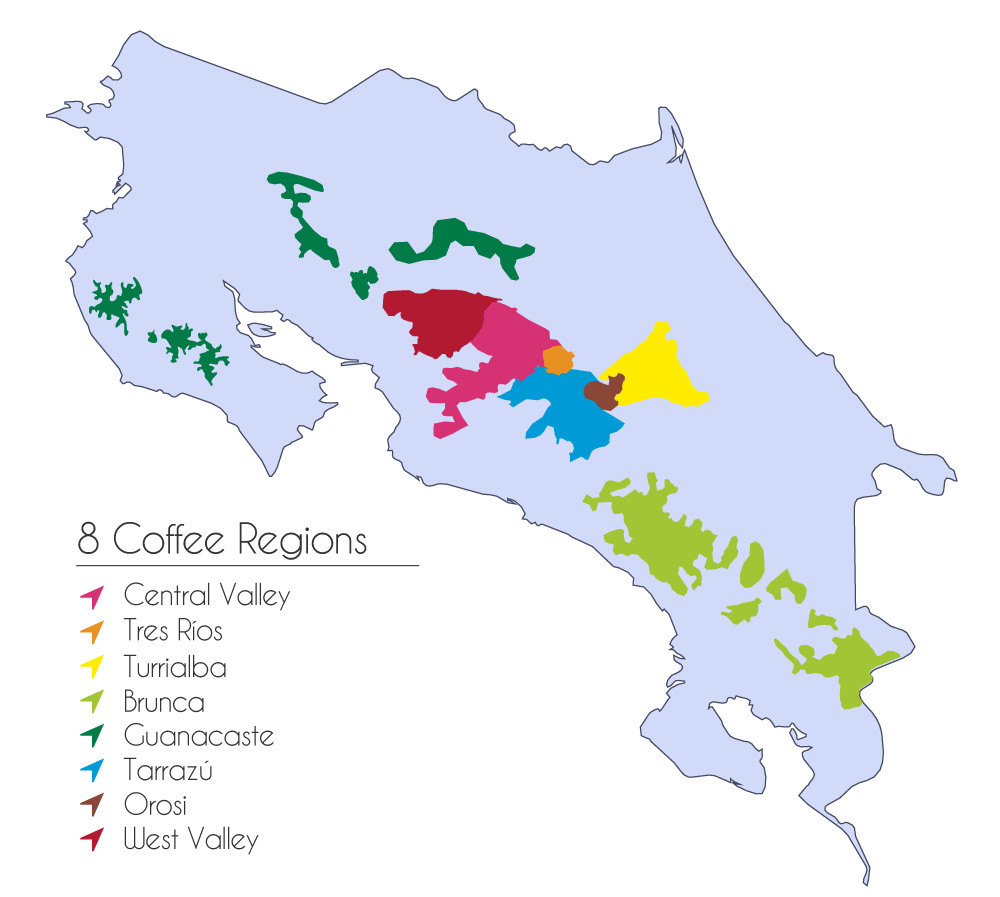
Tarrazu Region
Tarrazu is located south of the capital San Jose and is one of Costa Rica's most important coffee regions, as well as a globally significant coffee origin. The soil here is fertile and well-drained. Although coffee production is not particularly large, this land has been continuously managed by the last three generations of the British McAlpine family. The Tarrazu region has the highest average latitude overall, and both its climate and soil conditions are extremely ideal, making it Costa Rica's most renowned and generally recognized finest major region.
The Tarrazu region is the most concentrated area for fruit cultivation in Costa Rica. Estates mainly grow passion fruit, and the amount of coffee planted is relatively limited. However, coffee beans in this area mostly use processing methods such as red honey, black honey, and yellow honey. Their sweetness and berry aroma are stunning, with outstanding sweetness, body, and thickness, and they carry a ripe fruit note similar to dried banana.
Finca Canet
Finca Canet is a small estate of only 5 hectares, located in the town of San Marcos in the Tarrazu region, and owned by the Robles brothers Leo, Elian, and Melvin and their family. They have been engaged in cultivation and production together for more than ten years and share a micro wet processing plant (Beneficio).
Finca Canet is located in the highest-altitude coffee-growing area of Tarrazu, Costa Rica. This area is the most concentrated fruit-growing region in Costa Rica. The estate owner mainly grows passion fruit, and the amount of coffee is quite scarce, planted only in a specific plot and given special care, with only ripe red cherries harvested.
Variety: Bourbon Variant Caturra
Caturra is a single-gene variant of Bourbon, discovered in Brazil in 1937. Its production capacity and disease resistance are both superior to Bourbon, and the tree is shorter, making harvesting easier. Unfortunately, it also inherits Bourbon's characteristic of bearing fruit one year and resting the next. In terms of flavor, Caturra is on par with or slightly inferior to Bourbon beans; what is more prominent is its extremely strong adaptability. It does not need shade trees and can grow vigorously even when directly exposed to the sun, so it is commonly called Sun Coffee. It is suitable for high-density planting, but fertilizer application must be increased, which raises costs, so early coffee farmers did not accept it very readily.
Caturra is suitable for planting from low altitudes of 700 meters to high altitudes of 1,700 meters. The higher the altitude, the better the flavor, but bean yield decreases accordingly. There is also a yellow Caturra variant in Central and South America, but its reputation is not as good as Yellow Bourbon.
Costa Rica Is Classified by Altitude Grade
SHB: Strictly Hard Bean, grown at 1,500 meters
GHB: Good Hard Bean, grown at 1,100-1,200 meters
HB: Hard Bean, grown at 1,000 meters
High-quality Costa Rican coffee is called "Strictly Hard Bean," and this type of coffee can grow above 1,500 meters. Generally, the higher the altitude, the better the coffee bean quality: on the one hand, high altitude helps increase the acidity of coffee beans, thereby enriching the flavor; on the other hand, nighttime temperatures in high-altitude areas are lower, so trees grow slowly, making the flavor of the coffee beans more intense.
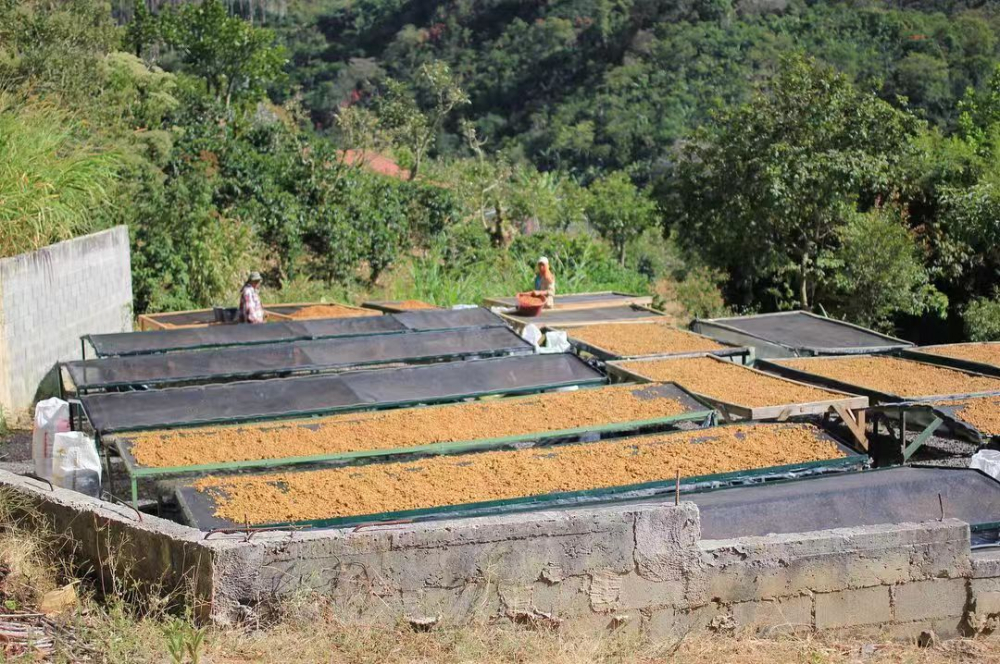
Raisin Honey Processing Method: Retaining 100% Pectin and a Zero-Water Processing Method.
This practice increases the difficulty of honey processing and places extremely strict requirements on timing control. On the day the coffee cherries are harvested, the harvested fruit is poured into a large water tank. Fully ripe and plump fruit sinks to the bottom, while underdeveloped or overripe fruit floats to the surface, and these floating beans need to be removed. The selected coffee fruit is placed on raised beds to dry for at least three days, then the cherry skin is removed, and drying continues after retaining the pectin. At this stage, climate factors are key to the success or failure of honey processing.
During the drying process, the coffee cherries need to be constantly turned to ensure even drying, but the frequency of turning must be handled properly: drying must proceed slowly to ensure the coffee has the effect of fermented processing, while at the same time it cannot be too slow, lest fermentation go too far.
Yellow Catuai (Catuai Amarillo) comes from a cross between Mundo Novo and Caturra, and was first successfully bred by Brazil's Instituto Agronomico de Campinas in 1949. Yellow Catuai, like Red Catuai (Catuai Rojo), has extremely high disease resistance and is suitable for planting in high-altitude and windy areas.
Both Catuai varieties also have a delicate and clean acidity. Through machine adjustment, red honey, yellow honey, and black honey processed coffees can be produced (depending on the degree of honey processing). Canet is located in the highest-altitude coffee-growing area of Tarrazu, Costa Rica. This area is the most concentrated fruit-growing region in Costa Rica. The estate owner mainly grows passion fruit, and the amount of coffee is quite scarce. Coffee is planted only in one specific area and given special care, with only ripe red cherries harvested.
Roasting Curve
The roaster is a Yang Chia Fei Ma 800N from Taiwan, a semi-direct-fire type, with maximum airflow of 5, and a charge amount of 300 grams.
Charge temperature 180, turning point at 1'43'' with temperature 94.2; yellowing point at 6'15" with temperature 151.5; first crack at 9'40" with temperature 183.3, development time after first crack 1'45", drop temperature 196.
The Agtron bean color value is 67.7 (upper image), the Agtron ground color value is 78 (lower image), and the Roast Delta value is 10.3.
Roasting Approach
This Front Street Costa Rica Baha coffee bean uses two of the most common varieties in Central and South America: Caturra and Catuai. The green beans smell of fermented fruit; observing the appearance, the beans are dark green, at an altitude of about 1,950M, with a relatively hard bean density, and as they are from the 2019 crop year, the moisture content is relatively high. In roasting, therefore, a method of gradually reducing heat and extending dehydration time was adopted to advance this curve. Considering that this "Front Street Costa Rica Musician Baha" uses double-fermented raisin honey processing, the roast level was designed as medium roast, with the main intention of highlighting the beans' fermented aroma and fruit aroma while preserving the balanced and full-bodied mouthfeel of honey-processed beans.
Taking Front Street Costa Rica Baha Coffee Beans as an example
Front Street Costa Rica Baha Coffee Beans Cupping Flavor
It smells like the fermented aroma of rice wine, and drinks with the sweet-tart sensation of ripe tropical fruit and berries, nutty and creamy flavors, a caramel-like finish, and a faint floral note in the aftertaste.
Front Street Costa Rica Baha Coffee Beans Brewing Method
Brewing equipment: Hario V60
Water temperature: 90℃
Coffee-to-water ratio: 1:15
Grind size: medium-fine grind
Brewing method: staged pouring. Use 30 grams of water for a 30-second bloom, pour in a small stream in circles until 125 grams, then pause in stages; when the water level drops and is about to expose the coffee bed, continue pouring until 225 grams and stop pouring; when the water level drops and is about to expose the coffee bed, remove the dripper (timing starts from the beginning of the bloom), with an extraction time of 1.56 seconds.
The above content is compiled by CoffeeHunters, a coffee news website.


