







What Makes Kenya Coffee Taste So Bright and Fruity?
Kenya coffee stands out for intense cherry-tomato acidity, floral notes and a clean, full body, a profile heavier and more savory than most Ethiopian lots. The guide covers Kenya's growing environment and its six main regions, the SL28 and SL34 varieties behind that character, and the 72-hour washed method known as K72.
Brewing follows the same logic: pour-over parameters and a three-stage pour bring out berry acidity without muddling it, and iced pour-over, ice drip and cold brew each shift the cup in a different direction. Kenya sits on the equator with the East African Rift Valley running through it, and its high-altitude farms supply the density behind that acidity.
Kenyan coffee is known for its intense cherry-tomato-like acidity and distinct floral and fruity aromas. In contrast to Ethiopia's light and bright profile, it is another shining star among African specialty beans. This article begins with Kenya's growing environment and six major regions, explains the origins of unique varieties such as SL28 and SL34, and details Kenya's signature 72-hour washed processing method (K72). Then, Front Street Coffee will share the parameters for pour-over Kenyan coffee and the three-stage pouring technique, as well as specific methods for iced pour-over, ice drip, and cold brew, helping coffee lovers fully bring out the bright berry acidity and clean, full-bodied flavor of Kenyan beans.
When people mention African coffee, most first think of Ethiopia, which has conquered palates worldwide with its captivating acidity and aroma. However, Africa has another highly representative origin—Kenya. Ethiopian coffee generally has a light overall style, a bright mouthfeel, and particularly striking floral and fruity acidity; Kenyan coffee has higher acidity than Ethiopian, also with floral notes, but the acidity is fuller and heavier. For example, Ethiopian acidity is close to citric acid, while Kenya presents an intense cherry tomato flavor. At Front Street, Ethiopian beans have always been the best-selling category, especially washed Yirgacheffe, but many customers are especially obsessed with Kenya's strong cherry tomato profile.
Kenya Coffee Growing Environment
People trying Kenyan coffee for the first time are often startled: What kind of coffee is this, and why is it so sour? Those who like fruit can easily identify it as the taste of cherry tomatoes, while others think it resembles tomato juice. Front Street believes none of these descriptions are wrong, because everyone's sense of taste is different. The flavor of coffee beans is naturally inseparable from the terroir in which they grow. Different regions have different flavors, and the differences between producing countries are even more pronounced.
Kenya is located in East Africa, with the equator passing through its center and the East African Rift Valley running north to south. It borders Somalia to the east, Tanzania to the south, Uganda to the west, Ethiopia and South Sudan to the north, and the Indian Ocean to the southeast. Except for the coastal plains, most of Kenya is a plateau with an average altitude of about 1,500 meters. The capital, Nairobi, has a mild climate, with an average annual temperature of 17.7°C and annual rainfall of 1,049 millimeters. Temperatures in mountainous areas are lower, slowing coffee growth and allowing aromatic substances to accumulate fully, resulting in more prominent fruity acidity and harder beans. This fertile, crescent-shaped coffee zone is the core producing area for Kenyan specialty beans. The coffee harvest is divided into two seasons depending on the rains, with 60% concentrated from October to December and another 40% from June to August; the rest of the year is the dry season. Annual rainfall decreases from 1,500 millimeters in the southwest to 200 millimeters in the northeast.
Main Coffee Producing Regions in Kenya
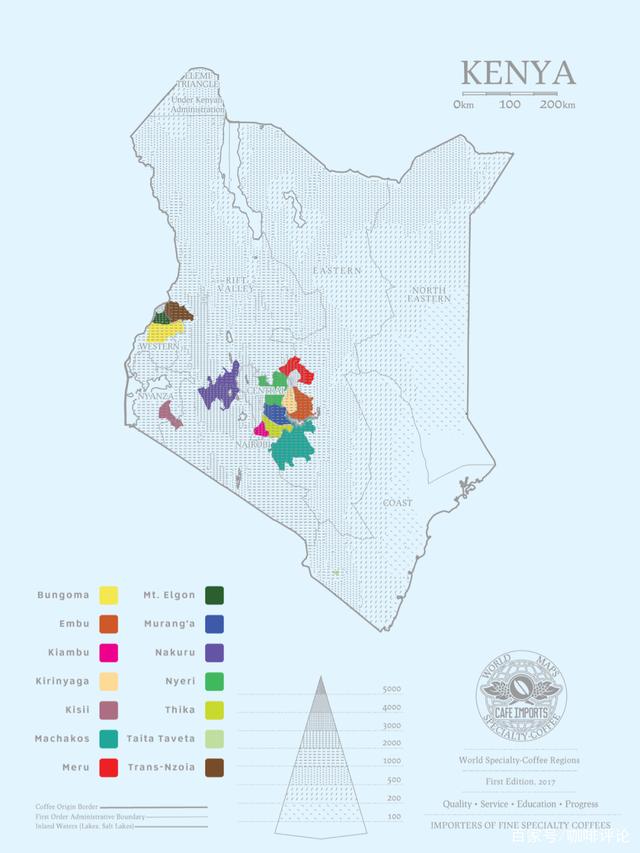
Kenyan coffee is mainly grown in the volcanic belt from the capital, Nairobi, to the areas around the Kenyan highlands at altitudes of 1,600-2,100 meters. There are six main producing regions: Thika, Kirinyaga, Mt. Kenya West, Nyeri, Kiambu, and Muranga. The Kenyan coffee beans on Front Street's store bean list come from the Thika region.
The growing altitude in the Thika region ranges from 1,550 to 1,750 meters. Thika is a small town near Kenya's capital, Nairobi, surrounded by a large number of coffee farms. Although Thika itself is an industrial town, it is surrounded by agricultural areas and waterfalls. There are about 2,000 coffee farmers in the area. Based on cupping, Front Street judges that the flavor profile of this region shows bright fruity acidity, a thick berry-juice texture, and honey-like sweetness.
Kenyan Coffee Varieties
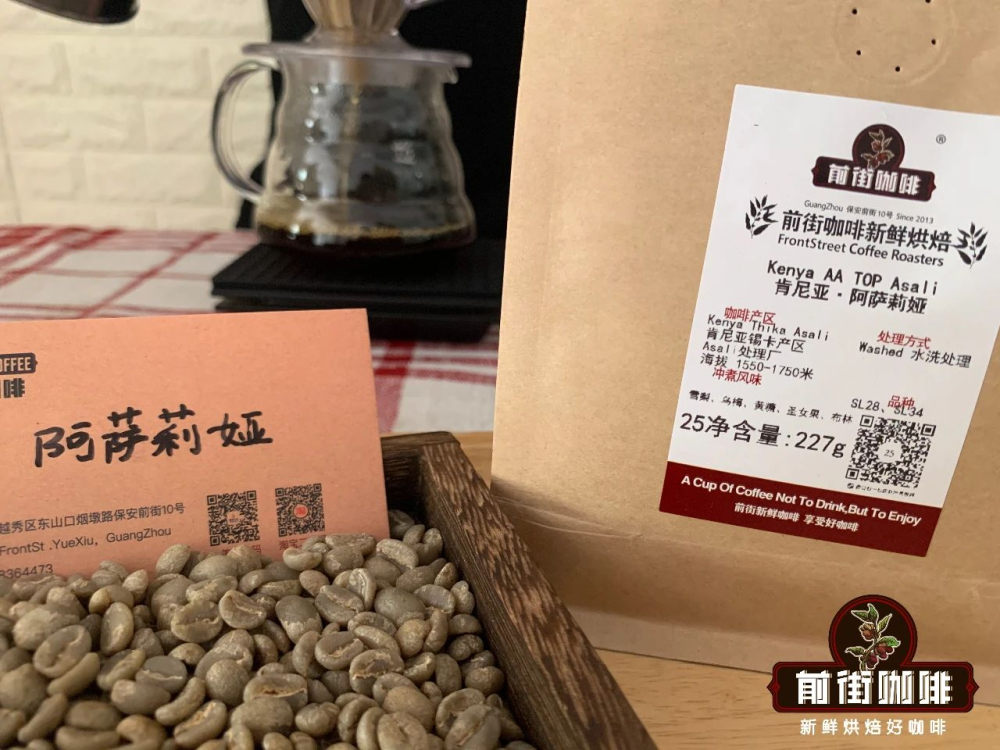
The naming of Kenyan coffee varieties differs from common varieties. It is not the familiar Typica, Geisha, Yellow Bourbon, Caturra, Catuai, Pacas, and so on, but rather SL28, SL34, Batian, and Ruiru11. Among them, Kenya's most famous varieties are SL28 and SL34. The Kenya Asalia coffee launched by Front Street Coffee (FrontStreet Coffee) is composed of SL28 and SL34.
SL stands for "Scott Laboratories," translated into Chinese as "斯科特实验室." This institution is located in Kenya and specializes in coffee variety research. Between 1934 and 1963, Scott Laboratories developed multiple varieties, mainly based on the Mocha and Bourbon varieties grown in Kenya. The laboratory selected 42 trees from different origins and studied their yield, quality, drought resistance, and disease resistance. After numbering and screening them one by one, SL-28 and SL-34 were ultimately obtained. SL28 and SL34 were first created in the 1930s, when the Kenyan government commissioned the newly established Scott Labs to screen varieties suitable for the country. After the 42 initially selected varieties were numbered and screened one by one, SL-28 and SL-34 were finally retained. The former originated from Bourbon, and the latter from Typica; the two are not from the same series.
[SL28] Bred from Tanganyika D.R in 1931, SL28 is now found throughout Kenya, and its cupping score is enough to show its outstanding flavor. The SL coffee tree has broad leaves with copper-colored tips, short and round beans, and a thick body. Its flavor characteristics are bright acidity and noticeable sweetness. Some sources say that Scott Laboratories crossed French Mission Bourbon, Mocha, and Yemen Typica to obtain the SL28 variant. SL28 has excellent flavor and good drought resistance. It can withstand drought, pests, and diseases, and is suitable for planting at medium to high altitudes, but it is susceptible to common diseases.
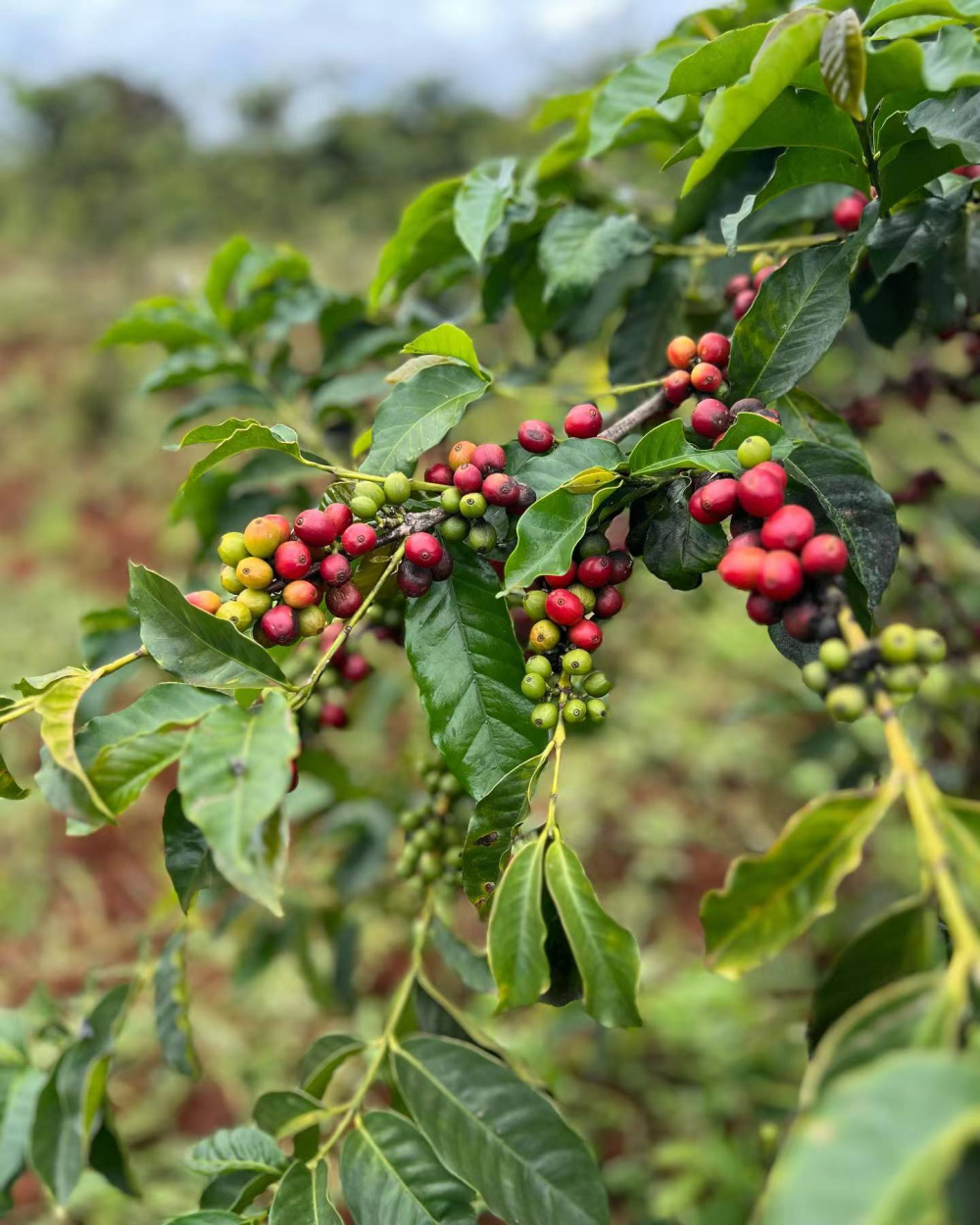
[SL34] SL34 is a mutation of French Mission Bourbon, originating from the Loresho estate in Kabete. The SL34 coffee tree has broad leaves and dark brown leaf tips. It is suitable for planting in high-altitude areas with abundant rainfall, but it is also susceptible to various common coffee diseases.
SL28 and SL34 have similar flavors, but SL34 has richer acidity and a more intense mouthfeel. Both possess the unique Kenyan flavor—abundant fruity acidity and a balanced mouthfeel.
Kenyan Coffee Beans 72-Hour Washed Processing Method
Different processing methods can lead to vastly different coffee flavors, such as Indonesia Mandheling's wet-hulled method and Honduras's whiskey barrel processing method. Kenyan coffee is famous for its unique washed processing. According to Front Street Coffee (FrontStreet Coffee), unlike the washed method of neighboring Ethiopia, Kenya uses a process of washing after fermentation and repeating the cycle.
After high-quality ripe coffee cherries are harvested that day, they are immediately depulped and placed in a fermentation tank to ferment for 24 hours. After the first 24 hours, they are immediately rinsed with plenty of clean river water. Then a second 24-hour fermentation is carried out with clean river water. After the second 24 hours, the above steps are repeated, for a total duration of 72 hours. Because the entire washing process takes 72 hours, it is called the Kenyan-style 72-hour fermentation washed processing method, or K72 for short. This processing method allows the coffee beans to ferment for a long time at low temperatures, thereby obtaining a brighter, cleaner, and fuller flavor. Front Street Coffee's (FrontStreet Coffee) Kenyan coffee beans use the K72 washed processing method.
How should Kenyan coffee beans be brewed to taste better?
Generally speaking, all coffee beans can be brewed by pour-over, but pour-over is not necessarily the brewing method that best showcases a particular bean's flavor. For example, Brazilian beans taste better in a blend than as pour-over. As Front Street said earlier, high-quality Kenyan coffee mostly has noticeable acidity, lingering berry flavors, and bright acidity, making it very suitable for enthusiasts who prefer coffee acidity. Therefore, Front Street recommends making Kenyan coffee into iced coffee, such as iced pour-over, ice drip, or cold brew.
Front Street Pour-Over Kenyan Coffee Parameters:
The brewing parameters actually used by Front Street are: V60 dripper, water temperature 90°C, water-to-coffee ratio 1:15, coffee dose 15g, medium-fine grind (80% passing through a Chinese No. 20 standard sieve).
Front Street uses a three-stage pouring technique: first use 30 grams of water to bloom for 30 seconds, then pour in a circular motion to 125 grams in the second stage, and when the water level drops to the point where the coffee bed is about to be exposed, continue pouring to 225 grams and stop. After the coffee liquid has fully flowed into the server, remove the dripper. The extraction time is about 2 minutes.
Asalia coffee bean flavor: The wet aroma has ripe tomato and floral notes; on entry it presents cherry tomato and smoked plum flavors, with bright acidity and a clean, rich mouthfeel. The mid-palate has prominent sweetness with a juicy feel, and the finish is berry aroma and yellow sugar sweetness, accompanied by green tea fragrance.
How to make iced pour-over coffee?
Front Street Coffee's (FrontStreet Coffee) approach to iced pour-over is: extract a low-ratio coffee liquid (high concentration), then dilute it with ice cubes.
Coffee dose 15 grams, coffee-to-water ratio 1:10, water temperature 90°C, grind size medium-coarse (80% passing through a 0.85 mm sieve). After extraction is complete, use another server with ice cubes for pre-chilling. After pre-chilling, remove the old ice cubes and add 100 grams of new ice cubes. Pre-chilling is to prevent the ice cubes from melting too quickly and over-diluting the coffee's flavor.
Then pour the extracted coffee liquid into the ice and shake to mix. Cover the server lid: on one hand, it reduces the volatilization of aroma molecules; on the other hand, it allows the coffee liquid to be poured out without ice cubes. Because iced pour-over is made by diluting a low-ratio extraction with ice cubes, it tastes relatively intense and full-bodied at first. As the ice gradually melts and dilutes it, the mouthfeel becomes smoother and milder, and the flavor shifts from complex to refreshing.
How to make ice drip coffee?
Front Street's ice drip method is to use 60 grams of coffee powder to extract 600 milliliters of coffee liquid, with a coffee-to-liquid ratio of 1:10. The drip rate is about 3 drops every 10 seconds. The upper chamber uses an ice-water mixture as the water source, and the extraction time is about 8 hours. After extraction, put the coffee liquid into a sealed bottle and refrigerate it for 48 hours.
How to make cold brew coffee?
Front Street's cold brew method is to use 50 grams of coffee powder and restore the coffee-to-liquid ratio to 1:10, so add 400 milliliters of cold water and 200 grams of hard ice (a total ice-water mixture of 600 grams; the coffee powder absorbs about twice its own weight in water). Stir evenly, then seal and store in the refrigerator for 8–12 hours. After taking it out, filter the coffee grounds with filter paper, then put the coffee liquid into a clean sealed bottle and refrigerate it for 32 hours.
Front Street Coffee (FrontStreet Coffee) Brewing Suggestions:
No matter which brewing method is used, the freshness of the coffee beans is crucial. Front Street has always believed that the freshness of coffee beans is closely related to flavor performance, so the coffee beans shipped by Front Street Coffee (FrontStreet Coffee) are all products within 5 days of the roast date. Front Street's roasting philosophy is "freshly roasted good coffee," so every customer who places an order can receive it in the freshest condition. The bean resting period is about 4-7 days, so when customers receive it, it is at its peak flavor.
For friends who need ground coffee, Front Street kindly reminds you: once coffee beans are ground in advance, they no longer need to be rested, because during transportation the pressure from carbon dioxide inside the package can also round out the flavor, so you can brew a cup immediately after receiving the ground coffee. However, ground coffee should be brewed as soon as possible, because after contact with air it oxidizes quickly, the flavor dissipates faster, and the quality declines accordingly. Therefore, Front Street recommends buying whole beans and grinding fresh before brewing, so you can better appreciate the coffee's flavor.
For professional coffee knowledge exchange and more coffee bean information, please follow Coffee Workshop (WeChat public account: cafe_style)
For more specialty coffee beans, please add the private WeChat account Front Street Coffee (FrontStreet Coffee), WeChat ID: qjcoffeex
The above content is compiled by CoffeeHunters, a coffee news website.


