Front Street has noticed that many friends, when they first start learning coffee brewing, always run into this problem: they find the coffee they brew doesn't taste good, but they can't quite put their finger on what exactly is wrong.
Honestly, if we want to brew a good cup of coffee, besides learning the underlying logic of brewing and mastering the correct extraction parameters, we also need to know how to identify the extraction condition of the coffee.
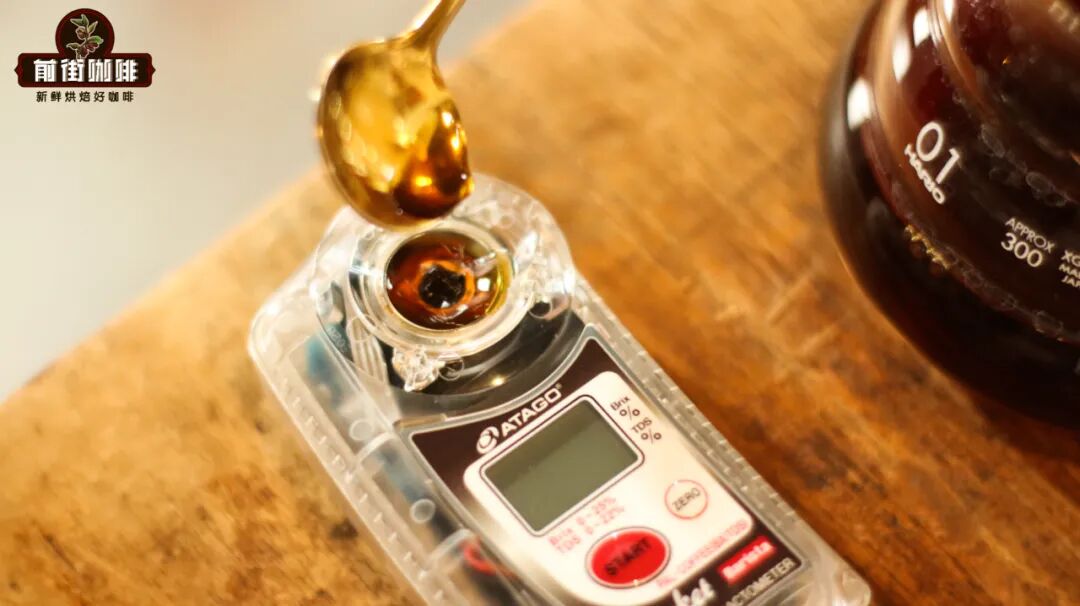
Becausecoffee that tastes bad is mainly caused by two situations: "under-extraction" and "over-extraction"(Front Street here is referring to the impact on extraction), and their characteristics and solutions are different. Only by knowing which situation is causing the coffee to taste bad can we find the corresponding improvement plan and ultimately brew a delicious cup of coffee.So whenever a friend at a Front Street store gives feedback that their brewed coffee doesn't taste good, Front Street always first asks them to describe the specific characteristics of the bad taste, and then gives corresponding improvement suggestions. But it's okay if you don't know either—today Front Street will share with everyone how to distinguish the extraction condition of coffee!What is over-extraction? What is under-extraction?Friends who have studied coffee theory know thatthe definitions of under-extraction and over-extraction mainly come from the Golden Cup extraction. In the Golden Cup standard, an extraction yield of 18%–22% is considered the reasonable extraction range for a good-tasting cup of coffee. An extraction yield below 18% is judged as under-extraction, while an extraction yield above 22% is regarded as over-extraction.But brewing coffee is ultimately just an everyday matter. Even baristas with extensive brewing experience won't constantly pull out a refractometer to measure the coffee's concentration and judge whether it meets the standard, let alone ordinary coffee enthusiasts who have just started.And most critically, the Golden Cup standard is not absolutely correct. Coffee within the Golden Cup extraction range is not necessarily good-tasting, and coffee outside the Golden Cup range is not necessarily bad-tasting. Why? Because this is related to the quality of the coffee beans.First, we need to know that the soluble substances in coffee beans account for only 30% of the bean weight. And within this 30%, there are not only the high-quality flavor substances we like, but also some unpleasant substances. Many times when we think coffee tastes bad, it's because these unpleasant substances have gained the upper hand in the cup.The proportion of these substances in coffee beans is mainly affected by the quality of the coffee beans. The variety of the coffee beans, the growing environment, and so on are all factors that determine coffee quality. The higher the quality of the coffee beans, the fewer the unpleasant substances, and vice versa.What is Front Street trying to say? It's that if the quality of the coffee beans is high enough, then even if we dissolve out a large amount of their soluble substances and the extraction yield exceeds 22%, the coffee won't necessarily taste bad, because there aren't many unpleasant substances in it; conversely, if the coffee already contains many unpleasant substances, then even if the extraction yield falls within the Golden Cup range, it won't necessarily taste good.
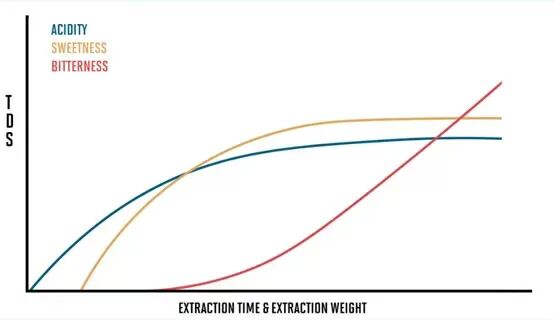
Of course, this is also related to differences in how substances dissolve. Since the extraction yield only calculates an average value, it cannot determine which substances in the coffee are good and which are not. So compared to relying on instrument measurements, Front Street more recommends that everyone combine it with reality and judge the specific extraction condition through the characteristics of the coffee's taste.What are the signs of under-extraction?Based on the above, Front Street believes everyone already has some understanding of under-extraction and over-extraction. Under-extraction means that only a small amount of flavor substances in the coffee are brought out by the water. For example, coffee has 30% soluble substances, but through brewing we only dissolve out 10% or 15%. Generally speaking, under-extracted coffee will have one or any of the following three negative characteristics.Weak flavor:Because many flavor substances haven't had time to dissolve before extraction ends, under-extracted coffee usually has the negative characteristics of weak aroma and bland taste.Very watery:Because there isn't enough flavor substance in the coffee, when the coffee-to-water ratio is relatively small, the concentration will be somewhat insufficient. The coffee will taste very watery, and the mouthfeel will be very thin.Sharp sourness, astringency, saltiness:Sharp sourness, saltiness, astringency, and so on are common negative manifestations in under-extracted coffee. This is because the dissolution speed of coffee's flavor substances is affected by molecular size. Light molecules related to acidity dissolve the fastest and will dissolve out in large amounts right at the beginning; sweet molecules come next; bitter substances have the largest molecular weight, so they dissolve the slowest.Many friends stop extraction before the sweet and bitter substances have dissolved in sufficient amounts, so the coffee only contains the sour substances that dissolved in large amounts at the very beginning. Because there is no balance from other flavors, sourness dominates alone, and the coffee may taste extremely sharp. You may even taste obvious saltiness or astringency in under-extracted coffee.When extraction is proper, the saltiness and astringency of coffee are generally masked by other flavors, and it is usually hard for us to notice them. But when under-extracted, because the other flavors that would mask them are lacking, we can taste them in the coffee.If we taste the above three or any one of these negative manifestations in the coffee, then this cup of coffee is most likely under-extracted. There are many factors that cause under-extraction, such as grinding too coarse, water temperature too low, time too short, too little water, or even insufficient stirring frequency. As for the solutions, because they are the same as for over-extraction, Front Street will discuss them together at the end.What are the signs of over-extraction?The situation of over-extraction is much easier to identify, because over-extraction means extracting too much, dissolving out too many of the unpleasant things in the coffee, such as large-molecule substances with slower dissolution rates.
The main manifestations of over-extracted coffee are obvious bitterness, dryness, or the appearance of some muddled flavors like wood or straw. Because we are relatively sensitive to these manifestations, many times we can immediately identify that the coffee has been over-extracted.The causes of over-extraction are the opposite of under-extraction: the extraction efficiency is too high. Examples include grinding too fine, water temperature too high, time too long, stirring too strong, and so on. But in most cases, over-extraction is caused by extraction time being too long.How to improve under-extraction and over-extraction?The causes of over-extraction and under-extraction are nothing more than extraction efficiency being too high or too low in terms of parameters, so we only need to reduce extraction efficiency when the coffee is over-extracted and increase extraction efficiency when it is under-extracted. But the difficult part is: with so many parameters affecting extraction, how should we choose what to adjust?Actually it's very simple. We only need to fix a few of the parameters and then adjust one parameter.Water temperature, grind, time, and water amount are the four major parameters affecting coffee extraction, and among them only the grind size value is invisible, so our fixed objects can be water temperature, time, and water amount, and then we use grind as the only variable to adjust.Take Front Street as an example! Suppose the object Front Street is brewing is a light-roasted coffee bean. Then Front Street will use a water temperature of 91–93°C (for dark roast, 86–89°C), a 1:15 coffee-to-water ratio, and a time of two minutes to brew it, and choose a commonly used grind setting. If the brewed taste shows the characteristics of under-extraction, then adjust the grind finer. And if the characteristics of over-extraction appear, then adjust the grind coarser.In this way, we can very quickly find the parameters suited to the current coffee beans, while also correcting the coffee's taste and making the coffee taste good.But this method can only provide a preliminary improvement, and besides parameters affecting coffee extraction and taste, there are also many other factors that can affect coffee, such as the issue of fines. For these more complicated situations, everyone can move on to"Portal"this article to learn more. Front Street won't elaborate too much here. The above content is compiled by CoffeeHunters, a coffee news website.