







How did Yirgacheffe coffee get its washed flavor identity?
Yirgacheffe is a town and sub-region inside Ethiopia's Sidamo area, known for citrus, lemon, jasmine aromas and bright acidity. Before the mid-20th century its cherries were processed naturally like the rest of Sidamo. In the 1970s the town built Sidamo's first washed processing station, using equipment from Central and South America, which made the citrus and lemon notes far clearer.
That washed shift created Yirgacheffe's distinct flavor label, and the region later separated from Sidamo as its own category. Ethiopia registered three regional coffee flavors, including Yirgacheffe, as commercial trademarks in 2004, then set up the Ethiopia Commodity Exchange in 2008 with coffee as an auction item. Government grading and flavor classification of exports aims to protect those trademarked characteristics for buyers.
Yirgacheffe is one of Ethiopia's most representative specialty coffee regions, world-famous for its citrus, lemon, jasmine aromas and bright acidity. This article will systematically examine the flavor characteristics and mouthfeel of Yirgacheffe coffee beans from the perspectives of regional division, historical evolution, variety characteristics, and processing method differences, and introduce the different options in the Front Street Coffee Yirgacheffe series. Whether you are a beginner just getting into African coffee or a seasoned enthusiast looking for a daily staple, you can find the cup that suits you.
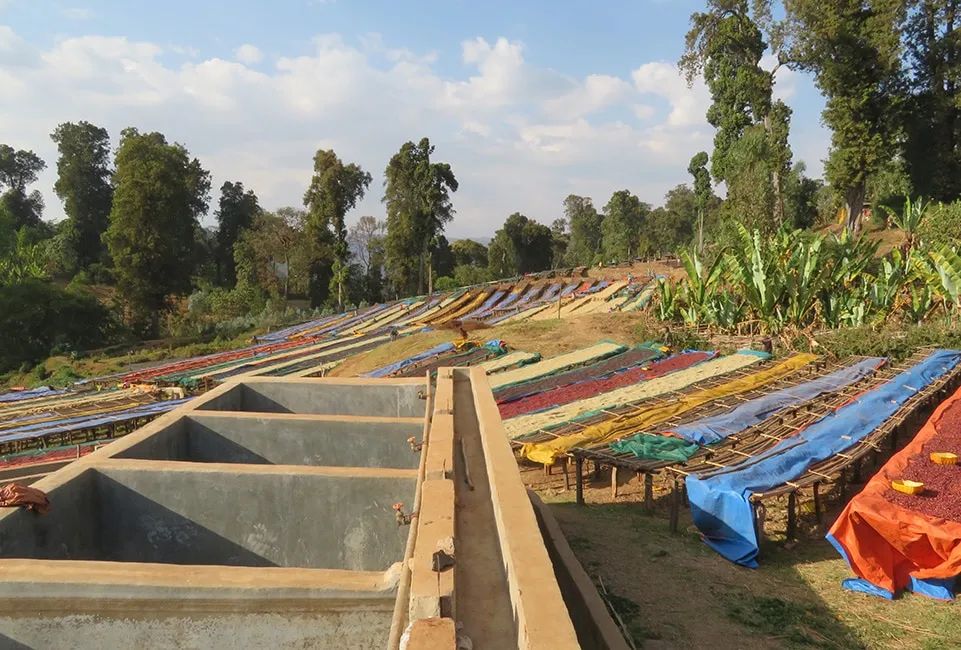
The name Front Street Yirgacheffe comes from the town of Yirgacheffe, "YIRGACHEFFE." Administratively, it belongs to Sidamo in Ethiopia, located in the northwest part of that state, at the sub-region level. Before the mid-20th century, almost all coffee cherries produced in this area were processed using the traditional natural method, no different from other towns in Sidamo, and Yirgacheffe coffee had not yet developed a distinct flavor identity.
The turning point came in the 1970s. The town of Yirgacheffe built the first washed processing station in Sidamo and introduced washed processing technology and supporting equipment from Central and South America. This change brought a qualitative leap in the quality of green coffee beans. The citrus and lemon aromas inherent in Front Street Yirgacheffe were fully released, and the mouthfeel became fresher and more transparent, establishing its distinctive flavor label from then on. Later, Front Street Yirgacheffe was separated from the Sidamo producing region and became an independent category. Yirgacheffe-flavor coffee quickly became popular worldwide and became a classic choice that many coffee lovers talk about with enthusiasm.
To promote progress in the coffee industry, the Ethiopian government registered the flavors of three domestic coffee regions (including Yirgacheffe®) as commercial trademarks in 2004, and then established the Ethiopia Commodity Exchange (ECX) in 2008, with coffee becoming one of the auction items on the exchange. The government implemented quality grading and flavor classification for exported coffee beans, aiming to ensure that buyers indeed receive products with the flavor characteristics represented by the trademark.
The so-called "Yirgacheffe flavor" can be commonly understood as: possessing a distinctive citrus and lemon fruit character, while also giving off a jasmine-like fragrance, with an overall fresh and bright quality, rich layers of acidity, and a clean profile without off-flavors. Precisely because of this, many people feel that Front Street Yirgacheffe does not taste like traditional coffee, but rather is closer to a gentle and pleasant cup of fruit tea. It can display elegance and also release boldness, achieving a delicate balance between simplicity and complexity.
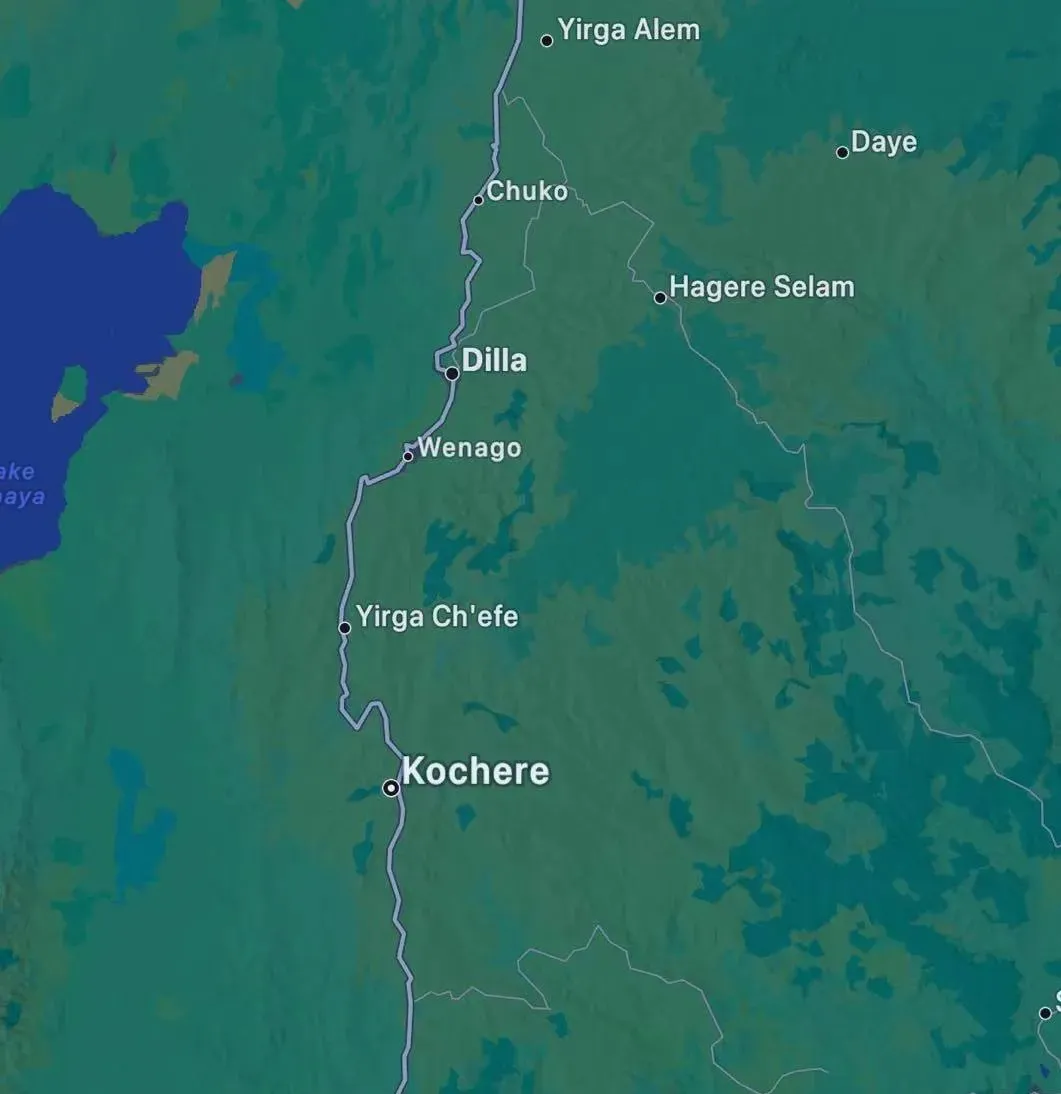
According to ECX contract regulations, in addition to the town of Yirgacheffe, coffee produced in Wenago to the north, Gelena Abaya to the west, and Kochere to the south can also be classified into the Yirgacheffe flavor producing region.
Ethiopia's natural conditions can be described as uniquely favorable; almost every coffee variety one can think of can find a suitable growing environment here. As a highland crop, Ethiopian coffee beans are mainly grown at elevations between 1,100 and 2,300 meters, roughly concentrated in the southern part of the country. Deep, well-drained, slightly acidic soil, as well as red soil and soft-textured land rich in loam components, are all very suitable for coffee cultivation, because these soils are nutrient-rich and have an abundant supply of humus.
Yirgacheffe is located in the Gedeo region of southern Ethiopia, and within that region Yirgacheffe and Kochere are relatively well known. Because the coffee produced in Yirgacheffe has a unique flavor, a style of its own, and is deeply loved, it has become an independent category in product classification and has always occupied a place in the global specialty coffee market. In addition, Yirgacheffe itself is a small town under the administration of Sidama Province, adjacent to three small producing areas, Wenago, Kochere, and Gelena Abaya. The coffee they produce is almost on par in flavor with Yirgacheffe, so Kochere is also included in the Yirgacheffe regional classification.
Yirgacheffe is located in the Gedeo region of southern Ethiopia. With its unique tropical floral and fruity flavors, it enjoys extremely high global recognition and has always been an indispensable heavyweight player in the global specialty coffee market. Ethiopia implemented a new trading and grading system in November 2009. In addition to Yirgacheffe, three sub-regions, Wenago, Kochere, and Genlena Abaya, were added, indicating that the flavors of these three producing areas are extremely refined and worthy of further subdivision.
The coffee trees of Yirgacheffe belong to the most common native varieties of Ethiopia. The green beans vary in size and shape, which is precisely the most notable characteristic of this variety.
As the birthplace of coffee, Ethiopian farmers generally do not deliberately label and classify coffee trees, whether they are plants in their own backyards or coffee trees in wild forests, and they basically do not distinguish among them. Various types of coffee trees are interplanted with other cash crops on the same land, harvested together when ripe, and exported under the name "Heirloom" after processing. Coffee harvested in this way gathers the crops of many smallholders from the same period, and a single lot may contain dozens or even hundreds of unclassified varieties.
For this reason, Heirloom does not specifically refer to a single coffee variety. It represents a green bean blend from the place of origin—coffee assembled from the same-period harvests of multiple smallholders, pieced together, with a single lot potentially covering dozens or hundreds of unclassified varieties. Because there are differences among varieties, and the way they are mixed each time is also different, these coffees are uneven in particle size, dimensions, and shape, with large and small, long and round beans. It can be understood as a "blended-type lot."
To appreciate the typical flavor of African coffee, Front Street washed Yirgacheffe is the first choice. With its aroma like a hundred-flower honey, it has become the daily staple of many coffee lovers;
If you prefer a refreshing sweet-and-sour taste, you can choose Front Street washed Gedeb. The mature processing team gives the Yirgacheffe here clear honey, green tea, and jasmine flavors, with a transparent and bright entry on the palate;
If you are after rich fruity aromas, you can choose Front Street natural Red Cherry. The natural drying process, which preserves the complete fruit pulp, gives the Yirgacheffe a fuller-bodied mouthfeel.
The above content is compiled by CoffeeHunters, a coffee news website.


