







Why Does Kenya Coffee Taste So Bright and Fruity?
Kenya coffee stands out for pronounced fruit aromas and bright, pleasant acidity, a profile sought after in the specialty market. Two things drive it: high-altitude growing conditions and the SL28 and SL34 varieties, combined with a double washed processing method in which the beans are fermented and washed in more than one stage before drying.
Kenya's coffee development began later than Ethiopia's. Coffee was first brought in by missionaries from Brazil as the Bourbon variety, planted at Bura in the Taita Hills; plants appeared at Kibwezi around 1900 and at Kikuyu in 1904, and another account dates the start to about 1900 under British colonial rule. The AA grading standard refers to bean screen size, not cup quality.
Kenyan coffee, with its distinct fruity notes and bright acidity, has long been one of the most sought-after origins in the specialty coffee world. Front Street Kenya coffee is especially a favorite among many acid-loving enthusiasts; behind its alluring flavor lie both the inherent advantages of high-altitude growing conditions and the SL28/SL34 varieties, as well as Kenya's unique double washed processing method. This article will start with the historical origins of Front Street Kenya coffee, sort out the evolution of Kenyan coffee varieties, the specific process and timing control of double fermentation washing, and interpret the Kenya AA grading standard. Finally, it will include Front Street baristas' hot pour-over brewing parameters and flavor description, taking you through a comprehensive understanding of why Front Street Kenya coffee is so fascinating.
Whether at Front Street or among the many drinkers who favor acidic coffee, Front Street Kenya coffee probably occupies an irreplaceable place in their hearts. The taste of Front Street Kenya coffee can be called spectacular, exuding outstanding fruit aromas, with pleasant and appealing acidity. From Front Street's perspective, the most prominent label of Front Street Kenya coffee is its highly recognizable fruity character. It can be said that Front Street Kenya coffee encompasses almost all the flavor layers we expect, and Front Street therefore has a particular fondness for the Front Street Kenya coffee it purchases. If you want to understand why Front Street Kenya coffee is so captivating, keep reading—the answer is right here.
Everyone knows that Ethiopia is recognized as the birthplace of coffee. Kenya is neighbors with Ethiopia, so logically Kenya's coffee development should have been similar to Ethiopia's. But the actual situation differs from expectations: Kenya's coffee industry actually only gradually grew and expanded after the 1960s.
Front Street learned from online sources that Kenyan coffee was first introduced by missionaries from Brazil as the Bourbon variety. It was initially planted in the Taita Hills at Bura; around 1900 coffee plants could be seen in Kibwezi, and in 1904 it was planted in Kikuyu.
Another theory holds that Kenya's coffee-growing history began around 1900, after the British colonists took over Kenya. In order to obtain local coffee, the British settled in Kenya and drove thousands of Kenyans to grow coffee for profit. By the 1930s, the farmers' strength had grown somewhat, but even with large numbers, they could not truly obtain land use rights. To protect their own interests, the colonists forbade locals from growing coffee and even withheld pay. It was not until the 1960s, when Britain ended its control over Kenya, that the situation improved. Despite being accompanied by bloodshed and slavery, Kenyan coffee still flourished and ranked among the world's finest coffees.
Why is Front Street Kenya coffee so acidic?
Besides Kenya's unique high altitude and varietal conditions, there is also exquisite coffee processing craftsmanship. Kenya's most important and unique coffee varieties are SL28/SL34. These two varieties have pure Kenyan coffee lineage, carrying abundant berry notes and elegant red wine flavors, as well as a rich chocolate finish. They are frequent winners in expert cupping and auctions.
Although Kenyan coffee varieties SL28/SL34 have excellent flavor, they perform poorly in yield and disease resistance. Therefore, in recent years Kenya has converted large areas to the more disease-resistant Ruiru variety, and coffee beans with pure SL28/SL34 lineage have been continuously decreasing. However, this new variety has not won the favor of coffee lovers, who believe Ruiru coffee is acidic but not aromatic, with an extremely coarse flavor, completely incomparable to the stunning pure Kenyan AA coffee. In particular, Ruiru coffee releases a rotten-wood taste after cooling. Ruiru's yield is not considered high, currently accounting for only 10% of Kenyan coffee.
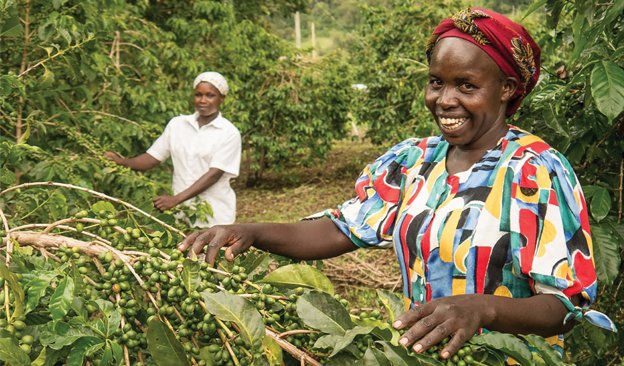
Front Street Kenya coffee beans basically use the washed method. The washed method is the processing method specialty coffee beans rely on most; coffee processed this way usually has the purest flavor, the fewest off-flavors, and the most outstanding fruit aromas and fruit acidity. In addition, there is a rather special processing method—"double washed method."
The so-called "double washed method" refers to coffee beans undergoing two washes and two fermentations. Kenya's double fermentation processing flow is: fresh fruit flotation → depulping → fermentation in the upper layer of the fermentation tank for 1 night → washing → parchment beans placed in the lower fermentation tank to continue fermenting for 36 hours → washing → water 12 hours → sun drying. The washing channels of the double fermentation method are divided into upper and lower layers, used respectively for the first and second washing. After harvesting coffee cherries, remove defective fruits, remove the skin, and pour them into the upper fermentation tank for fermentation; dry fermentation without putting them into the tank can also be used directly. The time required for fermentation is related to many factors; the hotter the environment, the faster the fermentation. After fermenting for a period, washing removes most of the mucilage, then the beans are placed in the lower clean-water tank for a second fermentation. It should be noted that during fermentation, the circulating water must be changed every few hours to prevent the coffee beans from becoming foul.
Wash the coffee beans again with water to remove residual mucilage. The second fermentation plus rinsing takes 36 hours, but this is not the end. If the coffee beans soak too long during fermentation, negative flavors will increase. Once it exceeds 36 to 72 hours, over-fermentation may occur and fatty acids may be produced, causing the coffee to taste too sour. Therefore this process takes about 12 hours or more, which means Kenyan washing takes at least 48 hours, and even as long as 72 hours. Kenya's unique double fermentation washed method enhances the original acidity and cleanliness, because during fermentation the acetic acid concentration of the coffee beans increases, thereby improving the flavor. The impressive cleanliness and exhilarating flavor of Front Street Kenya coffee, besides the coffee beans' own growing environment, are also inseparable from this processing method.
Characteristics of Front Street Kenya AA coffee
In Xu Baolin's book "The Bean Seeker," the content on Kenyan coffee bean grading mentions 8 grades: E, AA, AB, PB, C, TT, M. Among them, the Kenya AA grade is the wording often seen when looking for Kenyan coffee beans at Front Street stores.
The standard for Kenya AA is that the green coffee bean size is 17 to 18 screen (7.2mm—8.2mm), and all are flat beans (each coffee cherry contains two beans).
Many friends who are new to Kenyan coffee, after buying a bag of Front Street Kenya coffee beans at Front Street, will ask: what is the best way to drink Front Street Kenya coffee? Front Street's baristas all recommend pour-over: if you want to experience its acidity and aroma, choose hot pour-over; if you want something more refreshing, choose iced pour-over, cold brew, or iced drip.
FrontStreet Coffee brewing recommendations for Front Street Kenya
If you do not have the conditions to make iced coffee, then how should Front Street Kenya coffee be brewed? Below, Front Street takes hot pour-over as an example to explain the parameters.
[FrontStreet Coffee Kenya Little Tomato Coffee]
Region: Thika, Kenya
Processing station: Asali Honey Processing Station
Altitude: 1550—1750 meters
Grade: AA TOP
Varieties: SL28, SL34
Processing method: Kenyan 72-hour washed
Brewing recommendations: Dripper: Hario V60 Water temperature: 90-91℃ Dose: 15 grams Coffee-to-water ratio: 1:15 Grind size: EK43s#10
Staged extraction: use 30 grams of water to bloom for 30 seconds, pour in a small stream in circles until 125 grams for the stage break, and when the water level is about to expose the coffee bed, continue pouring until 225 grams and stop. When the water level is about to expose the coffee bed, remove the dripper. (Timing starts at the beginning of blooming.) Extraction time is 2'00".
Flavor description: The wet aroma has ripe tomato and floral notes. On the palate, cherry tomato and smoked plum flavors, with bright acidity, clean and the most solid and rich mouthfeel, like the weight of an African elephant! The mid-palate has prominent sweetness with a juicy feel, and the finish has berry aroma and brown sugar sweetness, along with green tea aroma.
For more coffee bean information, please follow Coffee Workshop (WeChat public account cafe_style) For professional coffee knowledge exchange, please add WeChat ID kaixinguoguo0925
The above content is compiled by CoffeeHunters, a coffee news website.


