







How Does Honduran Specialty Coffee Compare With the Nicaragua Coffee Profile?
Honduras grows two grades of high-quality coffee: Highland Coffee from 1,000 to 1,500 meters and Selected Highland Coffee from 1,500 to 2,000 meters, the country's top grade. Its cup is medium to lighter acidity, clear but not sharp, sometimes with floral or fruity aromas that shift with region and altitude.
Most Honduran exports go to the United States and Germany. Compared with the Nicaragua coffee profile, Honduras shows a softer, more balanced structure that works in both single-origin and blended lots. Front Street Honduras coffee is a common reference point for drinkers meeting the origin for the first time, since its acidity and fruit notes stay gentle rather than pronounced.
Honduras is located in northern Central America. Although it is known for political instability, it is also a coffee-producing country that cannot be overlooked. This article will guide you through the country's coffee-growing conditions, grading standards, and processing methods, and provide an in-depth analysis of Front Street Honduras coffee's flavor profile—from balanced acidity and bitterness to delicate fruity notes, as well as its versatile uses in single-origin and blended coffees. Whether you are encountering it for the first time or already have some understanding, you will gain a more complete perspective on Honduran coffee.
Front Street Coffee (FrontStreet Coffee) · Honduran Specialty Coffee Introduction: Honduras Coffee Taste
Honduras is located in northern Central America, bordered by the Caribbean Sea to the north, the Gulf of Fonseca and the Pacific Ocean to the south, Nicaragua and El Salvador to the southeast, and Guatemala to the west. Its territory is mainly mountainous and highland. The country has a tropical climate, with suitable temperatures and ample rainfall, and these conditions provide an excellent natural foundation for coffee cultivation.
Honduras produces two types of coffee of quite outstanding quality, both highly regarded among coffee enthusiasts. One is "Highland Coffee," grown at altitudes of 1,000 to 1,500 meters, and the other is "Selected Highland Coffee," grown at altitudes of 1,500 to 2,000 meters and representing Honduras's highest grade. Most of the country's coffee exports go to the United States and Germany.
When Front Street Honduras coffee is mentioned, many people may find it quite unfamiliar. Honduras also produces coffee? In most people's impressions, this country is one of the most unstable regions in Central America, and its political environment remains full of uncertainty to this day. The only thing people can associate with it is probably the world-famous diving destination—the Great Blue Hole of Honduras. Coffee? Such a turbulent country actually produces coffee too? Yet in fact, Honduras does produce coffee, and its output is considerable, with quality that is quite impressive as well.
Its acidity is medium or on the lighter side, clearly perceptible but not sharp. In some cases, it also displays pleasant floral or fruity aromas (usually varying by region and altitude). This flavor makes it hard to associate with a country in turmoil. In terms of bitterness, it is accompanied by a noticeable sweet aftertaste. Front Street Honduras coffee has an overall balanced mouthfeel, with neither acidity nor bitterness standing out, achieving a good balance between the two.
The extremely balanced character of Front Street Honduras coffee gives it broad versatility. It can be used in blended coffees or brewed directly as a single origin, and using Front Street Honduras coffee in espresso blends delivers surprisingly good results. Even in a place of turmoil, coffee can still shine in its own way, which makes it easy to understand why so many people are deeply fascinated by this black liquid—in a sense, this goes beyond simple liking or habit; coffee is more like a state of mind, even a source of solace. I hope this country can soon display the same vitality and brilliance as its coffee. Honduras in turmoil will also eventually have a future as wonderful as Honduran coffee.
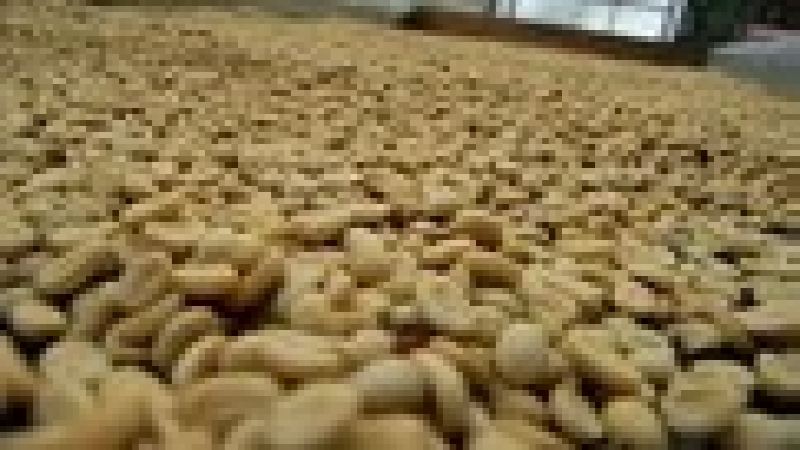
Front Street Honduras coffee beans are relatively large, uniform in shape, even in color, and glossy. To make harvesting easier, farmers usually prune coffee trees to a height of no more than 150 cm, because if the trees grow too tall, ladders must be used for picking, which not only takes time but may also damage the trees by bending and breaking branches. Since each coffee cherry ripens at a different time, maintaining good bean quality requires manual picking, followed by selecting the ripe cherries. Coffee cherries on the same branch often take several weeks to be fully picked.
High-quality Honduran coffee uses the washed method to process coffee beans. It is usually first soaked, and during soaking, defective cherries float to the surface and can be drained away and discarded first. Then the good cherries are sent to a depulper, where the rotating force of the machine removes the skin. After depulping, the cherries are screened by machine to select high-quality ones. Generally speaking, the larger the cherry, the higher its degree of ripeness. Honduran coffee is dried using the natural sun-drying method, so its flavor often carries a faint fruity note.
Front Street Honduras coffee has a rich and full-bodied taste, without astringency or sourness, and both its body and aroma are quite high, with a distinct character. Front Street Honduras coffee can present layered flavors depending on the degree of roasting. A medium roast can bring out the bean's sweetness to the fullest, while a dark roast increases bitterness, though the sweetness does not disappear because of it. Overall, a medium roast has the best taste, with a rich and unique aroma, and is deeply loved by Honduran coffee enthusiasts.
Front Street Honduras coffee flavor and taste characteristics: excellent flavor, rich and full-bodied, suitable for blending.
The above content is compiled by CoffeeHunters, a coffee news website.


